
Your cart is currently empty.

So, what exactly is a whiteboard with stand? Think of it as your portable hub for ideas. It’s a classic dry-erase board mounted on a freestanding frame, usually with wheels, letting you bring the brainstorming session to wherever it needs to happen. It's a must-have for offices, classrooms, and any creative space where you can't be tied to a wall.
Matching Your Whiteboard to Your Workspace
Picking the right whiteboard is about more than just finding a blank space to write on. It’s about choosing a tool that will become the centre of your team's collaboration. The board that’s perfect for a fast-paced tech startup is going to be worlds away from what a primary school classroom needs.
Before you even start looking, the single most important thing you can do is figure out exactly what you'll be using it for. It's a bit like buying a car. A courier needs a dependable van to get packages from A to B, while a family needs an SUV for the school run and weekend trips. Both are vehicles, but their function defines their form. It's the same with whiteboards.
Defining Your Primary Use Case
Is this for quick, informal team huddles? A classic dry-erase board on a simple A-frame might be all you need. But if you’re running dynamic presentations and need to save, share, and edit your notes digitally, then a sophisticated interactive digital whiteboard is the way to go. Nailing down this difference is the key to making the right choice.
For businesses, figuring out how a mobile whiteboard fits into your office layout is a big part of the puzzle. You can find some inspiring conference room setup ideas to see how these versatile tools can work in your space.
Your goal should be to choose a tool that fits its purpose perfectly. That way, your investment actively helps your team communicate clearly and be more creative, rather than just being another piece of furniture in the room.
To help clarify the options, let’s quickly compare the two main types.
Traditional vs Interactive Whiteboard At a Glance
This table breaks down the essential differences between a classic whiteboard and its high-tech interactive counterpart.
| Feature | Traditional Whiteboard | Interactive Whiteboard |
|---|---|---|
| Functionality | Manual writing and erasing with dry-erase markers. | Digital writing, drawing, and multi-media integration. |
| Collaboration | In-person collaboration; requires photos to save content. | Real-time local and remote collaboration. |
| Content Saving | Manual (photos, transcribing). | Instantly save, share, and email notes and files. |
| Cost | Lower initial investment. | Higher initial cost, but can replace other equipment. |
| Best For | Brainstorming, teaching, quick notes, temporary displays. | Dynamic presentations, hybrid meetings, interactive learning. |
Ultimately, both have their place. We're seeing a growing demand for both traditional and interactive models across New Zealand, especially as hybrid work makes mobile, flexible solutions more important than ever. It just goes to show how valuable these tools are in today's workplaces.
The Five Key Factors for Choosing Your Whiteboard
Choosing the right whiteboard with a stand isn't as simple as picking one off a shelf. It's a decision that directly affects how your team collaborates, communicates, and even how comfortable they are in their space. Getting it right means investing in a valuable, long-lasting asset. Getting it wrong? You're stuck with a wobbly, ghost-stained board that nobody wants to use.
Think of it like choosing the right tool for a job. You wouldn't use a sledgehammer to hang a picture frame. In the same way, the perfect whiteboard for a bustling corporate training room will be completely different from one destined for a small, creative studio.
Let's break down the five essential things you need to get right.
1. Size and Space Considerations
First things first: get out the measuring tape. One of the most common mistakes we see is buying a board that’s either comically large for the room or so small that people in the back are left squinting. Measure the wall where the board will spend most of its time, making sure to leave plenty of clearance on either side.
Next, think about who will be looking at it. A good rule of thumb is that for every three metres of distance between the board and the furthest person, you need at least one metre of horizontal whiteboard space. This simple calculation ensures everyone can actually read what’s being written.
Don’t forget to account for the stand's footprint! A mobile whiteboard needs room to do its job, which means clear pathways for it to be wheeled between different areas without becoming a clumsy obstacle.
2. Surface Quality and Durability
The writing surface is where the real quality of a whiteboard shines through. This is what determines how easily it erases, its resistance to scratches, and whether it will suffer from "ghosting"—those faint, annoying marks left behind from old ink.
You've generally got three main options to weigh up:
- Melamine: This is your entry-level, budget-friendly choice. It’s perfectly fine for light or occasional use, but because the material is porous, it will eventually stain and ghost if you don't clean it religiously.
- Porcelain (or Ceramic): A serious step up. These surfaces are baked onto steel, making them incredibly tough, scratch-resistant, and non-porous. They wipe clean effortlessly every single time, which is why they’re the top choice for heavy-use environments like classrooms and busy offices.
- Glass: Sleek, modern, and stylish. Glass whiteboards offer a superior writing experience and are almost impossible to stain or ghost. They’re a premium option that looks fantastic in boardrooms and design-led workspaces.
This decision tree helps illustrate how your type of workspace can point you toward the right kind of whiteboard technology.
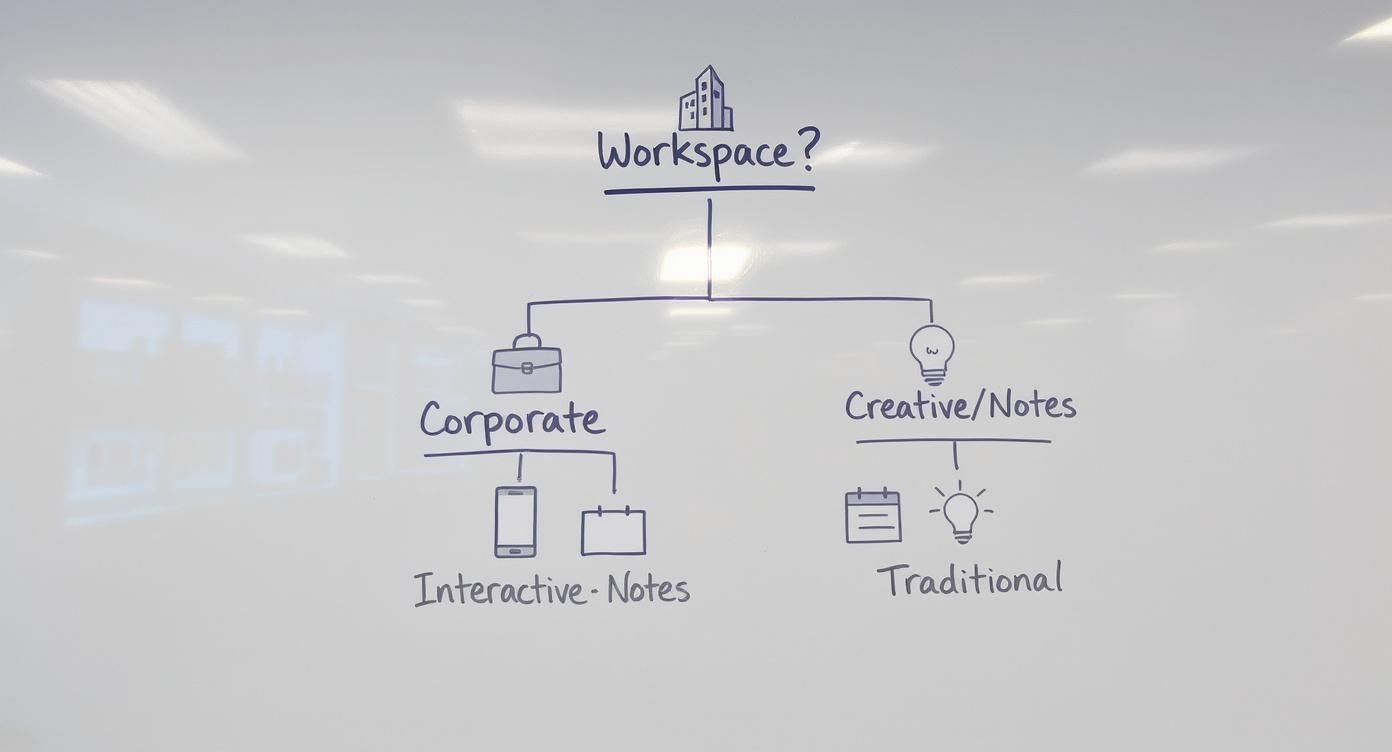
As the diagram shows, while a corporate environment might get more out of interactive features, a space dedicated to pure creative brainstorming often thrives with a simple, high-quality traditional surface.
3. Mobility and Stability
A mobile whiteboard is only as useful as its stand. The whole point is to move it around with ease, but have it stay firmly in place when you're writing.
Take a close look at the caster wheels. You want something durable that rolls smoothly over different floor types, whether it’s carpet, tile, or polished concrete. Just as important are the locking mechanisms. A quality whiteboard with stand will have robust locking casters that engage properly, stopping any annoying shifting while you’re in the middle of a thought. The frame itself should feel solid—steel or aluminium is best—to prevent that dreaded wobble.
4. Ergonomics and Adjustability
A whiteboard should be an accessible tool for everyone, not just the tallest person in the room. This is where ergonomics come into play.
Look for stands with adjustable height settings. This small feature makes a huge difference, allowing each user to set the board at a level that’s comfortable for them, which helps reduce neck and shoulder strain. Some of our more advanced models even offer a tilting or rotating function. This is brilliant for cutting down on glare from overhead lights and can give you a much better angle for writing or drawing. These thoughtful ergonomic features make the whiteboard a genuinely inclusive and versatile tool for the entire team.
Beyond the Blank Slate: Custom and Branded Whiteboards
A whiteboard with stand is so much more than a place to jot down notes. It’s a blank canvas, ready to become a powerful branding tool or a purpose-built system that drives your team's productivity. Why settle for a generic piece of equipment when it can actively strengthen your organisation’s identity and streamline your unique ways of working?
Think of it this way: a standard, off-the-shelf whiteboard is like a plain t-shirt. Sure, it does the job, but it doesn't say anything about who you are. A custom-branded whiteboard, however, is like a team uniform—it instantly communicates professionalism, unity, and a clear sense of identity. It turns a simple utility into a thoughtful part of your professional environment.
Infusing Your Brand Identity
The most obvious way to make a board your own is by incorporating your brand. This isn’t just about making your space look good; it’s about creating a cohesive, polished atmosphere that clicks with both your team and any visiting clients. When your collaborative tools reflect your brand, it subtly reinforces company culture and pride.
We can bring your brand to life in a few key ways:
- Company Logos: Placing your logo discreetly in a corner, or even as a faint watermark, adds a professional touch that elevates the entire room.
- Brand Colours: We can customise frame elements or the board's border to match your specific brand palette, integrating the whiteboard seamlessly into your office design.
By turning a generic whiteboard into a branded asset, you're making a statement. You're showing that every detail in your workspace is considered, contributing to a strong, unified, and professional image.
Creating Purpose-Built Productivity Tools
This is where customisation really starts to boost efficiency. Instead of your team having to draw the same grids, charts, or templates day after day, you can have them permanently printed right onto the whiteboard surface. This saves a huge amount of time and ensures everyone is working from the same consistent, accurate framework. The possibilities are endless, designed to fit exactly how your NZ-based team operates.
Just imagine how these bespoke layouts could change your daily operations:
- Project Management: A permanent Kanban or Scrum board with columns for "To-Do," "In Progress," and "Done" keeps agile teams aligned and on track. No more wiping away the structure at the end of a sprint.
- Strategic Planning: Print a SWOT analysis grid or a sales pipeline tracker directly onto the board. It becomes the permanent home for your ongoing strategy sessions.
- Training and Education: In a classroom or a corporate training setting, a permanent timetable, a complex procedural diagram, or a list of core company values keeps essential information visible at all times.
- Healthcare Settings: Hospitals and clinics can use boards printed with patient care schedules or staff rotation charts to improve communication and reduce the chance of errors.
These custom-printed layouts transform your mobile whiteboard from a simple note-taking device into a specialised instrument. It becomes a central, reliable hub for your most important processes, helping your team stay organised, efficient, and focused on what matters—without the repetitive setup.
5. Looking After Your Investment: Assembly and Care
Your new whiteboard has arrived, and you're keen to get it set up and start brainstorming. It's tempting to rush through the setup, but taking a little time now for proper assembly and learning a few care tricks will make sure your board serves you well for years to come. A bit of initial effort is the best way to prevent a wobbly frame or a stained surface down the track.
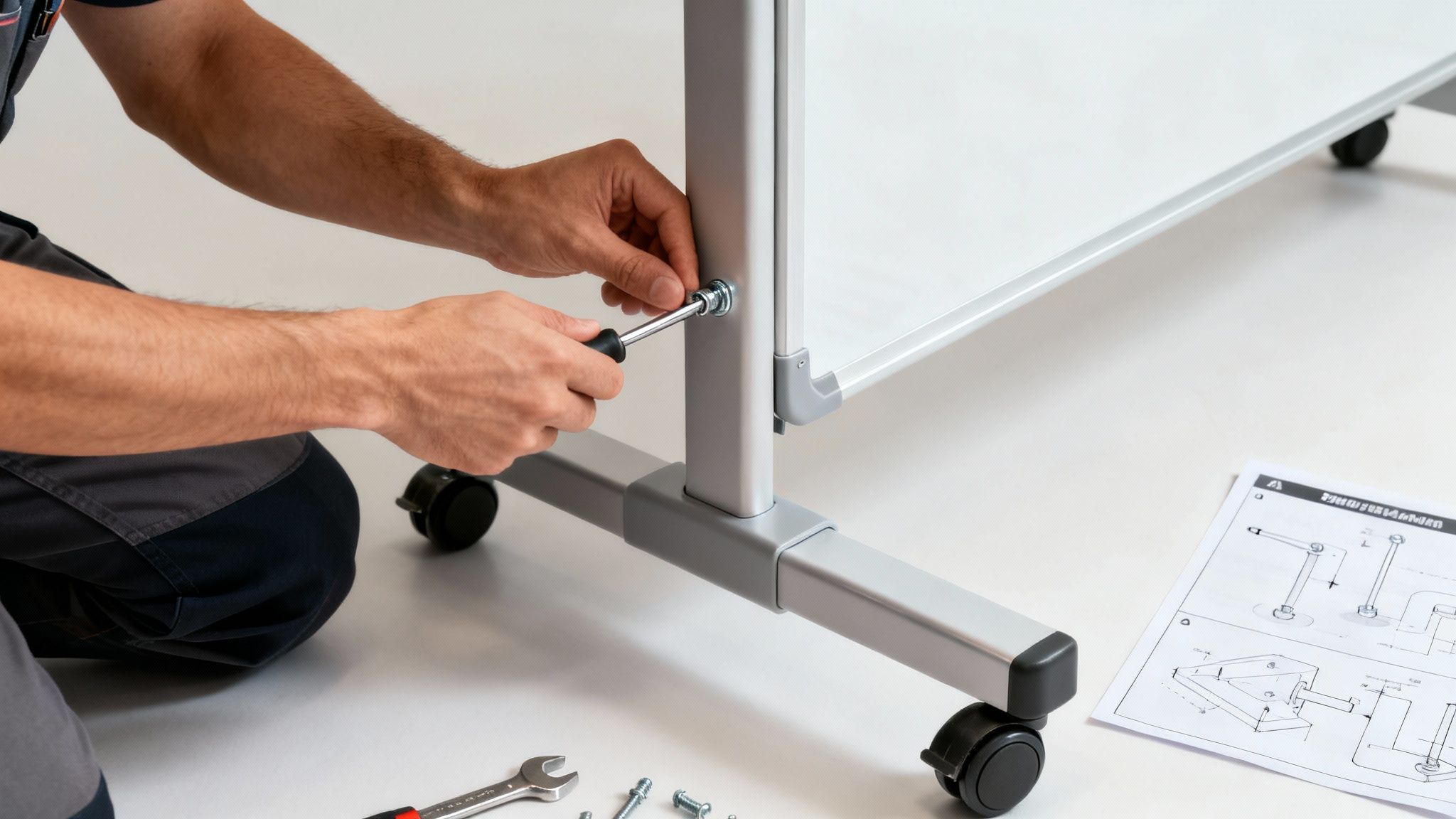
Think of the assembly process like putting together a solid piece of furniture. If you rush it, you’ll end up with something that feels unstable and is frustrating to use. Always follow the manufacturer’s instructions to the letter, making sure every screw is properly tightened and each part is securely fitted.
A crucial first check is to test the locking casters. Once you’ve built the stand, lock the wheels and give it a gentle nudge. A stable whiteboard with stand shouldn't budge, giving you a firm and safe surface to work on.
Keeping Your Whiteboard Surface Pristine
The secret to a long-lasting whiteboard is preventing that annoying "ghosting"—the faint marker residue that just won't erase. Thankfully, it's easy to avoid with a few simple, consistent cleaning habits.
Follow these best practices to keep your board looking brand new:
- Use the Right Tools: Always stick to high-quality, low-odour dry-erase markers. Cheaper markers often contain pigments that can permanently stain the surface. The same goes for erasing—a soft microfibre cloth or a proper felt eraser is your best friend.
- Wipe it Down Daily: At the end of each day, give the board a quick wipe. Leaving ink on for too long allows it to set, making it much harder to remove later.
- Give it a Weekly Deep Clean: Once a week, use a proper whiteboard cleaning spray and a clean microfibre cloth to get rid of any stubborn marks or build-up. Steer clear of general-purpose cleaners, as their chemicals can strip the board's protective coating.
Dealing With Stubborn Marks and Stains
It happens to the best of us. Someone grabs a permanent marker by mistake, or an old note gets forgotten for weeks. Don't panic, and whatever you do, don't reach for an abrasive scourer that will scratch the surface for good.
For tough stains, there's a surprisingly simple trick. Scribble over the permanent mark with a black dry-erase marker, let it sit for a few seconds, and then wipe both away. The solvent in the fresh ink actually helps dissolve the permanent pigment. It’s a clever little hack that can save your surface and extend the life of your board.
How NZ Businesses and Schools Are Using Mobile Whiteboards
It's amazing how a simple tool can be so useful in so many different places. A mobile whiteboard is a perfect example of this. Its real power isn't in the board itself, but in the creative ways people put it to work. All across New Zealand, from corporate high-rises to local primary schools, a good whiteboard with stand is helping teams solve problems and bring ideas to life.

Picture a busy tech company in Auckland deep in an agile project. Their mobile whiteboards aren't just stuck to a wall; they're the living, breathing centre of daily stand-ups and sprint planning. When the team moves from a casual breakout space to a formal meeting room, the board covered in Kanban charts simply wheels along with them. That keeps the project's progress right where everyone can see it.
Or think about a client strategy session at a Wellington marketing agency. The mobile whiteboard becomes the shared canvas for brainstorming, sketching out customer journeys, and getting feedback on the spot. It’s a far more engaging way to collaborate than everyone squinting at a single laptop screen.
Transforming Education and Training
Schools have really embraced mobile whiteboards, and for good reason. It’s all part of a bigger shift towards more interactive and flexible teaching methods. The goal is to create learning environments that are dynamic, not static.
In the classroom, these boards are no longer just the teacher’s domain. You’ll see students huddled around them, working together to solve a maths problem, map out a story, or present their science project findings. Because they’re on wheels, a teacher can switch the room layout in minutes, moving from quiet individual work to buzzing group presentations.
For educators looking to get the most out of these tools, it's worth exploring how mobile whiteboards can enhance problem-solving and collaboration with design thinking.
Adaptable Solutions Across Industries
The sheer flexibility of a whiteboard on a stand means its usefulness extends well beyond the typical office or classroom. You'll find them in all sorts of Kiwi workplaces.
- Creative Agencies: Film studios and design firms use them for storyboarding, letting teams physically move scenes and concepts around a room to see how they flow.
- Retail Environments: Cafes and shops often use smaller mobile whiteboards as eye-catching signs for daily specials or sales, which can be easily wheeled out to the busiest spot.
- Healthcare Facilities: In hospitals and clinics, they're invaluable for staff training simulations and managing patient flow—providing a large, clear surface for critical information that changes constantly.
From a high-stakes corporate pitch to a primary school art project, the core function remains the same. A mobile whiteboard provides a temporary, movable, and highly visible space for shared thinking.
This incredible versatility is what makes the humble whiteboard with a stand such a lasting and essential piece of kit. It’s a simple solution that supports complex problem-solving, creative brainstorming, and genuine teamwork in just about any setting you can imagine.
Here is the rewritten section, crafted to sound human-written and natural.
Your Guide to Ordering a Custom Whiteboard
Getting your hands on the right whiteboard shouldn't be complicated. Let's walk through what the process looks like with SONI DESIGN, so you know exactly what to expect from our first chat to the final delivery, anywhere in New Zealand.
For our standard, off-the-shelf models, things move pretty quickly. But when you’re after a custom-branded board with your company logo or a specific printed layout, we add an essential step: design proofing. This is where we work together to get every detail just right before anything goes into production. It’s our way of making sure the final product is a perfect match for what you had in mind.
We believe in total transparency. Our aim is to make ordering your custom whiteboard a completely smooth and predictable part of your project, fitting right into your schedule without any surprises.
Lead times can change depending on the job, so we’ll always give you a clear estimate right at the start. This is especially important as these boards become more popular. In fact, the demand for interactive whiteboards across New Zealand is really taking off, partly thanks to government funding for education tech. This has pushed access to interactive whiteboard technology into over 50% of our secondary schools, which just shows how vital they've become. If you're interested in the numbers, you can read more about this market trend on Market.us.
Still Have Questions? Let's Clear Them Up
Even after going through the details, it's natural to have a few lingering questions. Making the right choice is all about feeling confident, and that comes from having clear, honest answers. Let’s tackle some of the most common queries we get about whiteboards on stands.
Do Magnets Work on All Whiteboards?
That’s a great question, and the answer comes down to what’s under the surface. Porcelain whiteboards are magnetic by default because they’re built with a steel core. This is a huge bonus if you want to pin up documents, charts, or project notes right next to your brainstorming.
On the other hand, most standard melamine and glass whiteboards won't hold a magnet. So, if pinning things up is a must-have for your workflow, you’ll definitely want to go with a porcelain board to get that extra layer of functionality.
Think of a magnetic surface as a second brain for your board. It’s no longer just a place to write; it becomes a dynamic planning centre where you can mix handwritten ideas with physical printouts and reminders.
How Can I Stop My Whiteboard from Ghosting?
Ah, ghosting—that annoying faint shadow left behind by old marker ink. It's the biggest headache for whiteboard owners, but luckily, it's easy to avoid with a bit of routine care. The best defence is a good offence: use high-quality, low-odour dry-erase markers and a clean microfibre cloth or eraser.
Also, try to get into the habit of giving the board a quick wipe-down at the end of each day. Ink that sits for too long is far more likely to set in and leave a stain. For a proper deep clean, a bit of dedicated whiteboard spray once a week will keep your surface looking brand new for years.
Ready to find the perfect collaboration tool for your NZ team? Explore our full range of customisable whiteboard solutions at SONI DESIGN and let us help you bring your ideas to life. Visit us at https://www.sonidesign.co.nz.
Leave a Comment
Stay home & get your daily
needs from our shop
Start You'r Daily Shopping with Nest Mart