
Your cart is currently empty.

So, you're staring at a folder packed with digital memories and wondering where to print photos that will truly do them justice. The right choice really comes down to what you need. Instant kiosks are great for speed, online labs offer a fantastic mix of variety and value, and professional print shops like SONI DESIGN deliver unbeatable quality for the projects that count.
Your Quick Guide to Finding the Best Photo Printing Service
Deciding where to print photos can feel a bit much, especially with so many services available right here in New Zealand. But it all boils down to a simple trade-off between three things: speed, quality, and cost.
I like to think of it like choosing a meal. Sometimes, you just need the convenience of fast food (that’s your instant kiosk). Other times, you're after a reliable, decent meal from a familiar restaurant chain (think large retailers or online labs). And then, for those special occasions, you seek out a gourmet chef for an experience that's a cut above the rest—and that's your professional printer.
Each option has its place. Just trying to get some happy snaps off your phone and into a scrapbook? A same-day retail kiosk is perfect. Need to print a huge number of flyers for a marketing mailout without blowing the budget? An online service is your best bet.
But what if you need a large, perfectly colour-matched print for a trade show, or a stunning fine art piece for your office? That’s when the expertise of a professional print partner becomes non-negotiable.
Choosing Your Printing Path
The first step is figuring out what's driving your project. Is it pure urgency? A careful balance of cost and quality? Or is it an absolute need for professional precision? This simple decision tree can help you visualise which service makes the most sense for your goals.
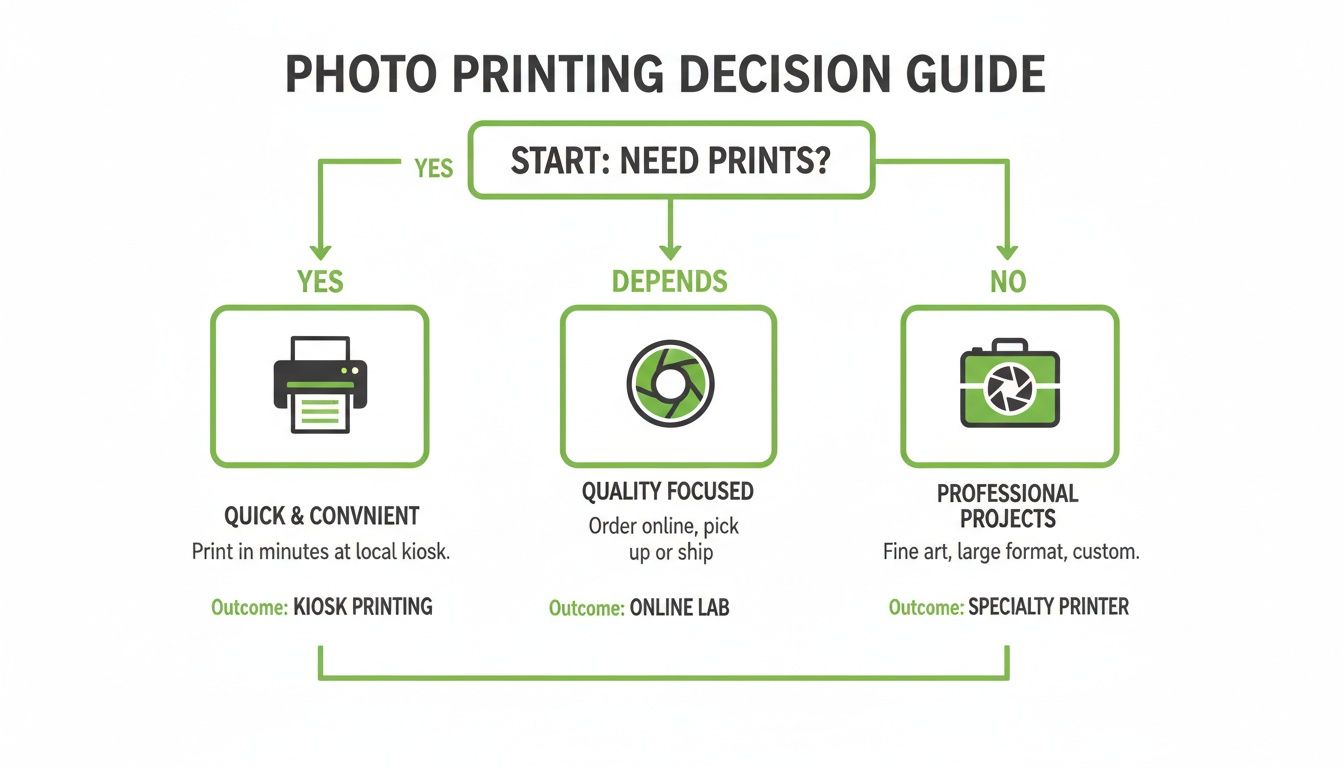
As the flowchart shows, knowing your main priority is the key. It guides you straight to the most logical and effective printing solution for your specific situation.
To make things even clearer, let's break it down in a table.
Comparing Your Photo Printing Options at a Glance
This table gives you a quick snapshot of the main printing services out there, highlighting the key differences to help you choose.
| Printing Option | Best For | Typical Quality | Turnaround Time | Average Cost |
|---|---|---|---|---|
| Retail Kiosks | Instant prints, casual snaps, small batches | Good | Immediate | $ |
| Large Chain Retailers | Standard prints, photo gifts, convenience | Good-Very Good | Same day to 1 day | $$ |
| Online Printing Labs | Large orders, variety, competitive pricing | Very Good | 3-10 business days | $$ |
| Professional Print Shop | Fine art, business needs, superior quality | Exceptional | 1-5 business days | $$$ |
Ultimately, having this quick comparison on hand helps take the guesswork out of the decision, ensuring you pick the right service for the right job every time.
Breaking Down Your Main Photo Printing Choices
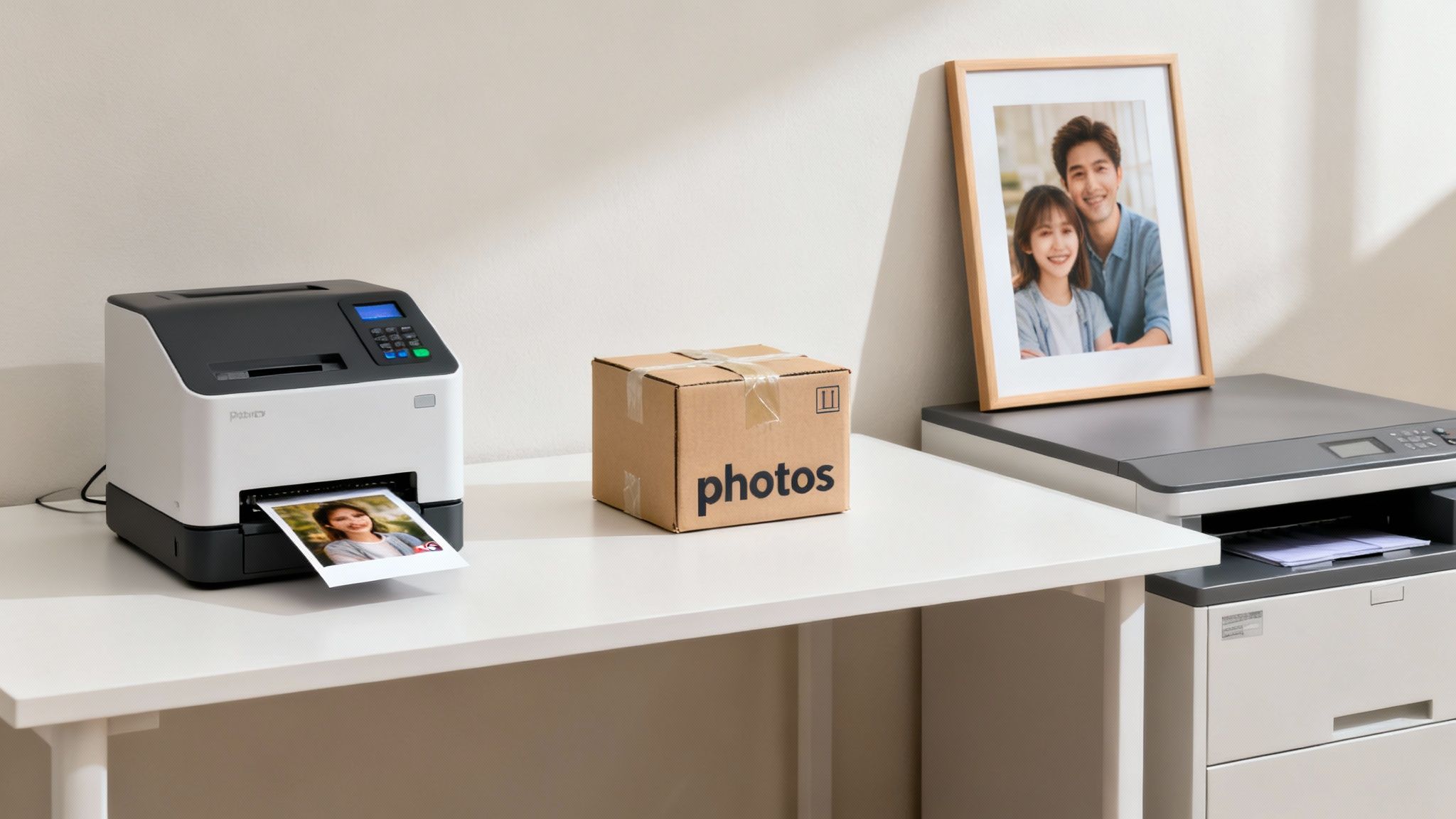
Trying to figure out where to get your photos printed can feel a bit overwhelming, kind of like staring at a restaurant menu with way too many options. To make it simple, let's group your choices into four main camps. Each one serves a different need, and once you know what they are, you'll know exactly where to go.
It helps to think of it as a spectrum. At one end, you've got pure speed and convenience. At the other, you have premium, artisan quality. Where you land depends on what matters most for your specific project.
Same-Day Kiosks and Large Retailers
This is the ‘fast food’ option of the printing world. Think of the self-service kiosks you see at places like Warehouse Stationery or the photo counters at Kmart. They’re designed for one thing: getting prints in your hand, right now.
These are absolutely perfect when you need a few standard 6x4 prints for a scrapbook, a last-minute school project, or to quickly pop into a frame for a gift. The convenience is unbeatable. But, there’s a trade-off. The colour accuracy can be a bit hit-or-miss and the paper quality is pretty basic. For quick and casual snaps, they’re great. For professional work? Not so much.
Dedicated Online Printing Labs
Stepping up a level, you have the dedicated online printing services. These guys are a huge leap in quality from the retail kiosks and are built for both everyday users and serious photographers. You simply upload your photos, choose from a massive menu of options—from standard prints to photo books, calendars, and canvas—and they deliver it right to your door.
The big wins here are the competitive pricing (especially when you’re ordering in bulk) and the sheer variety of paper types and finishes available. The catch is you have to wait for delivery, so that instant gratification is gone. This makes online labs a brilliant middle-ground if you can plan ahead and want a quality result without paying top dollar.
An image on a screen is temporary, but a physical print is a performance of that image. It transforms a fleeting digital file into a tangible object that tells a story, making it a powerful tool for connection.
Local Professional Print Shops
At the very top of the pyramid, you’ll find local professional print shops like SONI DESIGN. This is where you go when the quality simply has to be perfect, with no compromises. Think of these shops as the craftspeople of the printing world. You’re not just buying a print; you’re getting expert advice, the best materials, and a fanatical attention to detail.
Professional printers are the go-to partners for businesses, photographers, and artists who need their work to look stunning. They are the clear choice for:
- Large-format prints for a trade show or shop display where every detail needs to be crisp.
- Colour-critical marketing materials like brochures and flyers, where your brand colours must be exact.
- Fine art reproductions that demand archival-quality papers and inks to last a lifetime.
- Bespoke projects that need a creative, hands-on approach to get just right.
Yes, the investment is higher, but what you get in return is a flawless product that brings your vision to life. This is the solution when your print isn't just a picture—it's a critical piece of your brand or your art.
Understanding How Paper and Technology Impact Print Quality
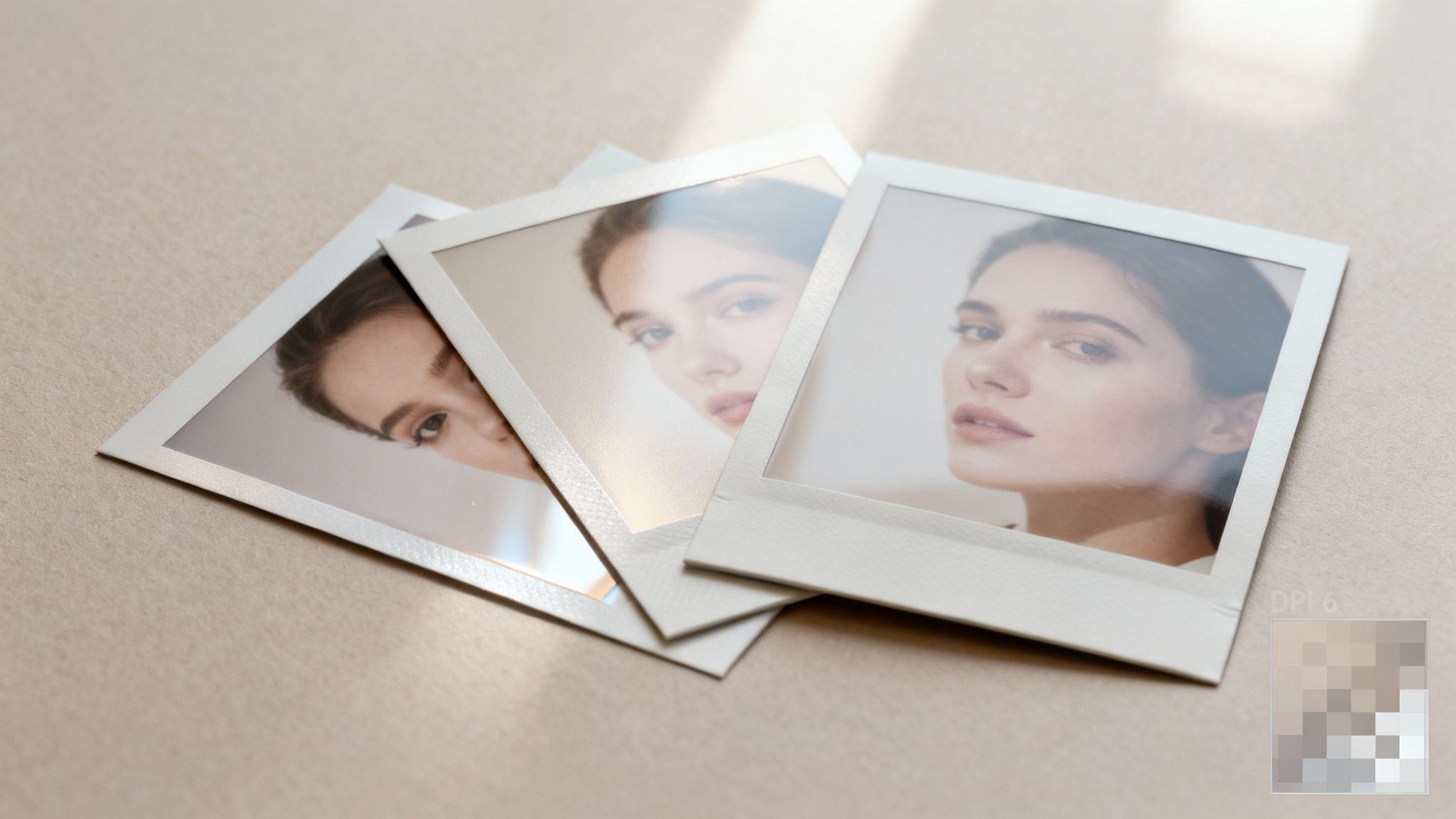
Ever wondered why one photo print looks incredibly sharp and vibrant, while another from a different place seems flat and lifeless? It's not magic. The secret is all about the combination of the printing technology used and the paper it's printed on. Getting this right is a huge part of figuring out where to print your photos.
Think of it like cooking a gourmet meal. You can have the best ingredients in the world (the paper and inks), but without a skilled chef (the printing technology), you won't get an exceptional result. A budget kiosk is like a microwave meal – fast and easy – whereas a professional print shop is your Michelin-star kitchen with perfectly calibrated commercial gear.
Decoding Dots Per Inch or DPI
One of the most important terms you’ll come across is DPI, or Dots Per Inch. The concept is pretty simple. Imagine you're making a mosaic out of tiny tiles. The more tiles you pack into a small area, the more detailed and lifelike the final image will be. DPI is the exact same idea for printing; it's a measure of how many tiny dots of ink a printer can squeeze into one square inch of paper.
A higher DPI means more detail, richer colour blends, and an image that just looks sharp. A low-resolution photo might look perfectly fine on your phone screen, but when you blow it up for a print, it can suddenly look pixelated and blurry. For high-quality work, 300 DPI is the gold standard in the industry.
"The truth is revealed when the ink hits the paper." This old saying really hits home here. A print shows flaws and highlights brilliance in a way a screen simply can't, which is why that technical precision is so essential for a final product you can be proud of.
Professional print shops live and breathe this stuff. They constantly calibrate their machines to make sure every single dot is placed perfectly, giving you those crisp, clear prints your photos deserve. That’s a level of detail you just won’t get from the faster, cheaper options.
How Paper Finish Transforms Your Photo
The paper you choose is every bit as important as the printer itself. The finish doesn't just change how the print looks; it affects its durability and even the way it feels in your hands. Each paper type has its own personality, and each is suited for different kinds of photos.
Here’s a quick rundown of the most common finishes you’ll encounter:
-
Glossy: This is the classic shiny, reflective surface that makes colours really pop. It’s fantastic for vibrant, high-contrast images, but the downside is that it can create a lot of glare in bright light and it’s a magnet for fingerprints.
-
Lustre (or Semi-Gloss): This is the go-to choice for most professionals, and for good reason. Lustre strikes a beautiful balance between glossy and matte, offering a subtle sheen and a fine texture that hides fingerprints and cuts down on glare. It's perfect for framed prints or professional portfolios.
-
Matte: With its completely non-reflective, smooth surface, matte paper lends a sophisticated, almost artistic feel to an image. It’s an excellent choice for black-and-white photography or for any prints that will be displayed in brightly lit rooms where you want to avoid reflections entirely.
For example, a cafe owner printing menus would get great results from a durable lustre or matte finish to avoid glare and hide smudges from constant handling. A real estate agent, on the other hand, might pick a glossy finish for property flyers to make the home's colours look as rich and inviting as possible. Understanding these differences helps you make the best call for your specific project and get the most impact out of your prints.
Preparing Your Digital Files for Flawless Printing
The journey from a picture on your screen to a beautiful print in your hands starts well before you even think about where to get it printed. A stunning final product is impossible without a properly prepared file. Getting this part right saves you time, money, and the gut-wrenching feeling of a disappointing result.Think of your digital file as the blueprint for your print. If the blueprint is shaky—low resolution, weird colours—the final building is going to look dodgy, no matter how good the builder is.
File Formats: JPEG vs TIFF
Your first big decision is the file format, and it usually boils down to JPEG or TIFF. Each has its place, a bit like choosing between your everyday car and a heavy-duty ute.
-
JPEG (Joint Photographic Experts Group): This is the one you see everywhere. JPEGs are compressed to keep file sizes manageable, making them perfect for emails, websites, and most standard photo prints. For your day-to-day printing, a high-quality JPEG is almost always the right tool for the job.
-
TIFF (Tagged Image File Format): This is the heavyweight champion. TIFF is an uncompressed, or "lossless," format, which means it keeps every single bit of original image data. The files are massive, but the quality is unmatched. For archival-quality art prints or huge commercial projects, TIFF is the professional standard.
So, for most of us printing family snaps or business flyers, a top-quality JPEG will do beautifully. For the pros chasing absolute perfection and maximum detail, TIFF is the only way to fly.
Getting Your Head Around Colour Space
Next up is colour space. In simple terms, this is the 'language' your file uses to describe colour. The two you’ll bump into most are sRGB and Adobe RGB.
Imagine sRGB is a standard box of 24 crayons – it has all the essential colours you need for most drawings. Adobe RGB, on the other hand, is that massive 120-crayon professional set, packed with extra shades of green and cyan.
Most consumer printers and web browsers are built to understand sRGB. But professional print shops like SONI DESIGN use equipment that can actually reproduce the wider range of colours in an Adobe RGB file, giving you more vibrant, true-to-life prints.
The most important thing you can do is ask your printer which colour space they prefer. Sending a file in the wrong one can lead to some nasty surprises, like your beautiful forest greens coming out dull and muddy.
Checking Image Resolution for Sharp Prints
Finally, let’s talk resolution. This is the big one for getting sharp, crisp prints. As we’ve mentioned, 300 DPI (Dots Per Inch) is the gold standard for high-quality printing. An image with low resolution will look pixelated and blurry when printed, especially once you start going bigger.
Before you send anything off, do a quick check. Zoom in to 100% on your screen and hunt for any blurriness or digital "noise"—that grainy, speckly look that can ruin an otherwise great photo. To get the best clarity, it really pays to understand image quality. You can dive deeper with this helpful guide to noise reduction in images.
At the end of the day, a clean, high-resolution file is the foundation for a flawless print.
When to Partner with a Professional Printer
While same-day kiosks and online services are brilliant for your everyday snaps, some projects just demand a higher level of care and precision. This is where you need to move beyond a simple consumer service and partner with a true professional. It's the right call whenever your brand's reputation is on the line.
Think of it like this: a quick print from a kiosk is a bit like a social media post—it’s fast, great for the moment, but ultimately fleeting. A professionally managed print, on the other hand, is like a feature article in a glossy magazine. It’s been crafted with serious care, built to last, and designed to make a real impact.
When there's zero room for error, working with an expert is the only way to guarantee a flawless result.
Scenarios Demanding Professional Expertise
So, when does it actually make sense to invest in professional printing? There are specific times when the colour accuracy, material quality, and expert guidance you get from a specialist print shop like SONI DESIGN are absolutely essential.
You'll want to go pro for projects like these:
- Large-Format Displays: If you're printing for a trade show, creating retail signage, or making large wall art, you need specialised gear. This is the only way to ensure your images stay tack-sharp and your colours look right, even when blown up to a massive scale.
- Colour-Critical Marketing Materials: Getting your brand's specific shade of blue or green just right isn't a "nice-to-have"—it's a must. A slight colour shift in a brochure can throw off your entire brand identity. Professional calibration is non-negotiable here.
- Fine Art Reproductions: For artists and galleries, creating prints that will last is paramount. Archival-quality inks and papers are vital to produce prints that not only look incredible on day one but will also stand the test of time without fading.
The Value Beyond the Print
Working with a professional is about so much more than just the final piece of paper. It’s a collaborative process. You get direct access to expert advice on everything from choosing the perfect paper stock to preparing your files correctly, making sure your vision comes to life exactly as you imagined.
This partnership transforms a simple transaction into a strategic investment in your brand's image.
Professional printing is where your brand's digital vision becomes a tangible, high-impact reality. It’s an investment in quality that communicates professionalism and a commitment to excellence.
This kind of specialisation is a cornerstone of New Zealand's robust $1.4 billion printing industry. And while the market has certainly seen changes, there are still over 750 printing businesses operating nationwide. The specialists are thriving by focusing on high-calibre work like digital-offset prints and custom photo products for advertising and retail.
If you'd like to dive deeper into local industry trends, you can find more details in this market analysis from IBISWorld. It's good to know that when you really need premium quality, there are dedicated local experts ready to deliver.
Bringing Creative Visions to Life with Custom Projects
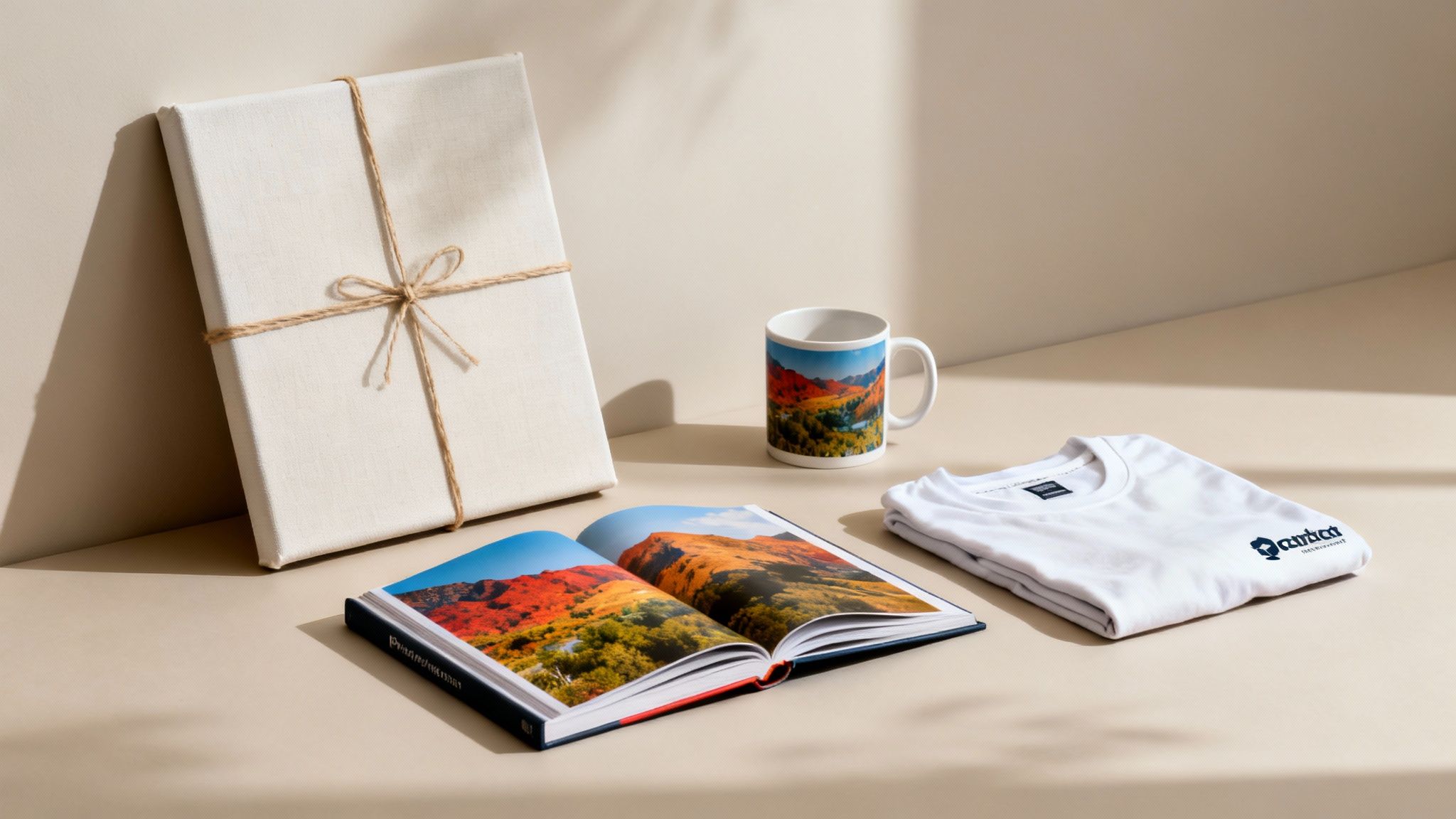
Printing photos these days is about so much more than the standard 6x4 you might slip into an album. Your images can be transformed into physical products that tell a story, build your brand, or completely change the feel of a room. This is where your creativity can really shine.
Think about it: that one stunning landscape photo could become a huge canvas wrap to help stage a home for sale. Or you could print a clever design onto T-shirts for a team event. The options are almost endless, giving you powerful new ways to connect with your audience and leave a lasting impression.
Expanding Beyond the Frame
Custom printing opens up a whole new world of possibilities for personal and professional projects. It’s all about looking at a photo not just as a snapshot in time, but as the starting point for something tangible and impactful.
Here are just a few ideas to get you started:
- Print-on-Demand Merchandise: If you run an e-commerce store, you can sell T-shirts, hoodies, and mugs with your unique designs—all without needing to hold any stock yourself.
- Personalised Corporate Gifting: Imagine giving clients a custom photo book that celebrates a shared milestone, or branded drinkware that’s actually stylish. These are gifts people remember.
- Stunning Real Estate Staging: A few high-quality canvas prints of local scenery can add that professional, welcoming touch that makes a property feel like a home.
- Eye-Catching Hospitality Signage: A café or restaurant can use beautifully printed photos on menus or as wall art to create a unique atmosphere that sets them apart.
This custom approach is really taking off here in New Zealand. The local print-on-demand market is currently valued at USD 120 million, largely thanks to the growth of e-commerce and a real hunger for personalised products. Apparel is leading the charge, but home décor like custom canvas prints isn't far behind, proving that Kiwis love turning their digital photos into real-world items.
A photograph transformed into a custom product does more than just decorate a space—it starts a conversation. It turns a passive image into an active part of a brand's story or a personal celebration.
If you're looking for more inspiration beyond standard prints, it's worth exploring the best custom photo gifts to see just how creative you can get. Whether it’s for marketing, décor, or a meaningful present, the right printing partner can help bring your vision to life.
Your Photo Printing Questions, Answered
Jumping into photo printing can feel a bit daunting. There are a few technical bits and pieces to get your head around, but don't worry, they're simpler than they sound. Here are some of the most common questions we get asked, with straightforward answers to help you get the best possible prints.
What’s the Right Resolution for a Good Print?
For a really sharp, professional-looking print, the magic number is 300 DPI (Dots Per Inch) at your desired print size.
Think of it like this: the resolution of web images is usually around 72 DPI, which is fine for a screen. But when you print at that resolution, the image often comes out looking fuzzy and "pixelated." To avoid that, you’ll always want to start with the highest resolution file you have.
Should I Bother Editing My Photos Before Printing?
Absolutely. A few simple tweaks can make a world of difference. Adjusting basics like brightness, contrast, and a touch of sharpening can really make your photo sing.
A word of caution, though: steer clear of heavy-handed social media filters. What looks good on a glowing phone screen often doesn't translate well onto paper and can sometimes make the image quality worse.
It never hurts to get a second opinion. A professional printer can take a quick look at your file and let you know if it's good to go. This simple check can save you the disappointment (and cost) of a print that doesn’t turn out how you hoped.
Glossy vs Lustre vs Matte: Which Paper Should I Choose?
This really comes down to personal taste and where you plan to display the photo. Each finish has its own personality.
- Glossy: This is your classic, high-shine finish. It makes colours look incredibly vibrant and punchy. It’s fantastic for everyday snapshots, but it does show fingerprints easily and can cause a bit of glare in bright lighting.
- Lustre: Often called the professional's choice, and for good reason. Lustre paper has the rich colour of a glossy finish but with a very fine texture that resists fingerprints and cuts down on glare. It's a perfect all-rounder, especially for prints you plan on framing.
- Matte: With its smooth, non-reflective surface, a matte finish lends a more subtle, artistic feel to an image. It’s a brilliant choice for black-and-white photography or for any print that will be displayed in a well-lit room where glare could be an issue.
When you’ve put your heart into a photo and need it to look absolutely perfect, don't leave the final step to chance. At SONI DESIGN, we work alongside you to turn your digital files into beautiful, high-quality prints that truly stand out. Explore our professional printing services today!
Leave a Comment
Stay home & get your daily
needs from our shop
Start You'r Daily Shopping with Nest Mart