
Your cart is currently empty.

So, you're thinking about turning your van into a moving billboard. It's a smart move. But the first question on everyone's mind is always the same: "What's it going to cost?"
In New Zealand, you can generally expect a full van wrap to cost somewhere between $3,000 and $6,000. Of course, that's a ballpark figure. The final price tag depends on a few key things, like the size of your van and the quality of the materials you choose. Think of it as a starting point for figuring out your budget.
Understanding Your Van Wrap Cost
Investing in a vehicle wrap is easily one of the most effective marketing decisions you can make. It transforms a standard work van into a lead-generating machine that works for you around the clock.
The best part? Unlike traditional advertising that bleeds your budget month after month, a van wrap is a one-off investment that keeps delivering for years. It’s advertising for your business 24/7, whether you’re on the way to a job, parked up at a client's place, or just grabbing a coffee.
This guide will break down all the costs involved so you know exactly what you’re in for. We'll start with a simple overview of what different wrap options might cost for various van sizes. This helps you match your marketing ambitions with your budget right from the get-go.
Just to give you a real-world example, industry data from 2022 showed the average cost for a full wrap in Auckland was sitting around $4,200 NZD. If you're keen to dig deeper, you can find out more about car wrapping costs in NZ on sites like Canstar.
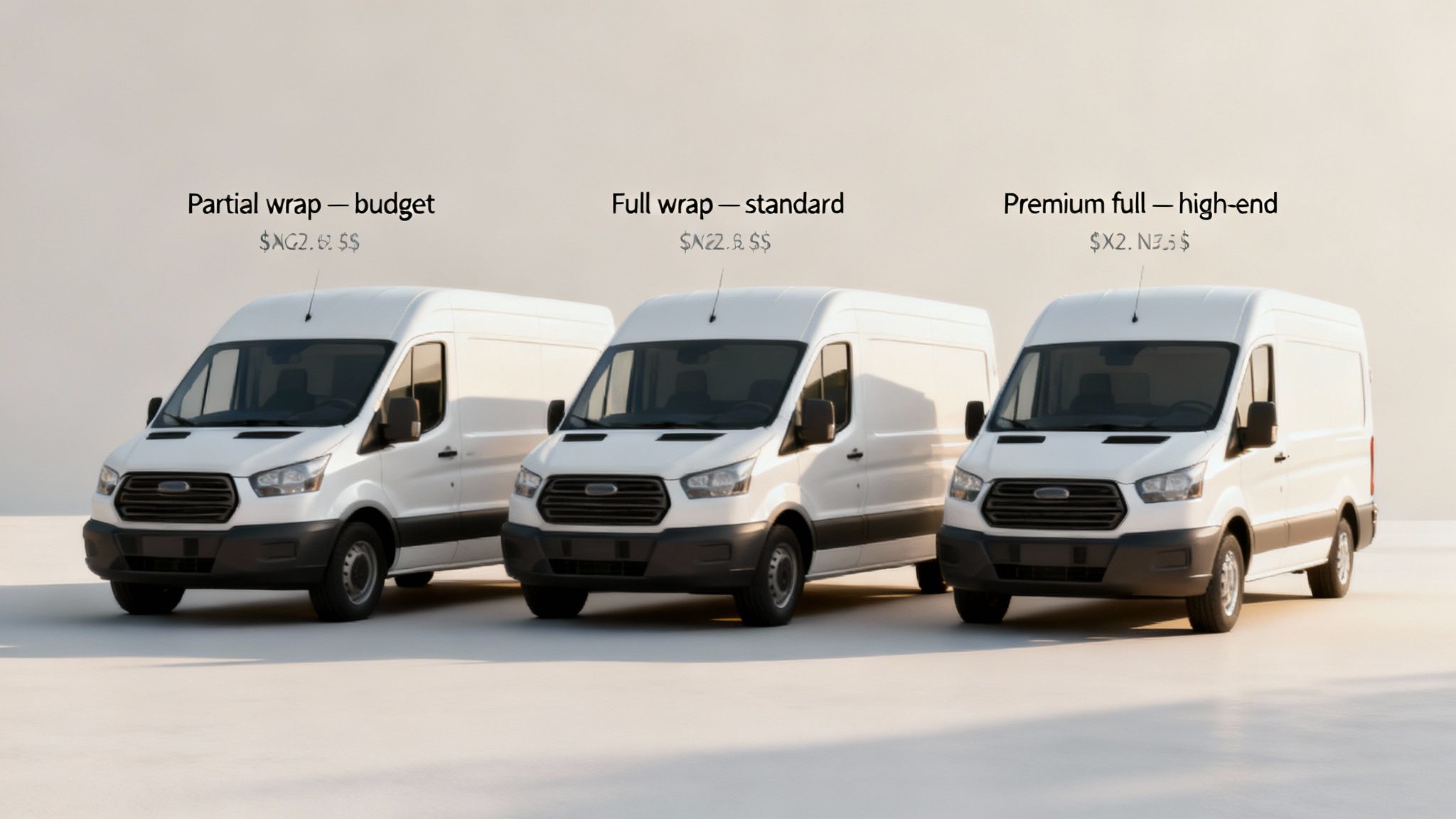
To make it even easier, here's a quick reference table with some typical price ranges you can expect to see here in NZ.
Estimated Van Wrap Cost at a Glance
This table gives you a snapshot of what you might pay based on your van's size and how much of it you want to cover.
| Van Size | Partial Wrap or Lettering (NZD) | Full Standard Wrap (NZD) | Full Premium Wrap (NZD) |
|---|---|---|---|
| Small Van (e.g., Ford Transit Connect) | $1,200 – $2,500 | $3,000 – $4,500 | $4,500 – $6,000 |
| Medium Van (e.g., Toyota HiAce) | $1,800 – $3,000 | $4,000 – $5,500 | $5,500 – $7,000 |
| Large Van (e.g., Mercedes Sprinter) | $2,500 – $4,000 | $5,000 – $6,500 | $6,500 – $8,500+ |
Remember, these are just estimates to help you get started. The final cost will depend on the specific details of your project, which we'll dive into next.
What Really Determines Your Van Wrap Price?
Seeing a price range is one thing, but understanding what actually drives the final van wrap cost is key to budgeting smartly. You might wonder why one quote comes in thousands of dollars higher than another for a van that looks pretty similar. The answer is always in the details—much like the difference between a suit bought off the rack and one that’s been properly tailored.
Think of your van wrap as a custom project with several moving parts. Each element has its own cost and plays a huge part in the final quality, how long it lasts, and the impression it makes on the street. Let’s break down the main factors that shape your quote, so you can make a truly informed investment.
Vehicle Size and Surface Complexity
This is the most obvious one. The bigger the van, the more vinyl we need. A large Mercedes Sprinter will naturally cost more to wrap than a compact Ford Transit Connect simply because it has more real estate to cover. More vinyl means higher material costs right off the bat.
But it’s not just about the overall size; the shape is a massive factor. A van with lots of deep channels, tricky curves, and multiple windows is far more challenging for an installer to work on. Every groove, bumper, and wing mirror needs painstaking attention to get the vinyl sitting perfectly without any bubbles or wrinkles. That extra labour time is a big part of the final price.
Vinyl Material Quality
The type of vinyl you choose is probably the single biggest variable in both the cost and the lifespan of your wrap. It’s always tempting to go for a cheaper material to save a bit of cash upfront, but this often turns out to be a false economy.
There are two main types of vinyl film to think about:
- Calendered Vinyl: This is the more budget-friendly option. It's made by stretching the material into sheets. While it’s okay for flat surfaces and short-term jobs, it’s not as durable and tends to shrink over time. That shrinkage can lead to peeling and cracking, especially on curved parts of your van.
- Cast Vinyl: This is the premium, gold-standard choice for vehicle wrapping. It starts as a liquid, which is then cast into a sheet, creating a super durable and flexible film that moulds beautifully to complex shapes. Cast vinyl lasts longer, holds its colour better, and gives you that flawless, paint-like finish. It's what the pros use for high-quality, long-lasting results.
Choosing a premium cast vinyl is an investment in your brand's image. It keeps your mobile billboard looking sharp and professional for years, protects the paint underneath, and ultimately delivers a much better return.
Design Complexity and Print Quality
A simple, single-colour wrap is always going to be more affordable than a fully custom-printed design packed with detailed graphics, logos, and text. The more complex the artwork, the more time a graphic designer needs to spend setting up the files perfectly for print.
On top of that, the printing process itself affects the cost. We use high-resolution printing with vibrant, UV-resistant inks to make sure your branding stays crisp and doesn’t fade under the harsh New Zealand sun. This costs a bit more than standard printing, but the difference in quality is night and day. Speciality finishes also add to the price tag, like:
- Matte or Satin Finishes for a modern, non-glossy look.
- Chrome or Metallic Finishes to create a stunning, high-end appearance.
- Colour-Shift Vinyls that change their hue depending on the angle you look from.
Installation Skill and Labour
Putting a wrap on a van isn't just about sticking on a giant decal; it’s a craft that takes years to master. An expert installer knows exactly how to prepare the vehicle’s surface, handle the vinyl to avoid overstretching it, and make precise cuts and seams that are almost invisible.
The cost breakdown for wraps in New Zealand really shows this. In 2023, you might have seen an economy wrap advertised for $3,000 to $4,500 NZD, while a premium cast vinyl wrap would typically be in the $4,500 to $7,000 NZD range. A huge chunk of that difference is labour. Average hourly rates for expert installers sit between $120 and $180 NZD, and most van wraps take anywhere from two to five full days to complete. You can get a closer look at New Zealand's vehicle wrap pricing to see how it all comes together.
Surface Preparation and Old Graphic Removal
A flawless wrap needs a flawless canvas to start with. The vinyl will only stick properly to a clean, smooth surface free of dirt, wax, rust, or any dings. If your van has chipping paint or a few dents and scratches, those issues have to be sorted out before any vinyl can be applied.
It's the same story if your van already has old graphics or a previous wrap. That old vinyl has to be removed professionally. This is a painstaking job that involves carefully heating and peeling the material off, then cleaning away every last bit of sticky adhesive residue. All of this necessary prep work will be factored into your final quote.
Full Wraps vs Partial Wraps: Which One Is Right for You?
Deciding between a full or partial wrap is one of the first big calls you'll make. It’s a choice that directly shapes not just the van wrap cost, but also how much of a splash your vehicle makes on the road. Both are fantastic ways to get your brand seen, but they're designed for different goals and budgets.
Here’s a simple way to think about it: a full wrap is like giving your van a complete brand uniform, turning every square centimetre into a mobile billboard. A partial wrap, on the other hand, is more like a sharp, branded jacket—it highlights your best features and gives you a professional edge without covering everything.
Let's break down the two options so you can figure out which one makes the most sense for your business.
The All-In Approach: Full Van Wraps
A full wrap is the ultimate way to make a statement. It means covering every painted surface of your van, from one bumper to the other, creating a totally seamless canvas for your brand. This gives you complete creative freedom for bold, complex designs that are impossible to ignore.
The biggest draw of a full wrap is its maximum visual impact. When your van is completely transformed with your brand’s colours and message, it stands out everywhere it goes. It’s a well-known fact in our industry that a single wrapped vehicle can generate between 30,000 to 70,000 impressions a day. A full wrap makes sure every single one of those glances counts.
A full wrap is probably your best bet when:
- You want to completely dominate your local area and make the boldest statement possible.
- Your design is complex or needs a lot of space. Things like large photos, detailed graphics, or smooth colour gradients look best on a full canvas.
- You want to protect your van's original paint. A quality vinyl wrap acts like a shield against stone chips, scratches, and sun damage, which helps maintain the vehicle’s resale value.
- You have the budget for a bigger upfront investment to get a massive long-term marketing return.
This quick visual breaks down the main things that affect your final quote, helping you see where the costs come from.
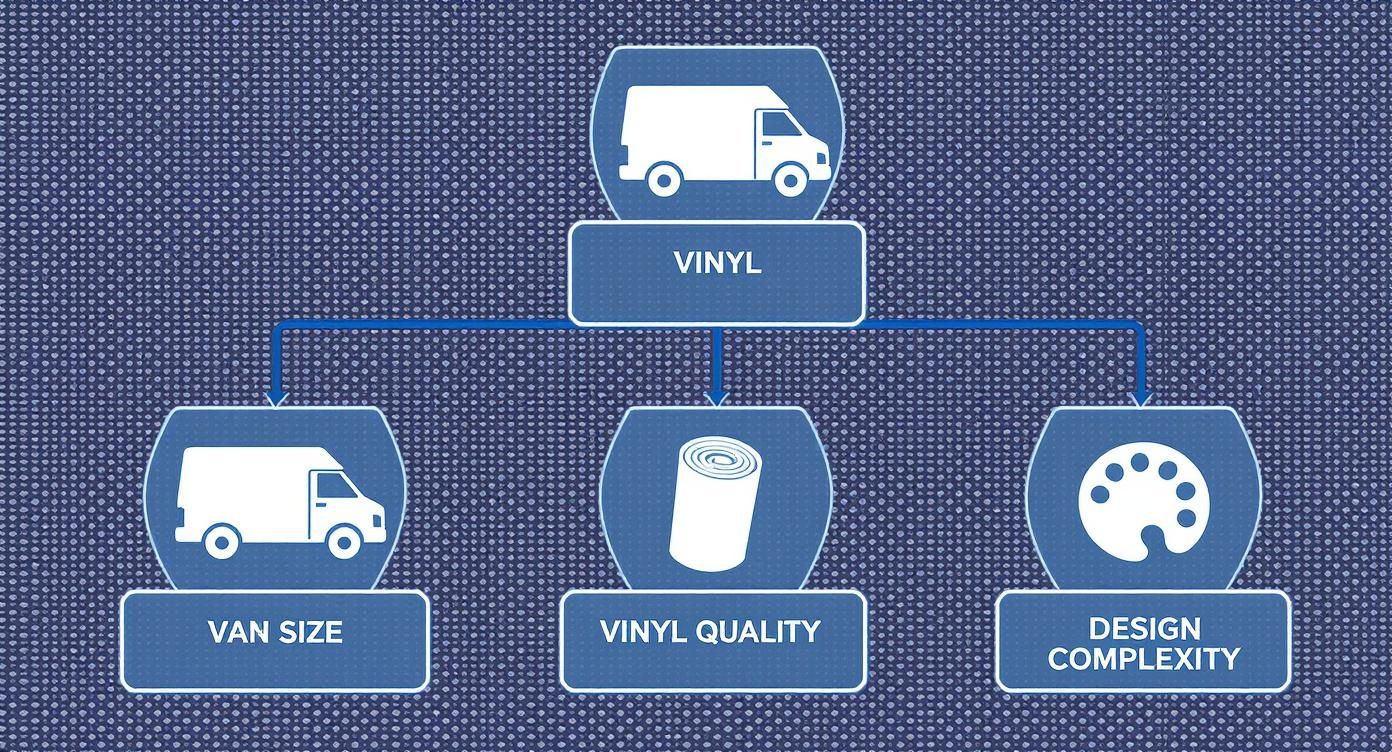
As you can see, the amount of coverage you choose, along with the van's size and the design's complexity, are the building blocks of your total investment.
The Strategic Choice: Partial Van Wraps
Looking for a smart, budget-friendly option that still looks fantastic? A partial wrap is your answer. Instead of covering the whole van, we only wrap specific sections—like the sides, back doors, or bonnet—and cleverly use the vehicle's original paint colour as part of the design. It's all about working smarter.
The number one advantage here is the lower cost. Because we’re using less material and it takes less time to install, a partial wrap can deliver a high-impact look for a fraction of the price of a full one. This makes it a brilliant starting point for new businesses or anyone keeping a close eye on their marketing spend.
A well-designed partial wrap is proof you don't need to cover every inch of a van to make a strong impression. Smart design and strategic placement can create a look that’s just as professional and memorable as a full wrap.
Partial wraps are also incredibly versatile. You can put your key message right where it’s most visible, making sure your contact details and services are easy for potential customers to spot in traffic.
Go for a partial wrap if:
- You’re working with a tighter budget. You still get a fully professional look at a more accessible price.
- Your van’s paint colour already works well with your brand. We can use that base colour to our advantage, saving you money and creating a truly unique design.
- You just need to get the essential info out there. If your main goal is to clearly display your logo, phone number, and services, a partial wrap is perfect.
- You’ve got a whole fleet of vans to brand. The lower cost per vehicle makes it much more affordable to get a consistent look across all your vehicles.
In the end, choosing between a full and partial wrap is about balancing your marketing goals with your budget. A full wrap is an unbeatable tool for getting eyeballs on your brand, while a partial wrap is a masterclass in making a huge impact without breaking the bank.
Calculating the True Return on Your Van Wrap
It’s easy to get fixated on the initial van wrap cost, but savvy business owners know to shift the conversation from expense to long-term value. A vehicle wrap isn't just another line item on a spreadsheet; it's a powerful marketing asset that works around the clock to generate leads and build your brand.
Think about it. Unlike a radio ad or a social media campaign that you have to keep paying for, a van wrap is a one-time investment that keeps paying you back for years.
Imagine your delivery van navigating busy city streets or parked up at a client's property. It’s doing more than just its job—it’s actively advertising your business to every single person who passes by. Every traffic jam becomes a marketing opportunity. Every job site becomes a billboard. This is where the real return on investment (ROI) starts to stack up.
Understanding Cost Per Impression
To really get your head around the value, we need to talk about a key marketing metric: Cost Per Impression (CPI). This simply measures how much it costs for a potential customer to see your ad. Traditional advertising, like radio spots or newspaper ads, comes with recurring fees that add up fast. A van wrap turns that entire model on its head.
Once you’ve covered the one-off cost of the design and installation, the ongoing cost per impression for a wrap is basically zero. Studies consistently show that a single wrapped vehicle can generate between 30,000 to 70,000 sets of eyeballs on it every single day, depending on how much time it spends on the road. That makes it one of the most cost-effective advertising channels out there.
A van wrap is a one-time purchase that delivers continuous advertising exposure. Over its lifespan of five to seven years, the cost per thousand impressions (CPM) drops to a fraction of what you would pay for almost any other marketing channel.
There's a good reason the vehicle wrap market here in New Zealand has been growing so steadily. With an average annual growth rate of around 12% since 2018, more and more businesses are realising just how effective this mobile marketing tool is. It offers high-impact branding without the high cost or permanent commitment of a custom paint job. You can dig into more stats on the growing vehicle wrap film market over at Allied Market Research.
Practical Scenarios and Real-World ROI
Let's bring this down to earth with a couple of real-world examples for a local Kiwi business.
-
Scenario A: The Electrician's Van
An electrician spends $4,500 on a full wrap for their van. That van is on the road five days a week, zipping across town to different jobs and parked in driveways all over the place. Over five years, millions of people see that wrap, building local brand awareness and bringing in a steady stream of new customer calls. -
Scenario B: The Catering Company Fleet
A catering company decides to wrap three of its delivery vans with vibrant, mouth-watering graphics. The vans are constantly on the move between events, suppliers, and client meetings. That professional, branded look builds trust and helps land new corporate clients, which leads directly to bigger, more profitable contracts.
In both of these scenarios, the initial investment is repaid many times over through new business and a much stronger brand reputation. The wrap essentially becomes a silent salesperson, reinforcing the company’s professionalism and keeping it top-of-mind in the community.
When you sit down and calculate the actual return, the initial van wrap cost stops looking like an expense and starts looking like one of the smartest marketing investments you can make.
How to Avoid Hidden Costs and Budget Surprises
When you first get a quote for your van wrap, the number can look pretty straightforward. But just like any project, hidden fees can pop up and inflate that final price, leaving you with a nasty surprise. To budget properly, you need to look past the headline figure and know what to watch out for.
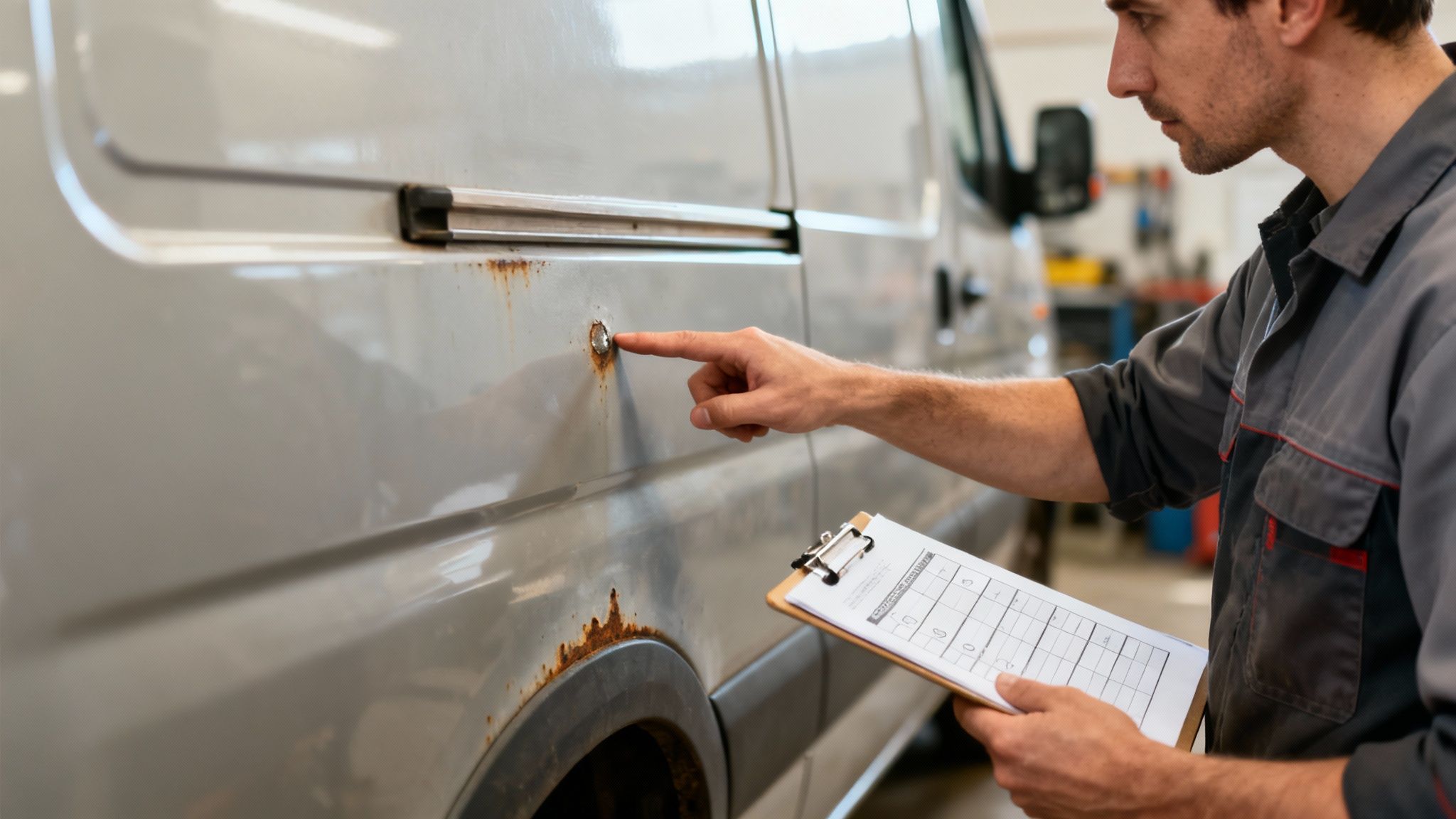
Think of it like renovating a house. You budget for the new kitchen, but once the old cabinets come out, you might find unexpected rewiring or plumbing jobs that need doing. Wrapping a van is exactly the same—what’s going on underneath the surface really matters.
Uncovering Potential Extra Charges
There are a few common things that can add to your bill after the initial quote. Knowing what they are ahead of time means you can ask the right questions and make sure your budget is realistic from the get-go.
Here are the usual suspects for extra costs:
- Complex Design Revisions: Most quotes will factor in a certain amount of design time. If you keep going back for major changes or endless tweaks, you’ll probably see extra design fees.
- Old Graphic Removal: Got old decals or a previous wrap on your van? Getting them off is a fiddly, time-consuming job. The careful heating, peeling, and cleaning of old adhesive will be an added cost.
- Surface Preparation and Repairs: Vinyl needs a perfectly smooth surface to stick to. Any rust, deep scratches, or flaking paint has to be properly repaired before we can even think about applying the wrap.
A flawless wrap can only happen on a flawless surface. Paying for proper prep work isn't an upsell; it’s an absolute necessity to make sure your wrap looks professional and lasts for years without peeling or bubbling.
To really get a handle on your finances for projects like this, it pays to have solid budgeting practices in place. For more on that, you can check out a comprehensive small business budgeting guide.
Your Pre-Quote Checklist
Before you sign on the dotted line, have a clear list of questions ready for your installer. This helps you get an all-inclusive quote and ensures you’re comparing apples with apples if you’re looking at a few options. Any trustworthy installer will be happy to give you clear, detailed answers.
Make sure your quote explicitly covers these key areas.
Questions to Ask Your Installer:
- Design Process: How many hours of design time and how many revisions are included in this quote?
- Surface Inspection: Have you had a good look at the van's paintwork? Is any pre-wrap repair work needed?
- Removal Fees: Does this price include taking off my old graphics? If not, what’s the estimated cost for that?
- Material Specifics: Can you confirm the exact brand and type of vinyl you'll be using (e.g., 3M or Avery Dennison cast vinyl)?
- Warranty Details: What exactly does the warranty cover, and for how long? Does it include both the vinyl itself and the installation?
By getting these points clarified upfront, you get rid of any grey areas and can be confident that the price you agree on is the price you'll pay. It’s a simple, proactive way to protect your investment and keep your branding project on track and on budget.
Getting an Accurate and Reliable Quote
Ready to stop guessing and get a real number for your van wrap? Nailing down an accurate quote is the most important part of planning your project. Think of it like giving a builder the blueprints for a house—the more detail you provide, the more precise their pricing will be.
A good installer needs specific info to give you a price you can actually bank on, which helps you avoid nasty surprises later. It really just comes down to clear communication and giving them the right details from the get-go. Much like utilizing a shipping quote calculator for clear estimates for logistics, providing clear details upfront makes the whole process faster and more transparent.
What Installers Need to Know
To put your quote together, any wrap shop will ask for a few key things about your van. Having this information ready will speed things up and make the whole process a lot smoother. It helps them figure out exactly how much material they’ll need and the labour involved for your specific vehicle.
Be ready to share these details:
- Van Make, Model, and Year: A 2023 Mercedes Sprinter is a completely different beast to a 2018 Toyota HiAce. These basics are the starting point for everything.
- Current Paint Condition: Is the paint original and in good shape? Or are there spots with peeling clear coat, rust, or deep scratches? Vinyl needs a solid, smooth surface to stick to properly.
- Desired Coverage: Let them know exactly what you're after. Is it a full wrap, a partial wrap just on the sides and back, or maybe just some simple cut vinyl lettering?
Why Photos are a Must-Have
You can describe your van all day, but nothing beats a picture. Sending clear, recent photos of your van from every angle—front, back, and both sides—is absolutely essential for getting a solid quote.
Photos let the installer spot things you might not think to mention, like aftermarket spoilers, custom bumpers, tricky body lines, or existing damage that needs attention.
A picture is worth a thousand words—or in this case, it could be worth hundreds of dollars. Good photos take the guesswork out of quoting, meaning the price is based on the real vehicle, not just an assumption.
When you provide all this information, you give the installer everything they need to offer a transparent and reliable price. A little prep work here sets your project up for success, ensuring the price you agree on is the price you pay. It’s the best way to kick off your van branding project with confidence.
Common Questions About Van Wrap Costs
When you’re on the brink of turning your van into a mobile billboard, a few last-minute questions are bound to pop up. It's completely normal. Getting clear, honest answers is what gives you the confidence to move forward, knowing you're putting your money in the right place.
Let's dive into some of the most common questions we hear from business owners across New Zealand about vehicle wraps. We'll give you the straightforward answers you need to finalise your plans.
How Long Does a Professional Van Wrap Last in NZ Conditions?
You can realistically expect a professionally installed van wrap, made with top-tier cast vinyl, to last anywhere from five to seven years. These materials are specifically designed to handle New Zealand's unique and often harsh climate.
But like anything, its real-world lifespan comes down to a few things. The relentless NZ sun is a big one, as is constant exposure to road grime or abrasive cleaning methods. To really get the most out of your investment, we always suggest a gentle hand wash with a pH-neutral soap. Steer clear of high-pressure water jets, especially around the edges, as they can cause the vinyl to lift over time.
Can a Vinyl Wrap Damage My Van's Original Paint?
Actually, it’s quite the opposite. A quality vinyl wrap is one of the best ways to protect your van's original paint. Think of it as a protective shield, guarding the factory finish against minor scratches, stone chips, bird droppings, and the sun's fading UV rays. It's a great way to preserve your vehicle's resale value down the line.
The only time you might run into trouble is if the paint is already in bad shape. If there are signs of chipping, peeling, or rust, the adhesive from the wrap could pull away loose paint during removal. Any reputable installer will do a thorough surface inspection beforehand to make sure your van is a good candidate and flag any potential issues.
Think of a wrap as a durable, temporary skin for your vehicle. It's engineered to be completely removable without harming the factory paint underneath, as long as that paint was in solid condition to begin with.
Is It Cheaper to Wrap a Van Myself?
The thought of saving on labour with a DIY wrap is tempting, but it often ends up being a classic case of false economy. Applying a vehicle wrap is a genuine craft that takes years to master, not to mention specialised tools and a perfectly controlled, dust-free environment.
It’s the complex curves, deep recesses, and door handles that trip people up. Without the right technique, you'll likely end up with frustrating wrinkles, bubbles, and graphics that just don't line up. Not only does this look unprofessional, but it often means wasting expensive material and having to start over. Worse still, a botched installation or removal can damage your paint. For that seamless, durable finish that makes your brand look its best, you really can't beat a professional job.
Does My Van's Original Colour Affect the Wrap Cost?
For a full wrap, the original colour of your van has no impact on the price. The premium vinyl films we use are completely opaque, so they totally block out whatever colour is underneath. It doesn't matter if your van is white, black, or bright orange – the new wrap will cover it completely.
The real cost drivers are the amount of vinyl needed, the complexity of your design, and the hours it takes to install it perfectly. Your van's base colour doesn't factor into any of that. Of course, for a partial wrap, the original colour is a different story; it becomes a key part of the design and we work with it to create a cohesive look.
Ready to transform your vehicle into a powerful marketing tool? The team at SONI DESIGN is here to bring your vision to life with stunning, high-quality van wraps that get your business noticed. Contact us today for a personalised quote and let's get started!
Leave a Comment
Stay home & get your daily
needs from our shop
Start You'r Daily Shopping with Nest Mart