
Your cart is currently empty.

Sourcing the right packaging boxes in NZ is a huge decision for any Kiwi business. It's something that genuinely affects how people see your brand, how safe your products are in transit, and even how smoothly your operations run. This isn't just about finding a container; it's a strategic move that needs to nail the balance between cost, sustainability, and that all-important unboxing experience.
Your Guide to Choosing Packaging Boxes in New Zealand
Welcome to your complete roadmap for getting packaging right here in New Zealand. Choosing the perfect box is about so much more than just what fits. It’s often the very first physical thing a customer experiences from your brand, and it sets the tone for everything that follows.
Get it right, and your product arrives safely, looking sharp. Get it wrong, and you're looking at damaged goods, frustrating returns, and a brand reputation that takes a hit.
This guide is built from the ground up for NZ businesses. We get the unique challenges and opportunities you face, whether you're a small e-commerce store shipping from Christchurch or a growing retail brand in Auckland. For you, packaging decisions are tied directly to your budget, your brand values, and the real-world logistics of getting things delivered.
Think of your packaging as your silent salesperson. Before your customer even sees the product, the box has already told them a story about your quality, your values, and your attention to detail.
What This Guide Will Cover
We're going to walk you through every step of sourcing packaging boxes NZ businesses can count on. Our goal is to cut through the jargon and give you clear, practical advice you can use straight away. We’ll cover everything from the basics to the finer points of customisation, so you can feel confident you're making the best choice.
Here’s a sneak peek at what you’ll learn:
- Essential Materials and Box Styles: We’ll break down the difference between corrugated cardboard and paperboard, and help you decide if a standard shipping box or a custom die-cut mailer is right for you.
- Sustainable Packaging Choices: Let's navigate the world of eco-friendly options, from FSC-certified materials to compostable solutions that Kiwi consumers really care about.
- Custom Design and Branding: Discover how to make your brand pop with custom printing, unique sizing, and special finishes that create an unboxing experience people will remember.
- Managing Costs and Logistics: Get a clear picture of what drives pricing, what to expect with minimum order quantities (MOQs), typical lead times, and smart shipping tips for getting your products across New Zealand.
By the time you're done with this guide, you won't just know what packaging to choose—you'll understand why it's the right fit for your products, your customers, and your business goals. Let's get started.
Getting to Grips with Box Materials and Styles
Choosing the right packaging all starts with understanding your building blocks. The material and style of your box are the first big decisions you'll make, and they have a massive ripple effect on everything from product safety and shipping costs to the very first impression a customer has of your brand.
Let's break down the most common options that packaging boxes NZ businesses use day in, day out.
Think of it like picking the right gear for a hike. A simple daypack is perfect for a stroll around Hagley Park, but you'll need something far more rugged for a multi-day tramp through Fiordland. The same logic applies to your packaging—the journey your product is about to take dictates the level of protection it needs.
It's all about finding that sweet spot between your brand's personality, solid product protection, and day-to-day packing efficiency.
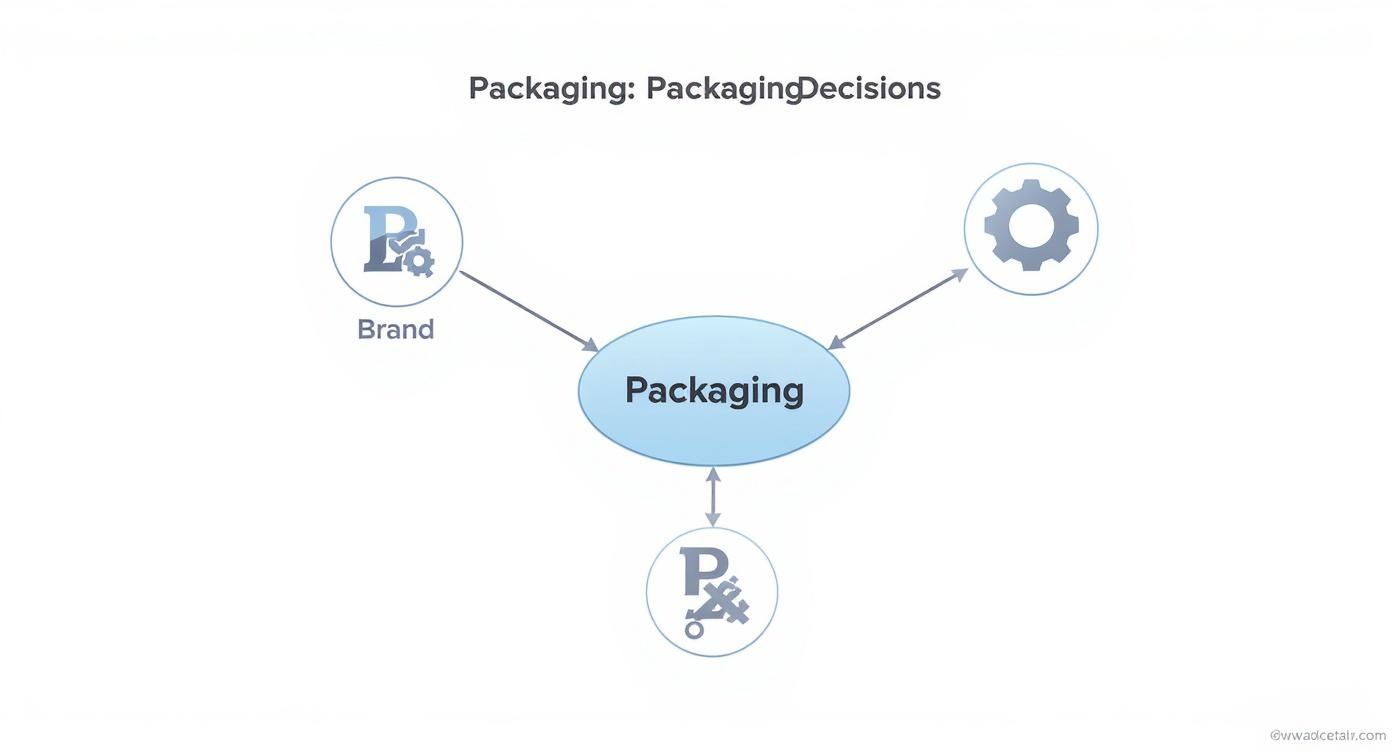
This diagram shows just how intertwined these decisions are. Your packaging choices need to sync up with your brand, the protection your product requires, and how your team actually operates. When all these elements align, you’ve got a winning formula.
The True Workhorse: Corrugated Cardboard
Picture a shipping box. Chances are, you’re thinking of corrugated cardboard. It's the undisputed champ of e-commerce and logistics for very good reasons. Its strength isn't just from being thick; it's all in the clever construction—a wavy, fluted layer of paper wedged between two flat linerboards.
That rippled layer in the middle, known as the 'flute', acts a bit like a series of arches, creating a cushion that provides surprising rigidity. It’s the secret sauce that lets a lightweight box survive the bumps and drops of a courier journey from Auckland all the way down to Invercargill.
Different flute profiles give you different benefits:
- B-Flute: A fantastic all-rounder. It offers a good balance of cushioning and a smooth surface that’s great for printing, making it a versatile choice for many products.
- C-Flute: A bit thicker and with better crush resistance than B-Flute. This is your go-to for standard shipping boxes where durability is the number one priority.
- E-Flute: Much finer and thinner, giving it a premium, almost paper-like surface perfect for high-quality printing. You’ll often see this used for smaller retail boxes and mailers where looks really matter.
The corrugated packaging market is a huge part of our local economy here in New Zealand, and for good reason. It’s tough, cost-effective, and recyclable—ticking all the boxes for businesses shipping everything from electronics to artisan foods. Projections show this sector is on track to grow by 4.06% in 2025. You can get a better sense of these trends by reading up on the NZ corrugated packaging market.
To help you decide, here's a quick look at how common materials stack up against each other.
Packaging Material Comparison for NZ Businesses
| Material Type | Best For | Strength | Print Quality | Relative Cost |
|---|---|---|---|---|
| Corrugated (B/C-Flute) | E-commerce shipping, bulk transport | High | Good | Low-Medium |
| Corrugated (E-Flute) | Premium mailers, retail-ready packaging | Medium | Excellent | Medium |
| Paperboard/Cardstock | Retail product boxes, food sleeves | Low | Excellent | Low-Medium |
| Rigid Box (Greyboard) | Luxury goods, gift sets, high-end electronics | Very High | Excellent | High |
This table is just a starting point, of course. The best material always comes down to your specific product, brand, and budget.
The Most Common Box Styles Explained
Once you’ve landed on a material, the next job is to pick a style. This decision literally shapes the unboxing experience and can even make your packing process faster or slower.
Regular Slotted Container (RSC)
This is the classic, everyday shipping box. It's made from a single piece of corrugated board with flaps that meet in the middle, ready for a bit of tape to seal it up. RSCs are cheap and incredibly efficient to produce, making them the default choice for bulk shipping and general e-commerce fulfilment.
Die-Cut Mailer Box
If you're after a more premium, considered feel, the die-cut mailer is a brilliant option. These boxes are stamped out from a sheet using a custom cutting tool (a 'die'), which allows for unique shapes, clever self-locking tabs, and a presentation-style opening. No tape needed to assemble them, and they give off a clean, professional vibe that really elevates the whole unboxing experience.
A die-cut mailer turns a simple delivery into a special event. The satisfying tear of a perforated strip or the clean lift of a hinged lid creates a moment of delight that strengthens a customer’s connection to your brand.
Custom Product Boxes
Moving away from pure shipping, we have custom product boxes. Often made from paperboard or fine E-flute, these are designed to look fantastic on a retail shelf. Their main job is to grab attention and communicate your brand's quality in an instant. Think of the sleek box for a new smartphone or the beautiful packaging for a luxury skincare product from a local Kiwi brand.
These boxes are built precisely around your product’s dimensions for a snug, secure fit. Kitted out with high-quality printing and special finishes, they become a powerful marketing tool right at the point of sale. For any retail-focused business in New Zealand, they're an essential part of the puzzle.
Embracing Sustainable Packaging in New Zealand
For Kiwi businesses, being eco-conscious isn't just a trend; it's practically woven into our DNA. Customers here expect it, and choosing sustainable packaging boxes in NZ is one of the most direct ways to show you’re on the same page. It’s about more than just a box—it’s a tangible reflection of your brand’s values.
When a customer receives a package made from responsible materials, it sends a powerful message. It tells them you care about your impact on our beautiful country, from the forests your paper comes from to the package that lands on their doorstep. This shared commitment can genuinely set you apart, turning a simple transaction into a moment of connection.
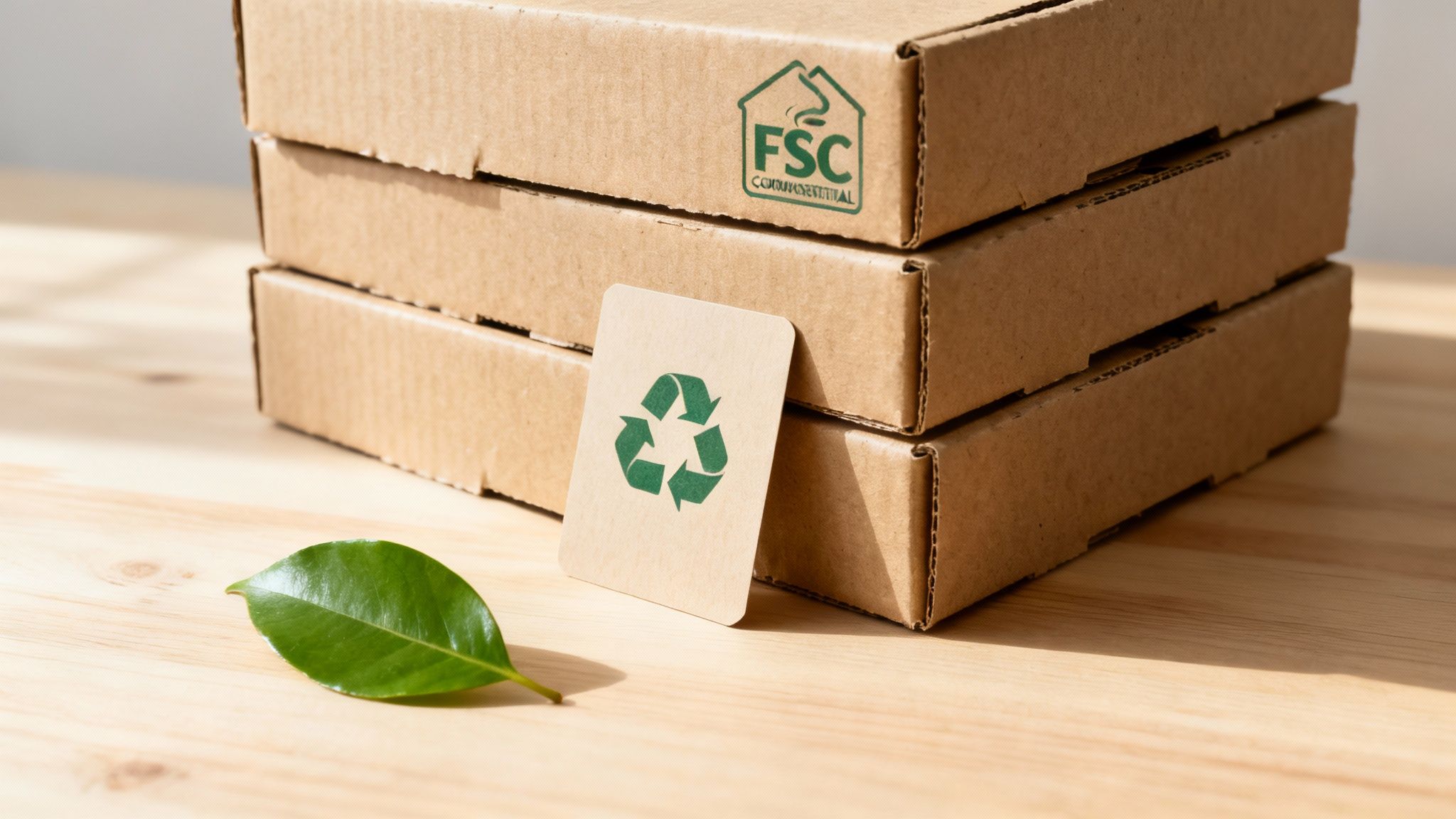
This push for greener packaging isn't just coming from consumers, either. Government initiatives are encouraging businesses to adopt biodegradable and compostable materials, which is sparking some brilliant innovation right here in our local industry.
Getting the Lingo Right: What Do These Eco-Terms Actually Mean?
Navigating the world of sustainable packaging can feel a bit like alphabet soup with all the different labels and claims. Let’s break down the three big ones so you can make informed choices and be transparent with your customers.
- Recyclable: Simple enough—the material can be collected, processed, and turned into something new. Corrugated cardboard is the hero here, with fantastic recycling rates across New Zealand.
- Compostable: This is more specific. It means the material will break down into natural, non-toxic elements in a proper compost environment. Certified compostable packaging has to meet strict standards for how quickly it decomposes.
- Biodegradable: This is a broader term meaning the material will eventually break down naturally. The catch is that it doesn't specify how long it will take or if it leaves anything behind, so "compostable" is often the stronger claim.
For your customers, a little clarity goes a long way. A simple icon or a friendly note like "Please Recycle Me" or "I'm Home Compostable" on your box makes all the difference. It helps ensure your good intentions are followed right to the end.
"True sustainability in packaging goes beyond the material itself. It involves clear communication that empowers the end-user to dispose of it responsibly, closing the loop and ensuring the environmental benefits are fully realised."
Popular Sustainable Material Choices
When it comes to choosing eco-friendly packaging boxes in NZ, you’ve got some fantastic options that don't mean sacrificing strength or style. These materials are becoming more and more accessible for businesses of every size.
One of the biggest shifts we're seeing is towards moulded fibre pulp. This segment of our local packaging industry was valued at a huge USD 238.2 million in 2023 and is set to grow by 4.8% each year for the next decade. That kind of growth tells you everything you need to know about the demand for renewable and biodegradable solutions.
Here are some of the best material choices available:
- FSC-Certified Paper and Cardboard: The Forest Stewardship Council (FSC) tick is your guarantee that the paper comes from responsibly managed forests. It’s the gold standard for supporting sustainable forestry.
- High-Recycled-Content Cardboard: Choosing boxes made with a high percentage of recycled material is a no-brainer. It cuts down the need for new resources, saves energy, and shrinks your packaging's carbon footprint.
- Kraft Paper: Made with a minimal chemical process, Kraft paper is naturally tough, biodegradable, and fully recyclable. It’s perfect for mailers, void fill, or wrapping products with an earthy, rustic feel.
Of course, the box is just one piece of the puzzle. Forward-thinking companies are looking at their entire operation, adopting sustainable supply chain practices like green warehousing and electric delivery vehicles. By choosing sustainable materials for your packaging, you're not just making a smart business move; you're aligning your brand with the values that matter most to Kiwis and doing your bit for a healthier Aotearoa.
Bringing Your Custom Box Design to Life
This is where the magic really happens.## Bringing Your Custom Box Design to Life
This is where the magic really happens. Your brand’s vision is about to jump off the screen and into your customers' hands. Creating custom packaging boxes in NZ isn't just about making a container; it's about turning an idea into a tangible asset. It’s that exciting point where strategic choices in design, materials, and printing come together to craft the perfect first impression.
Let's walk through how a simple concept becomes a beautifully finished box that not only protects your product but also creates a memorable experience for your customers.
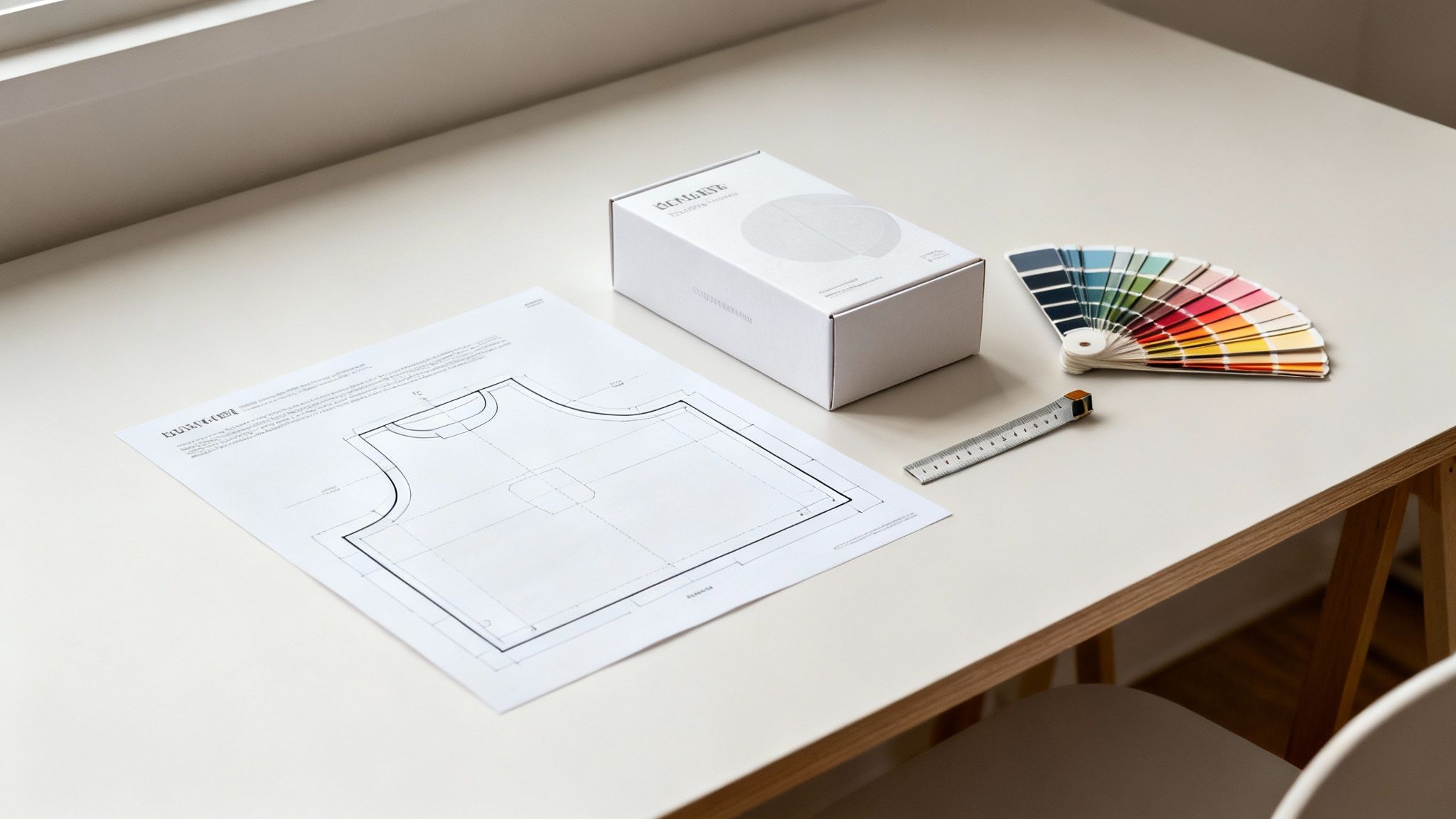
Starting with the Blueprint: Your Box Dieline
Before a single drop of ink is used, every custom box starts its life as a dieline.
Think of a dieline as the architectural blueprint for your packaging. It’s a flat, 2D diagram that maps out exactly where every single cut, crease, and fold will go on the cardboard sheet before it’s assembled into its final 3D form.
This blueprint is absolutely non-negotiable. It’s what guarantees every panel is the right size, every tab slots in perfectly, and the finished box is structurally sound. Getting the dieline right is the foundation of any successful custom packaging project.
Typically, your packaging partner (like us here at Soni Design) will give you a dieline template for your chosen box style. Your graphic designer then lays your artwork, logos, and text over this template, making sure everything aligns perfectly with the box’s physical structure.
Sizing for a Perfect, Snug Fit
One of the best things about going custom is creating a box that fits your product like a glove. A snug fit isn’t just about looking professional; it's a practical move with some serious benefits:
- Better Protection: A well-fitted box stops your product from rattling around during shipping, which dramatically cuts down the risk of damage. That means fewer returns and happier customers.
- Less Waste: By getting rid of unnecessary empty space, you use less material. This is not only better for the planet but can also trim your material costs.
- Lower Shipping Costs: Couriers often calculate fees based on dimensional weight. A smaller, more compact box can lead to big savings on shipping, especially if you’re sending parcels all over New Zealand.
To get the sizing right, measure your product's length, width, and height at their widest points. Then, add a small buffer of 2-3mm to each dimension. This ensures the product slips in and out easily without being too loose.
Choosing Your Printing Method
Once your dieline is sorted and the size is locked in, it's time to think about printing. The method you choose will have a huge impact on the final look, feel, and cost of your packaging.
Here’s a quick rundown of the three main options for printing packaging boxes in NZ:
- Flexographic (Flexo) Printing: Imagine a high-speed, industrial-sized rubber stamp. Flexo uses flexible plates to apply ink directly onto the cardboard. It’s incredibly fast and cheap for large runs, making it the perfect choice for simple, one or two-colour logos on shipping cartons.
- Offset Lithography: For stunning, photo-quality results, this is the way to go. The design is transferred from a plate to a rubber blanket, then onto the box. It’s ideal for vibrant, multi-coloured retail boxes where shelf appeal is everything. The initial setup costs are higher, but the per-unit price drops significantly on bigger orders.
- Digital Printing: This works a lot like your office printer, applying ink straight from a digital file. The big advantage here is flexibility. With no setup costs for plates, it’s a brilliant option for short runs, prototypes, or designs with variable info (like different product names).
Your choice really comes down to your order volume, how complex your design is, and your budget. For a small Kiwi startup doing its first run of 100 mailer boxes, digital printing is a great fit. For a large brand shipping thousands of products to supermarkets, offset or flexo will be much more cost-effective.
With your custom box design complete, the next step is making it shine online. Great packaging deserves great photos, so it's worth exploring how you go about taking professional product photos. From getting your artwork files print-ready to choosing finishes like a sleek matte or gloss laminate, every detail helps create an unboxing experience that builds real brand loyalty.
Managing Costs and Logistics for Your Order
Getting the numbers and timing right is one of the most important parts of the whole packaging puzzle. It's where your brilliant design meets the real world of budgets, production schedules, and shipping. Let’s pull back the curtain on the financial and logistical side of ordering the packaging boxes nz businesses rely on.
Nailing this part of the process means you can plan your supply chain properly, avoid nasty surprises on your invoice, and get your boxes delivered right when you need them. It’s all about making savvy, informed decisions that work for your business from day one.
Key Factors That Influence Your Final Quote
When that quote lands in your inbox, the final number is a careful mix of several key ingredients. Each one plays a part in the total cost, and knowing what they are helps you see exactly where your money is going—and where you might be able to find savings.
Essentially, four main things drive the price:
- Material: The type of board you select (a standard C-flute versus a finer E-flute, for instance) and any special eco-certifications will directly affect the cost.
- Size & Complexity: It’s simple, really. Bigger boxes use more material, and complex, custom-cut designs need more intricate tooling than a standard shipping box.
- Print Requirements: A straightforward one-colour print is always going to be more budget-friendly than a full-colour job with a fancy matte laminate finish.
- Order Volume: This is the big one. Ordering more boxes almost always brings down the price for each individual box.
Understanding Minimum Order Quantities (MOQs)
One of the first acronyms you'll bump into is MOQ, or Minimum Order Quantity. This is simply the smallest order a manufacturer is willing to produce in a single run. Why do they exist? Because setting up all the machinery for a custom job—from mixing the right inks to calibrating the cutting equipment—comes with a fixed cost.
Spreading that setup cost over a larger run makes each box much more affordable. Think of it like baking a cake; it’s far more efficient to make one big batch than it is to fire up the oven for just a single cupcake. For many custom packaging boxes in NZ, you'll find MOQs for high-quality printed designs often start around 500 or 1,000 units.
Finding the right order quantity is a balancing act between a great per-unit cost and your available cash flow and warehouse space. It’s that sweet spot where economy of scale meets practical business sense.
Typical Timelines and Shipping in New Zealand
Planning ahead is your best friend here. Custom packaging isn't something you can just grab off a shelf, so it pays to know the timeline from start to finish.
Here’s a rough guide to what you can expect:
- Design & Approval (1-2 weeks): This is where you'll be finalising your artwork, double-checking the dielines, and signing off on the proofs.
- Production (2-4 weeks): Once you give the green light, your boxes hit the production line. This can vary a bit depending on how complex your job is and how busy the manufacturer is.
- Shipping (2-5 days): Getting your boxes from the factory to your door depends on where you are. A delivery from Auckland to Christchurch will obviously take a bit longer than one just across town.
It’s also worth keeping in mind that the wider economy can play a role. The packaging services industry in New Zealand has felt the impact of shifts in agriculture and manufacturing, with revenue seeing a slight annual dip over the last five years. You can read more about NZ's packaging industry trends on IBISWorld.
By factoring these timelines into your own schedule, you can make sure you’ve always got boxes on hand when you need them, keeping your whole operation running like clockwork.
Your Top Questions About Packaging Boxes in NZ
Jumping into the world of custom packaging can feel a bit daunting. There are new terms to learn, a bunch of options to weigh up, and you want to get it just right for your business. We get it.
To wrap things up, we've pulled together the most common questions we hear from Kiwi businesses. Think of this as your final checklist—quick, clear answers to help you lock in your decisions with confidence.
What Is a Dieline and Why Do I Need One?
Imagine a dieline as the architect's blueprint for your box. It’s a flat, 2D diagram that maps out every single cut, crease, and fold on the cardboard sheet before it’s put together. For any custom box, this is an absolutely essential, non-negotiable step.
So, why is it so important? Precision. A dieline is your guarantee that every panel is the right size, every tab slots in perfectly, and your beautiful artwork lines up exactly where it should. Without one, trying to produce a consistent, professional-looking box is pretty much impossible.
How Do I Choose Between Different Flute Types?
The "flute" is that wavy layer of paper you see sandwiched between the flat cardboard sheets. It’s what gives a box its strength and cushioning power. Picking the right one really just comes down to what you need your box to do.
Here’s a simple way to think about the most common types:
- B-Flute: This is a great all-rounder. It strikes a fantastic balance between durability and having a smooth surface, which is ideal for printing. It’s a go-to for many e-commerce products.
- C-Flute: Noticeably thicker and tougher than B-Flute. This is your workhorse for standard shipping boxes. When protecting heavier items and resisting crushing is your main goal, C-Flute is the answer.
- E-Flute: This one is much thinner and finer, giving it a premium, almost paper-like surface that’s perfect for detailed, high-quality printing. You’ll often see it used for smaller retail boxes and elegant mailers where making a great first impression is everything.
What Is the Difference Between Compostable and Biodegradable?
These two terms get thrown around a lot, often interchangeably, but they actually mean very different things. Nailing the distinction helps you communicate your brand's sustainability efforts honestly and accurately.
Biodegradable is a pretty broad term. It just means a material will eventually break down into natural bits and pieces with the help of microorganisms. The catch? It doesn’t say how long this will take or what conditions are needed.
Compostable, however, is much more specific. For a material to be certified compostable, it must break down into non-toxic, natural elements within a set timeframe (usually 90-180 days) under proper composting conditions. It’s a much stronger, more verifiable environmental claim.
When it comes to eco-friendly packaging, clarity is king. Opting for certified compostable materials and labelling them clearly for your customers is the best way to ensure your sustainable packaging actually completes its journey and returns to the earth as intended.
Can I Order a Small Quantity of Custom Boxes?
Yes, absolutely! This is one of the best things to happen to small businesses, and it’s largely thanks to digital printing. In the past, custom packaging meant huge print runs to be affordable because of the high setup costs of older methods like offset printing.
Digital printing changed the game. It works a lot like your office printer, applying ink directly from a digital file without needing custom printing plates. This makes it totally economical to produce short runs of high-quality custom packaging boxes in NZ—we’re talking as few as 50 or 100 units. It's a brilliant option for small businesses, startups launching a new product, or just testing out a prototype.
What Artwork Files Do I Need to Provide?
To make sure your design looks sharp and professional when printed, you’ll need to supply your artwork in a vector format. The file types we’re looking for are typically .AI (Adobe Illustrator), .PDF, or .EPS.
Here’s why: vector files are built with maths, not pixels. That means they can be scaled to any size—from a tiny icon on a business card to a huge logo on a shipping carton—without ever getting blurry or losing quality. If you try to enlarge a standard JPEG or PNG, which is pixel-based, it will just look jagged and unprofessional.
How Can I Reduce My Packaging Costs?
Keeping a lid on costs is a reality for every business. The good news is there are some very practical ways to stretch your packaging budget further without compromising on a great result.
Here are four effective strategies:
- Increase Your Order Volume: This is the single biggest lever you can pull to lower your per-unit cost. The initial setup costs get spread across more boxes, bringing the price of each one down significantly.
- Simplify Your Print Design: A design with fewer colours is cheaper to produce. For instance, a one or two-colour flexographic print on a shipping box is far more cost-effective than a full-colour photo-realistic print.
- Optimise Your Box Size: Don't pay to ship air! A box that fits your product snugly not only uses less material but can also lower your shipping costs, since couriers often charge based on dimensional weight.
- Choose a Standard Box Style: Custom, unique shapes are fantastic for brand impact, but a standard style like a Regular Slotted Container (RSC) is much cheaper to make because it doesn’t require a custom cutting tool.
By thinking through these factors, you can find that sweet spot between creating packaging that wows your customers and keeping your budget happy.
Ready to turn your packaging ideas into something real? The team at SONI DESIGN is here to help you create something extraordinary. From the first sketch to the final product, we pour our passion for design into every project. Let’s work together to tell your brand’s story!
Leave a Comment
Stay home & get your daily
needs from our shop
Start You'r Daily Shopping with Nest Mart