
Your cart is currently empty.

Name tags are one of those small details that make a huge difference. They’re much more than just a piece of plastic with a name on it; they're a powerful tool for branding, security, and making genuine connections with customers across New Zealand. A well-designed name badge is an instant icebreaker, building trust and polishing your professional image.
Why Name Tag Badges Are More Than Just Identification
Think of a name tag as the first handshake your business offers. It's a small touch that carries a lot of weight, instantly breaking down barriers and making your team more approachable. Remember the last time you were at a big conference or in a busy shop? Being able to see a staff member's name changes the whole vibe from impersonal to personal.
This simple act of identification helps create a more connected and secure environment. For customers, knowing who they’re talking to builds instant trust. For your team, especially in larger companies, badges create a sense of unity and make it easier for everyone to get to know each other, which is a big help for new starters. They're a quiet but clear signal that your business is all about transparency and good communication.
The Strategic Value of a Name Badge
A great name badge does several jobs at once, making it a smart investment, not just another business expense. The benefits go far beyond simply knowing someone’s name.
Here’s what they really do for you:
- Boosts Your Brand: Every badge is like a mini-billboard for your business. Using your logo and company colours consistently across all name tags keeps your brand front and centre, giving your team a sharp, unified look.
- Improves the Customer Experience: It's proven that when staff wear name tags, customer satisfaction gets a real boost. Calling an employee by their name creates a personal connection that makes customers feel seen and valued.
- Strengthens Security and Accountability: In any workplace, from an office to an event venue, knowing who’s supposed to be there is vital. Badges help staff and security quickly identify authorised people, which makes things safer for everyone.
A well-crafted name badge turns an anonymous interaction into a personal connection. It’s not just about who a person is, but what they represent: your brand, your service, and your commitment to a great experience.
Ultimately, deciding to use professional name tags is a smart move that backs up your marketing, customer service, and security efforts all at once. It’s an investment in creating a more welcoming and professional atmosphere that leaves a lasting good impression.
Choosing the Right Materials and Finishes
The material of your name badge sends a message long before anyone even reads the name on it. Think of it as a handshake—it’s a tactile and visual cue that speaks volumes about your brand’s personality and attention to detail. This isn't just about looks; it's a strategic choice that balances durability, your work environment, and your budget to make that perfect first impression.
It’s a bit like choosing an outfit. A lightweight, durable plastic badge is perfect for a bustling, high-energy event, much like you’d wear activewear for a marathon. On the other hand, a sleek, engraved metal badge conveys permanence and authority, just like a tailored suit in a corporate boardroom. The material you pick really does frame the entire interaction.
Let's walk through the world of badge materials and finishes. We’ll compare the most popular options to help you find the perfect match for your brand and day-to-day needs.
First, let's look at how the right badge can support your core business goals, from branding to security.
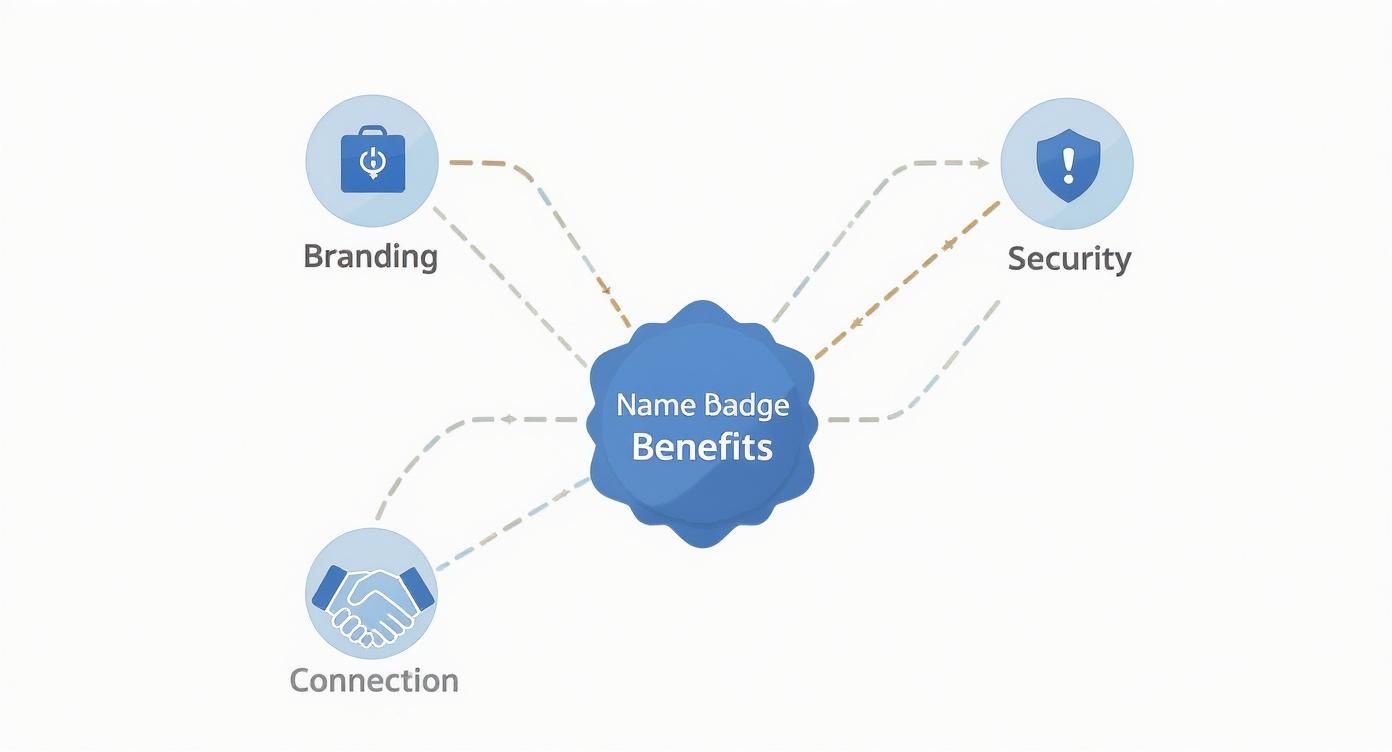
As you can see, name badges do a lot more than just identify people. They're a powerful tool for reinforcing your brand, enhancing security, and fostering a sense of connection.
Durable and Versatile Plastics
Plastic is an incredibly popular and versatile choice for name badges, and for good reason. It hits that sweet spot between affordability and customisation. For many organisations, from busy retail stores to massive conferences, it’s the go-to material because it can handle daily wear and tear while showing off vibrant, full-colour designs.
But don’t think "plastic" is a one-size-fits-all solution. There are a few different types, each with its own feel and function:
- Standard PVC: This is the workhorse of the badge world. It’s lightweight, flexible, and budget-friendly, making it ideal for temporary events or roles where staff turnover is high.
- Acrylic: If you’re after a more premium, glass-like look, acrylic is a great option. It’s rigid and can be laser-engraved for a sharp, professional finish that’s perfect for creative agencies or modern offices.
- Engravable Plastic: This type usually has two layers. When we engrave it, the top layer is removed to reveal a contrasting colour underneath, creating crisp, incredibly durable text and logos.
The biggest win with plastic is its sheer adaptability. You can achieve almost any look you can imagine, from a simple, one-colour design to a photorealistic image. This makes it a breeze to match your brand’s specific visual guidelines.
Elegant and Professional Metals
When you want to project sophistication, stability, and authority, nothing beats a metal name badge. The satisfying weight and cool touch of metal instantly communicate quality and permanence. They’re a long-term investment in your team’s professional image.
Metal badges are a natural fit for corporate offices, luxury hotels, and financial services—anywhere that building trust and credibility is paramount. The most common metals we work with are:
- Aluminium: Lightweight yet surprisingly strong, aluminium can be finished with a brushed, polished, or matte texture. It’s often printed in full colour or engraved for a classic look.
- Brass: With its timeless, golden appearance, brass conveys tradition and prestige. It’s typically engraved and then filled with colour for maximum contrast and readability.
- Stainless Steel: Known for being exceptionally durable and resistant to scratches, stainless steel is ideal for tough environments. Its modern, sleek look is a favourite among tech companies and high-end retail brands.
A metal badge isn’t just an identifier; it’s a piece of your brand’s identity that an employee wears with pride. It signals that both the employee and the brand are here to stay.
Protective and Stylish Finishes
The final touch that brings your name badge to life is the finish. This isn't just for show—it’s a protective layer that dramatically extends the badge's lifespan by shielding it from scratches, moisture, and UV fading.
A hugely popular choice is the domed resin finish. We apply a clear, scratch-resistant polyurethane coating that creates a glossy, 3D "domed" effect. This finish really makes colours pop and adds a tough, protective layer, giving the badge a premium, tactile quality.
Alternatively, a matte finish offers a subtle, non-reflective, and elegant look. It’s fantastic for reducing glare under bright lights, which can improve readability, and it’s great at hiding fingerprints.
To help you decide, here’s a quick comparison of the materials and finishes we've discussed.
Name Badge Material and Finish Comparison
This table breaks down the key advantages, ideal uses, and durability of our most common materials.
| Material/Finish | Key Advantages | Best For | Durability |
|---|---|---|---|
| Standard PVC | Lightweight, flexible, budget-friendly, full-colour printing | High-volume events, temporary staff, retail, roles with high turnover. | Moderate |
| Acrylic | Premium glass-like look, rigid, professional, sharp engraving | Creative agencies, modern offices, customer-facing roles where a polished look is key. | High |
| Aluminium | Lightweight yet strong, versatile finishes (brushed, polished) | Corporate environments, real estate, professional services, hospitality. | High |
| Stainless Steel | Extremely durable, scratch-resistant, modern and sleek | Demanding environments, high-end retail, tech companies, healthcare. | Very High |
| Domed Resin | High-gloss 3D effect, enhances colours, scratch-resistant | Any badge where you want a premium, eye-catching look and added protection. | Excellent |
| Matte Finish | Reduces glare, elegant and subtle, hides fingerprints | Badges used under bright lighting, professional settings where a non-reflective look is preferred. | Excellent |
Choosing the right finish is that final, crucial step in ensuring your name badges are as resilient as they are impressive.
Choosing the Right Fastener for Your Name Badges
You’ve spent time getting the design and material of your name tag badges just right, but have you thought about what’s on the back? The fastener might seem like a small detail, but it’s what makes the badge practical, comfortable, and even protects your team's uniforms.
Think of it this way: a poor fastener choice can lead to lost badges, damaged shirts, and daily frustration for your staff. Getting it right shows you've considered both the big picture and the small details that affect your team's day-to-day work.
Let's walk through the most common options so you can find the perfect match for your workplace.
The Staff Favourite: Magnetic Fasteners
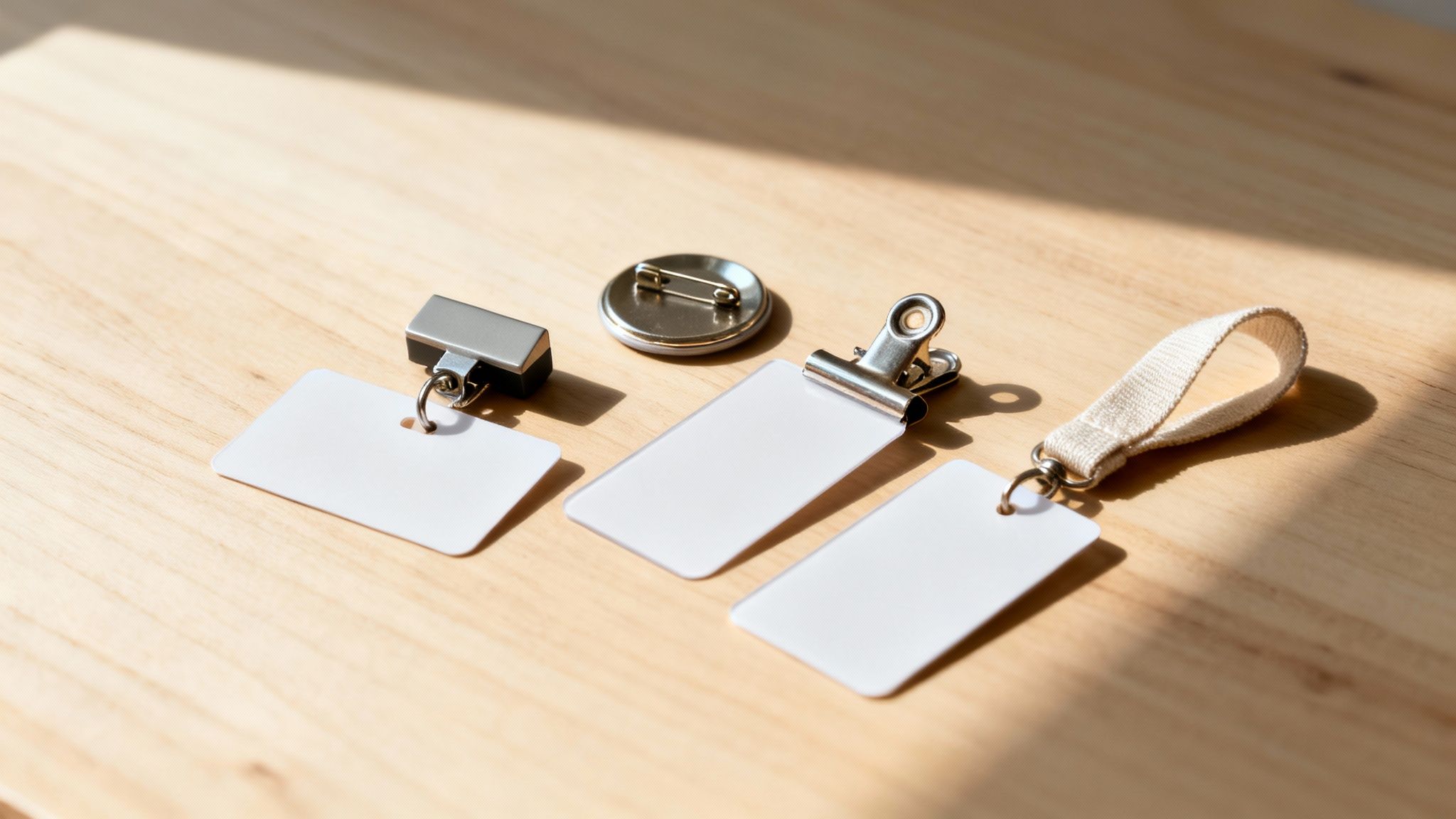
There’s a good reason why magnetic fasteners are so popular. They use a pair of powerful, flat magnets—one on the badge and a separate bar that slips inside your clothing. This creates a really secure grip without ever piercing the fabric.
This makes them the go-to choice for delicate materials like silk or expensive suit jackets where you absolutely want to avoid leaving holes. They’re also incredibly quick to put on and adjust, which is a lifesaver in any fast-paced environment. The strong hold keeps the badge sitting straight and looking professional all day long.
Just a quick heads-up: magnetic fasteners are not recommended for anyone with a pacemaker due to the risk of magnetic interference.
The Reliable Classic: Pin-Back Fasteners
You can’t go wrong with the classic pin-back fastener. It's that familiar safety pin-style clasp that pierces the fabric and locks tightly, offering a truly secure hold. This makes it an excellent choice for heavier garments like blazers, thick coats, or tough work aprons where a magnet might not be strong enough.
Pin-backs are also the most cost-effective option, a major plus when you're outfitting a large team or organising a one-off event. While they do leave a small hole, their dependability and affordability make them a solid, practical choice for many businesses.
The fastener you choose is a direct reflection of your consideration for your team's daily comfort and the investment you've made in their uniforms. A small detail like this can make a big difference in employee satisfaction.
Versatile Clips and Lanyards
Beyond the two main players, a couple of other options offer flexibility for different situations.
- Swivel Clips: Think of a small bulldog clip. These can be quickly fastened onto a lapel, pocket, or collar. They are easy to use and don’t damage clothing, making them a great alternative for those who can't use magnets.
- Lanyards: Perfect for conferences, trade shows, and big events, lanyards ensure ID is always visible and close at hand. Hanging the badge around the neck also keeps it from getting lost or snagging on clothing. Plus, a custom-branded lanyard doubles as a great marketing tool.
Ultimately, the best fastener comes down to your team’s daily routine, what they wear, and your budget. By carefully considering these points, you can make sure your name badges are not just well-designed, but also secure, comfortable, and fit for purpose.
Effective Badge Design and Layout Principles
A great name badge does more than just identify someone; it’s a tiny, wearable billboard for you and your brand. Its main job is to communicate key information clearly from a normal conversational distance—think one to two metres away. If people have to squint or lean in to read a name, the design isn't working.
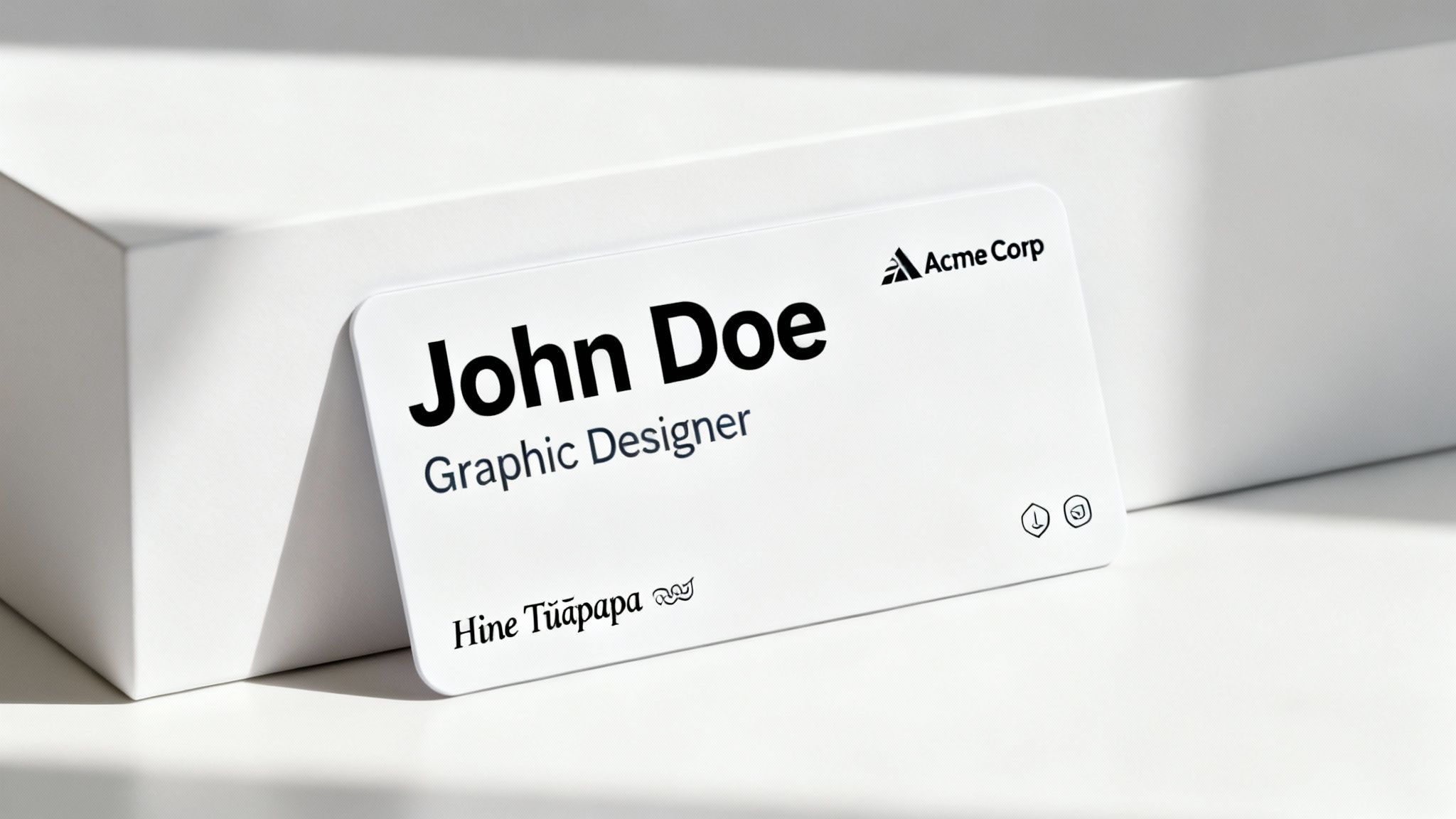
The secret to a successful name tag badge is all about visual hierarchy. It sounds technical, but it’s simple: make the most important thing (the person's first name) the most obvious thing. It’s just like a newspaper headline—it's the first thing you see, and it pulls you in to read the smaller details.
Creating a Clear Visual Hierarchy
To nail the hierarchy, you need to guide the reader’s eye. The goal is instant recognition, not a visual puzzle. The best layouts almost always follow a simple, logical flow.
- First Name: This has to be the biggest, boldest text on the badge. It's what people are looking for first in any conversation.
- Full Name (Optional): The surname can sit on the same line or just below the first name, maybe in a slightly smaller or less bold font.
- Job Title/Role: Pop this right under the name. It should be smaller than the name but still very easy to read to give that all-important context.
- Company Name/Logo: This is a key branding element, but it shouldn't shout louder than the person's name. Tucking it away at the top or bottom of the badge is usually the best bet.
This structure works because it ensures the name is readable from a distance, and as you get closer, the other details become clear.
Choosing Fonts for Readability
The font you pick can make or break your badge. It’s tempting to use a fancy script or a highly stylised font that matches your brand, but these are often a nightmare to read at a glance, especially from a few steps away.
For maximum clarity, stick with clean, simple sans-serif fonts. Think Helvetica, Arial, or Open Sans. These fonts don't have the little decorative strokes (serifs) you see on fonts like Times New Roman, which makes them far easier to read in small sizes and from a distance.
A well-designed badge puts function over flair. The most beautiful design is useless if it can't be read. Simplicity and clarity are your most powerful design tools.
When it comes to font sizes, think in layers. A good starting point is:
- First Name: 18-24pt font
- Title/Company: 12-14pt font
- Other Details: 10-12pt font
This simple trick ensures the most critical information jumps out immediately.
Using Colour and Contrast Effectively
Colour is a fantastic tool for branding and organisation, but it needs to be used wisely. The golden rule for name tags is high contrast between the text and the background. Dark text on a light background (like black on white or dark blue on a pale grey) is a classic for a reason—it just works.
Stay away from low-contrast combinations like yellow text on a white background or dark grey on black. They become almost impossible to read in different lighting conditions. You can absolutely use brand colours as accents or to colour-code different teams or access levels, but legibility must always come first.
Incorporating Logos Without Creating Clutter
Your logo is a vital piece of your brand identity, but on a small name badge, it can quickly make things look messy. The trick is to place it where it supports the design without competing with the name.
Positioning the logo in a corner—top-left or top-right—is a classic approach that always looks good. You could also place it at the very top or bottom to frame the content nicely. Just make sure the logo is big enough to be recognisable, but not so big that you have to shrink the all-important text.
Formatting Names Respectfully in New Zealand
For Kiwi businesses, getting names right is more than just good design; it’s a matter of cultural respect and inclusivity. This is especially true when it comes to displaying Māori names, names with macrons, or multiple given names.
The New Zealand government has set a clear standard for this in the public sector with the ‘Person name mandated standard’. While it’s not required for private businesses, following this best practice for your name tags shows you’re committed to being inclusive. You can learn more about the official guidelines for displaying person names on data.govt.nz. It’s a small detail that ensures every employee feels their identity is seen and respected.
Getting Your Name Badges Right for Your Industry
A name badge that’s perfect for a busy Auckland hospital won’t quite hit the mark in a Queenstown luxury hotel. The secret to a great name tag badge is context. When you tailor the material, design, and information to your specific field, the badge becomes more than just an ID—it actively helps your staff do their jobs better and elevates the customer experience.
There's no such thing as one-size-fits-all. A sleek, minimalist metal badge, for example, conveys authority and stability in a corporate law firm. On the other hand, a vibrant, easy-to-read plastic badge is exactly what you need for the high-energy buzz of a retail store. By aligning your badges with what your industry demands, you turn a simple identifier into a smart business tool.
Healthcare: Clarity and Patient Trust
In healthcare, whether it’s a local clinic or a major hospital, name badges are fundamental for building trust and ensuring clear communication. Patients need to know, at a glance, who is looking after them. A well-designed badge makes that connection instantly. The trick is to balance that clarity with staff privacy, a principle often championed by professional bodies like the New Zealand Nurses Organisation (NZNO).
For healthcare professionals, readability is non-negotiable. That means:
- Large, Clear Text: Use a clean, sans-serif font for the first name and role (like "Registered Nurse" or "Physiotherapist").
- High-Contrast Colours: Think dark text on a light background. It needs to be legible under the varied lighting conditions of a ward or consultation room.
- Durable Materials: Choose materials like stainless steel or high-grade engravable plastic that can handle daily cleaning and sanitisation.
A healthcare badge needs to communicate competence and approachability in a single glance. By clearly stating a professional's name and role, it removes uncertainty for patients and their whānau, creating a foundation of trust during what can be a stressful time.
A magnetic fastener is usually the best bet in this setting. It won't damage scrubs or uniforms and, with no sharp points, it's a safer option all around.
Retail and Hospitality: Creating Connections
In customer-facing worlds like retail and hospitality, being approachable is everything. A name badge acts as an open invitation for customers to connect with your team, turning an otherwise anonymous interaction into a personal and positive one. It’s a small detail with a surprisingly big impact on how people feel about your brand.
In fact, studies across New Zealand, Australia, and the UK have shown that businesses with staff wearing visible name tags can see customer satisfaction levels climb by up to 12%. When a customer can use a staff member’s name, they feel more comfortable and valued. You can explore the findings on personalised name tags at work to see just how powerful this connection is.
To get the most out of this effect, retail and hospitality badges should be:
- Brand-Aligned: Weave in your logo and brand colours to create a cohesive look that reinforces your business identity.
- Friendly and Readable: The first name should be the star of the show, encouraging people to connect on a first-name basis.
- Durable and Lightweight: Materials like acrylic or PVC, especially with a protective domed resin finish, are perfect for withstanding the daily hustle.
Corporate and Professional Services: Projecting Authority
In corporate environments—think law firms, financial institutions, and real estate agencies—name badges are all about reinforcing professionalism and credibility. The badge itself becomes an extension of the company brand, signalling stability, expertise, and a high standard of service.
Here, the choice of material really matters. You want options that are elegant and understated:
- Brushed or Polished Metal: Materials like aluminium or stainless steel have a sophisticated, permanent feel.
- Minimalist Design: Keep the layout clean and uncluttered. Typically, you'll just need the full name, job title, and company logo.
- Engraved Finish: Laser engraving gives a sharp, permanent, and highly professional look that speaks volumes about quality.
For these sectors, a strong magnetic fastener is almost always the right call, as it keeps professional attire like suits and blazers in pristine condition.
Conferences and Events: Maximising Networking
At conferences, trade shows, and big events, a name badge has one primary job: to get people talking. Badges need to be big, clear, and instantly readable from a conversational distance to help attendees break the ice and forge valuable connections.
The best event badges all share a few key features:
- Large Format: A bigger badge allows for a much larger font for the first name, making it visible from several metres away.
- Clear Hierarchy: The first name should dominate the design. The company name comes next, in a smaller font, and the job title is often secondary.
- Colour Coding: Use different coloured backgrounds or borders to easily spot different attendee types, like speakers, exhibitors, staff, and VIPs.
- Lanyard Compatibility: Most event badges are worn on lanyards to keep them visible and hands-free. Make sure the design works well in a vertical or horizontal holder.
Thinking through how name badges function in your specific industry ensures they aren't just a requirement, but a powerful asset that improves communication, strengthens your brand, and makes the experience better for everyone.
Badge Recommendations by Industry
To make it even simpler, here’s a quick-glance table summarising our recommendations for different professional sectors across New Zealand. Think of it as a starting point for designing the perfect badge for your team.
| Industry | Recommended Material | Recommended Fastener | Key Information to Display |
|---|---|---|---|
| Healthcare | Engravable Plastic, Stainless Steel | Magnetic | First Name (large), Role/Title, Department |
| Hospitality & Tourism | Domed Resin, Acrylic, Bamboo | Magnetic or Pin | First Name (large), Logo, "Kia Ora" or other greeting |
| Retail | Domed Resin, PVC, Engravable Plastic | Magnetic | First Name (large), Logo, Role (e.g., "Team Leader") |
| Corporate/Financial | Brushed/Polished Metal (Aluminium) | Magnetic | Full Name, Job Title, Company Logo |
| Real Estate | Metal, Premium Acrylic | Magnetic | Full Name, "Licensed Agent," Company Logo |
| Events & Conferences | Reusable PVC or Card Stock (in holder) | Lanyard | First Name (very large), Company Name, Attendee Type (colour-coded) |
Each element—from the material that projects durability to the fastener that protects a suit jacket—plays a role in how your staff are perceived. Getting these details right helps you make the best possible impression, every single time.
Your Step-by-Step Guide to Ordering Custom Badges
https://www.youtube.com/embed/atNGGGyrsXk
Ready to bring your perfect name tag badges to life? Ordering from Soni Design is a simple, clear process we’ve dialled in over the years. We want you to feel confident every step of the way, knowing exactly what’s happening from the moment you get in touch.
The whole thing kicks off with your vision. Once you have a good idea of the material, finish, and fastener you’re after, it's time to hand over the creative bits and pieces to us. That just means sending through your company logo and the list of names and titles for the badges.
Submitting Your Artwork and Names
For the best possible result, we need your logo in a vector format. Think files ending in .AI, .EPS, or .PDF. This type of file allows us to scale your logo without it getting blurry or pixelated, keeping it looking sharp on the final product.
As for the names and titles, a simple spreadsheet is the way to go. Just lay out each name and its corresponding title clearly. This little bit of prep work is a lifesaver for catching any potential spelling errors before we even start.
Once we have your files, our design team jumps into action and creates a digital proof. This is basically a digital mock-up that shows you precisely how your finished badges will look—layout, colours, fonts, everything.
The digital proof is the single most important checkpoint in the entire ordering process. It’s your opportunity to review every detail and give the final green light before we begin production. Take your time and check it carefully.
Reviewing Your Proof and Final Approval
When that proof lands in your inbox, give it a thorough once-over. Check that every name is spelled correctly, all titles are right, and your logo and brand colours look exactly as they should.
If you spot anything that needs a tweak, now is the time to let us know! We’ll make the changes and send you a revised proof to make sure it’s perfect.
Once you give us the final thumbs-up, we head into production. Our standard turnaround is usually 7-10 working days, but this can shift a bit depending on how complex or large your order is. Don't worry, we’ll give you a clear timeline from the get-go. After your beautiful new name tag badges are finished, we’ll pack them up securely and ship them right to your door, anywhere in New Zealand.
While you're thinking about custom identification, it's worth exploring options beyond just wearable badges. For more permanent fixtures like office doors, you might want to look into a detailed guide to customized name plaques.
A Few Common Questions About Name Tags
Getting the details right for your name tags can sometimes bring up a few questions. We get it. To help you out, we’ve put together answers to some of the things people ask us most often, so you can feel confident you’re making the right call for your team.
Think of this as a quick chat to clear up the final details before you order.
What’s the Go-To Size for a Name Badge?
While there's no single rule, the size we see most people in New Zealand go for is 76mm x 25mm. It’s become the unofficial standard for a good reason.
This classic rectangular shape gives you plenty of room for a name and title that’s easy to read from a normal speaking distance. It’s big enough to be clear, but not so big that it looks clunky on a shirt or blazer. Of course, for big events or conferences, you might want to go a bit larger to make sure names are visible in a bustling room.
How Do I Keep My Name Badges Looking Sharp?
A little bit of care goes a long way in keeping your name tags looking professional day in and day out. How you clean them really just depends on the material.
- For Plastic & Domed Resin tags: A quick wipe with a soft, damp microfibre cloth is perfect for getting rid of smudges and dust. Steer clear of any harsh chemicals, as they can damage the finish.
- For Metal Badges: A gentle polish with a dry, soft cloth will usually do the trick. If you’ve got a stubborn mark on an aluminium or stainless steel badge, a tiny bit of isopropyl alcohol on a cloth will lift it right off.
Our Top Tip: Get your team into the habit of storing their badges somewhere safe at the end of the day—a desk drawer or a locker is ideal. It’s a simple step that does wonders to prevent scratches and damage, keeping them looking brand new for much longer.
Do You Have a Minimum Order?
Nope! We believe every business, no matter its size, deserves to look professional. That’s why we have no minimum order quantity. So whether you just need one badge for a new hire or a full set for your entire company, we’re happy to help.
How Do I Order More Badges for New Staff?
We make re-ordering a breeze. The last thing you want is inconsistent-looking tags for new team members.
Just pop us an email with the names and titles for your new people. We keep your design safely on file, so we can get to work straight away on creating new badges that are a perfect match for the rest of your team’s.
Ready to get your team looking unified and professional? Soni Design makes it simple to create and order high-quality, custom name tag badges that truly reflect your brand. Start your order with us today!
Leave a Comment
Stay home & get your daily
needs from our shop
Start You'r Daily Shopping with Nest Mart