
Your cart is currently empty.

A card holder lanyard is one of those brilliantly simple things: a strap worn around the neck with a holder attached for an ID, access, or payment card. Its whole purpose is to keep your essential cards visible, secure, and right where you need them, which is why you see them everywhere from corporate offices to major events.
Why a Simple Lanyard Is a Business Powerhouse
It’s easy to write off the humble card holder lanyard as just another bit of office stationery. But that’s missing the bigger picture. This simple tool is actually a multitasking powerhouse for any modern business, playing a key role in security, branding, and the smooth flow of a busy workday.
Think of it as the final piece of a professional uniform. When every person on your team is wearing a branded lanyard, it creates an immediate sense of unity and trust. That visual consistency matters, whether your staff are meeting clients, representing you at a trade show, or just moving around a secure building.
The Dual Role: Security and Branding
At its core, a card holder lanyard does two critical jobs that directly boost your business's safety and profile.
- Bolstering Security: Visible ID is your first line of defence in keeping a space secure. Lanyards make sure ID badges are always on display, so security staff and colleagues can see who is meant to be there at a single glance. It's a simple visual check that helps prevent unauthorised access and makes the entire workplace safer.
- Amplifying Your Brand: Every single lanyard is a mini-billboard. It carries your logo and your colours everywhere your people go. At a packed conference, it makes your team stand out. In a retail store, it helps customers instantly spot a staff member. It’s a constant, mobile reminder of your brand.
Essential in a Tap-and-Go World
Even with digital everything, physical cards are still central to how we get things done. This is especially true here in New Zealand, where we value both convenience and security. Recent studies show that 67% of New Zealanders still prefer using a physical card for their daily purchases, and a massive 88% use contactless payments like tap-and-go.
This heavy reliance on physical cards makes a secure, easy-to-reach card holder indispensable for everything from grabbing a coffee to tapping into the office. You can dig deeper into Kiwi payment habits in the full Payments NZ consumer report.
A well-chosen card holder lanyard does so much more than just hold a card. It streamlines workflows, tightens up security, and turns every employee into a walking brand ambassador—proving its value is far greater than its cost.
Anatomy of a High-Performing Card Holder Lanyard
Choosing the right card holder lanyard isn’t just about picking a colour you like. It’s about understanding how each component works together to serve a specific purpose—whether that’s beefing up security, promoting your brand, or just surviving a busy worksite. A truly high-performing lanyard is a tool, where the material, attachment, and holder are all carefully selected to meet the demands of its environment.
When you break it down, a lanyard’s real effectiveness comes down to three core parts: the strap material, the attachment clip, and the card holder itself. Every choice you make here influences durability, how comfortable it is for the user, and how professionally your brand comes across. Getting these details right is what separates a lanyard that just gets the job done from one that genuinely enhances your operations.
This diagram shows how a card holder lanyard actually has two primary jobs to do for any organisation, and both are equally important.
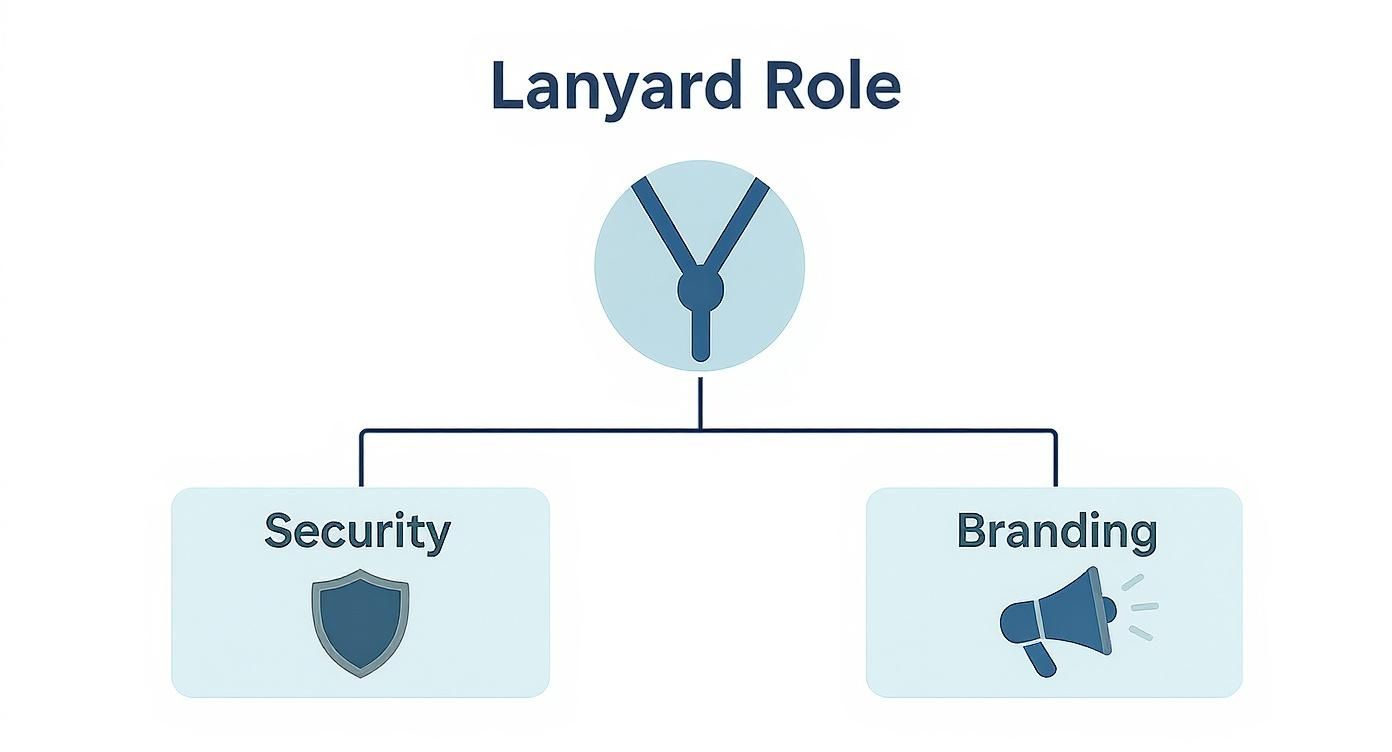
It’s clear that lanyards aren't just practical accessories. They're strategic assets that support both your security protocols and your branding efforts.
Selecting the Right Lanyard Material
The fabric of the lanyard strap is its foundation. It sets the look, the feel, and even the quality of the printing, so it’s a massive decision when you’re trying to align the lanyard with your brand’s image and daily use. Think of it like choosing fabric for a uniform—it needs to be comfortable, durable, and a good reflection of your company.
The market is dominated by three main materials, each with its own set of strengths:
- Polyester: This is the workhorse of the lanyard world. It's incredibly durable, easy on the budget, and takes print really well. That makes it the perfect go-to for large-scale orders for conferences or for daily office use where you need something that will last.
- Nylon: If you're after a more premium feel, nylon is the answer. It has a silky, smooth finish with a noticeable sheen, which makes logos and text look sharper and more vibrant. It's an excellent choice for client-facing teams or executive events where a polished look is everything.
- Eco-Friendly Options: Materials like bamboo fibre or recycled PET (made from plastic bottles) are gaining a lot of ground. They offer a sustainable alternative without giving up on strength, and they have a soft, comfortable feel that’s great for all-day wear.
Demystifying Attachments and Safety Features
That little metal or plastic clip at the end of the lanyard? It’s far more important than it looks. The right attachment keeps a card secure and easy to use, while the wrong one can be a source of constant frustration or even a safety risk.
Here are the most common styles you'll come across:
- Swivel Hook (J-Hook): A classic choice that lets the card holder spin freely, stopping it from getting tangled or facing the wrong way. It’s a versatile option that works with most types of holders.
- Bulldog Clip (Alligator Clip): This one grips onto a slot-punched card or holder with a firm, spring-loaded clamp. It's super quick to attach and detach, which is handy for roles where people need to remove their cards frequently.
But beyond the clip, the most critical feature to look for is the safety breakaway clasp. This is a small plastic buckle, usually sitting at the back of the neck, designed to snap apart when it's pulled with force.
For any environment where machinery, physical work, or healthcare is involved, a safety breakaway is non-negotiable. It’s a simple feature that prevents the lanyard from becoming a choking hazard if it gets caught, making it an essential part of your workplace health and safety compliance.
Choosing the Card Holder Style
Finally, the holder itself. It protects the card and decides how it’s displayed. Your choice between different materials and orientations should be guided by what the card is used for and the environment it’ll be in.
- Rigid vs. Flexible Holders: Rigid plastic holders offer the best protection against bending and cracking, so they’re ideal for expensive proximity cards or high-security IDs. Flexible vinyl holders are more lightweight and budget-friendly, making them a good fit for temporary event passes or standard staff identification.
- Vertical vs. Horizontal Orientation: This is a purely practical decision that should match the layout of your ID card. A vertical holder is best for portrait-style cards, while a horizontal one is made for landscape layouts. The goal is just to make sure all the information is visible and oriented correctly.
The table below breaks down the most common material and attachment options to help you pinpoint the best combination for your specific needs.
Lanyard Material and Feature Comparison
| Feature Type | Option | Best For | Considerations |
|---|---|---|---|
| Material | Polyester | Large events, daily office use, budget-conscious orders. | Standard feel, print quality is good but less sharp than nylon. |
| Nylon | Executive events, client-facing staff, premium branding. | Higher cost, has a noticeable sheen which may not suit all brands. | |
| Eco-Friendly (Bamboo/PET) | Brands focused on sustainability, all-day comfort. | Can be more expensive, material colour options may be limited. | |
| Attachment | Swivel Hook (J-Hook) | General use where cards need to stay front-facing. | Can be bulkier than other clips. |
| Bulldog Clip (Alligator Clip) | Roles requiring frequent card removal (e.g., swiping). | Can wear out the slot on a card over time. | |
| Safety Feature | Breakaway Clasp | Healthcare, schools, manufacturing, any active environment. | A must-have for safety compliance; slightly increases unit cost. |
By thoughtfully considering each of these components—material, attachment, and holder—you can design a card holder lanyard that is perfectly suited to what your business needs, creating the ideal balance between function, safety, and brand aesthetics.
Matching Your Lanyard to Your Industry
Picking the right card holder lanyard isn’t a one-size-fits-all deal. What works perfectly for a bustling construction site would look completely out of place in a corporate head office. The secret is to match the lanyard’s features to the real-world demands of your industry, making it a genuine tool for safety, function, and brand image.
Think of it like choosing the right tyres for a car. You wouldn't put slick racing tyres on a farm ute, and you wouldn't use chunky off-road tyres for a city commute. Every environment has its own set of rules and requirements, and your lanyard choice should follow that same practical logic.
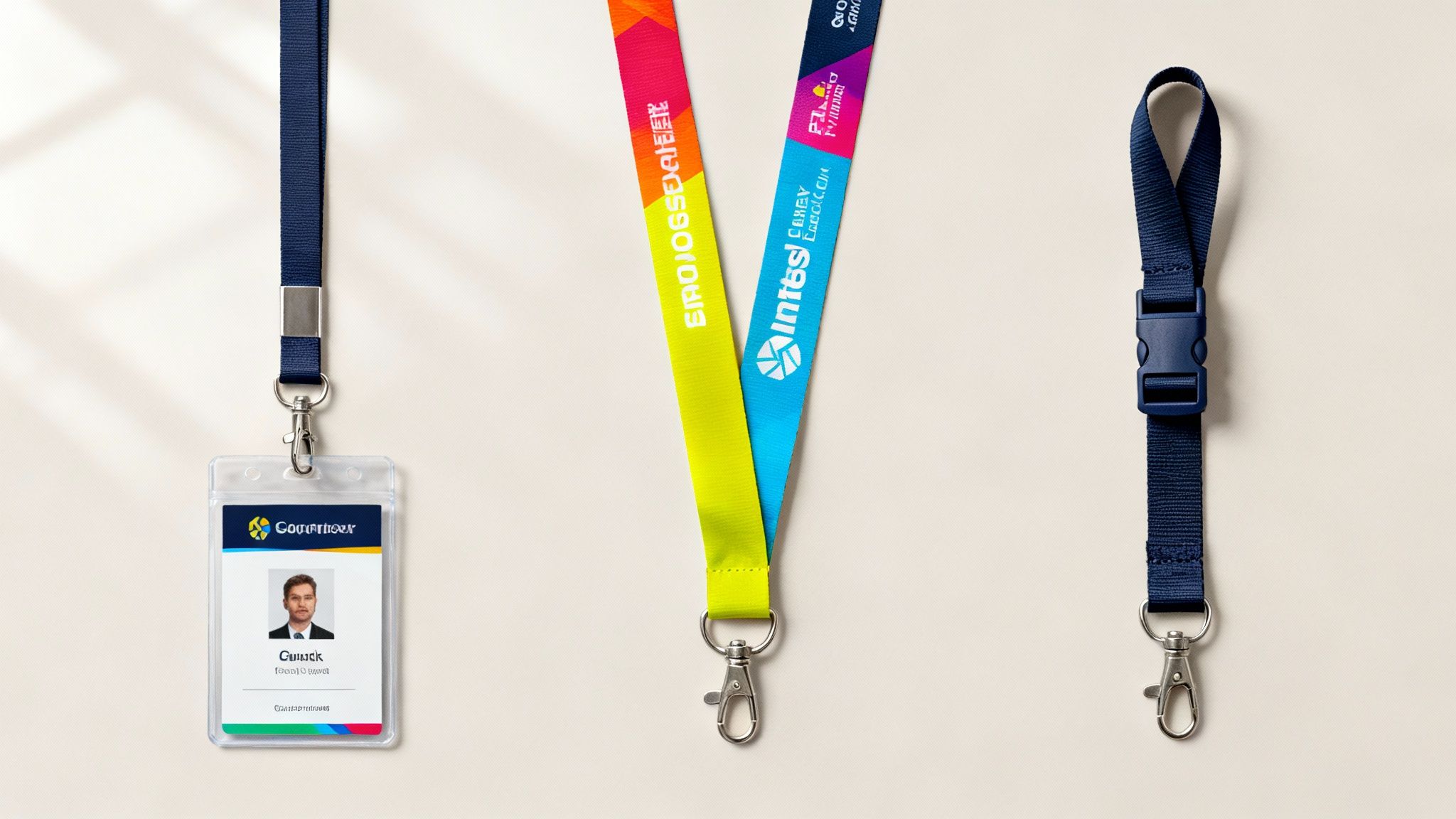
When you get this right, you end up with more than just a strap to hold a card—you get an asset that’s perfectly tuned to your day-to-day operations.
Corporate and Office Environments
In the corporate world, it’s all about professional polish and seamless function. You need something that looks sharp, feels comfortable for all-day wear, and keeps your team looking cohesive and secure.
A smooth polyester or sleek nylon lanyard is usually the go-to choice here. They’re durable enough for the daily grind but still look smart. Pair one with a clear, rigid plastic holder to shield the ID or access card from scuffs and scratches, keeping everything looking tidy.
In any office, the single most important feature is the safety breakaway clasp. It might seem like a low-risk setting, but it’s a non-negotiable health and safety feature. It prevents accidents if a lanyard ever gets snagged on a desk drawer, an office plant, or a closing door.
High-Energy Events and Conferences
For events, conferences, and festivals, a lanyard has a much bigger job to do. It’s no longer just an ID holder; it’s a high-visibility branding tool, a networking starter, and an organisational workhorse. It has to stand out, be informative, and instantly differentiate between attendees, staff, and speakers.
This is where wider lanyards, around 20-25mm, really shine. They give you a much bigger canvas for printing, turning them into prime real estate for sponsor logos and event branding. Bright, bold colours aren't just for show—they're a practical way to create visual separation at a glance.
- Colour-Coding: This is a classic event trick for a reason. Assign different colours to different groups (e.g., blue for attendees, red for staff, yellow for VIPs) for instant, effortless identification.
- Practical Holders: Opt for flexible vinyl holders with a wide top slot. This lets you slip in an event schedule or a small map behind the main credential.
- Maximum Visibility: A dye-sublimation print allows for vibrant, edge-to-edge designs, giving your sponsors fantastic exposure and making the lanyard a cool keepsake people might actually want to hold onto.
Healthcare and Education Sectors
In places like hospitals, clinics, schools, and universities, safety and hygiene are everything. People are constantly on the move, interacting with equipment and each other, so lanyards need to be both incredibly safe and easy to keep clean.
The one feature you can’t compromise on is the safety breakaway clasp. It's a critical requirement in healthcare to prevent injury around medical equipment, and it's just as vital in schools where lanyards can easily get caught during play.
Look for materials that are non-porous and simple to wipe down, like polyester. The holders should also be made from a rigid, easy-to-sanitise plastic. Many healthcare facilities also add a retractable badge reel to the lanyard, which is a great touch. It allows staff to scan their cards without having to remove the lanyard or lean over patients and sensitive areas.
Construction and Industrial Sites
On a construction site, factory floor, or in any industrial setting, it all comes down to two things: durability and safety. Lanyards here are exposed to tough conditions and, most importantly, must never become a hazard for people working with or around machinery.
A rugged, heavy-duty polyester is the only way to go. It stands up to dirt, grease, and general wear and tear. High-visibility colours like neon orange or yellow are also a smart choice to help make workers more visible on a busy site.
Once again, the safety breakaway feature is absolutely essential. It’s designed to snap apart under force if it gets entangled in machinery, which can prevent a serious injury. For these industries, it's best to pair the lanyard with a tough, fully enclosed rigid holder to protect valuable access cards from dust, moisture, and impact.
Turning Lanyards into Branding Assets
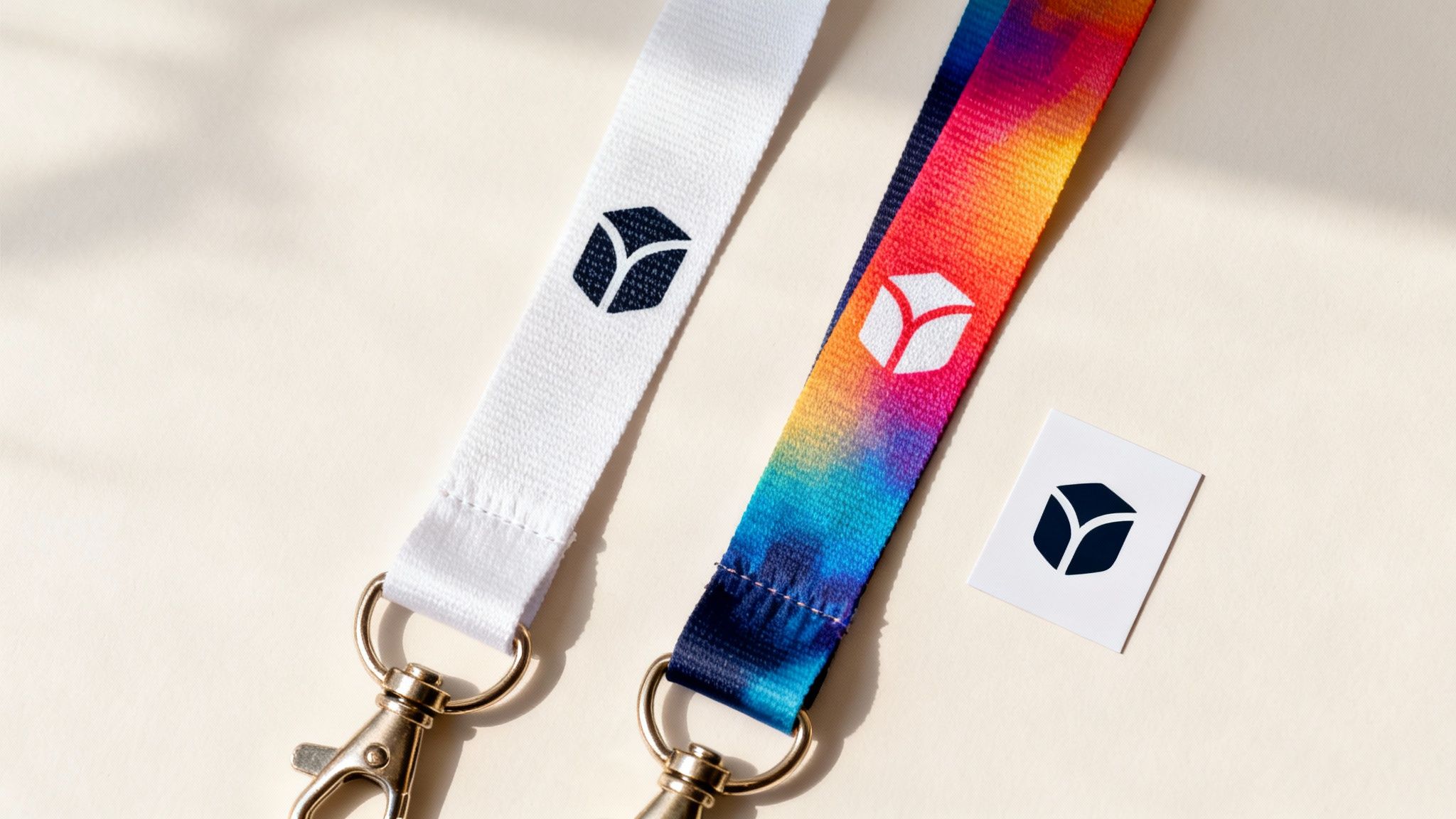
A card holder lanyard might seem like just a practical item, but its true potential is realised when you view it as a piece of mobile marketing. It’s more than a strap for an ID; it's a walking billboard that carries your brand's identity wherever your team goes. By moving beyond a simple logo slap, you can transform it into a powerful tool that reinforces your company’s image and professionalism.
The trick is to treat the lanyard as an integral part of your brand's visual language. You wouldn't randomly pick colours for your website or a font for your business cards, right? The same level of care should go into designing your lanyards. It’s a brilliant opportunity to make a statement and ensure your brand gets seen, remembered, and respected.
Choosing Your Printing Technique
How your design is printed directly affects the final look, feel, and lifespan of your lanyards. The two most common methods have their own strengths, and the right choice really boils down to your artwork's complexity and the impression you want to create.
-
Screen Printing: This is the classic, time-tested method. It works like a stencil, pushing ink through a mesh screen onto the fabric one colour at a time. It's the perfect choice for simple, bold designs with just one or two solid colours, like a crisp company logo or clear, punchy text. Screen printing delivers a durable, slightly raised finish that looks sharp and is very cost-effective, particularly for bulk orders.
-
Dye-Sublimation: This is where creative branding really gets to play. With dye-sub, your design is printed on special paper and then heat-pressed onto the lanyard. The heat vaporises the ink, permanently infusing it into the fabric's fibres. The result? A stunning, full-colour, edge-to-edge design with photographic detail. If your branding involves gradients, intricate patterns, or a whole palette of colours, dye-sublimation is the only way to get that flawless, premium look.
Creating Artwork That Shines
To get a fantastic result, you have to start with high-quality artwork. Handing over a blurry, low-resolution file is like giving a builder a smudged blueprint—the final product is bound to be disappointing. Steering clear of common design mistakes is the key to a professional outcome.
First up, always use vector files for your logo and graphics. Vector formats like .AI, .EPS, or .PDF are built with mathematical paths, not pixels. This means they can be scaled to any size—from a tiny icon to a massive billboard (or a lanyard)—without ever losing sharpness or looking jagged. A standard .JPG or .PNG, on the other hand, will almost certainly look fuzzy when printed on fabric.
Next, be a stickler for your brand colours. Don't just ask for "blue"; specify the exact shade with a Pantone Matching System (PMS) code. This universal colour guide ensures the blue on your lanyards is the exact same blue on your website and brochures, locking in that all-important brand consistency.
Taking a moment to organise your artwork and colour codes into a clear brief eliminates all the guesswork for your printer. This one simple step is the best way to ensure the finished lanyard perfectly matches what you envisioned, saving you from costly and frustrating reprints.
A Sample Brief for a Perfect Result
Getting your requirements across clearly is half the battle. A simple, well-structured design brief gives your supplier everything they need right from the get-go. And if you're thinking about the bigger picture, these essential small business branding tips can help you keep your message consistent everywhere.
Here’s a template you can use as a starting point for briefing your supplier:
- Project Title: Custom Lanyards for [Your Company Name]
- Quantity: 500 units
- Lanyard Material: Flat Polyester
- Lanyard Colour: White base
- Lanyard Width: 20mm
- Printing Method: Dye-sublimation (full colour)
- Artwork Files: Logo attached as [FileName.ai] (vector format).
-
Colour Specifications:
- Logo Blue: PMS 286 C
- Logo Grey: PMS Cool Gray 9 C
- Attachments: Metal swivel hook and safety breakaway clasp.
- Required Delivery Date: [Date]
- Special Instructions: Please provide a digital proof for approval before production begins.
This level of detail gets everyone on the same page, paving the way for a smooth process and a card holder lanyard that proudly represents your brand.
Navigating the Lanyard Ordering Process
https://www.youtube.com/embed/p62xsvel6W8
Ordering custom card holder lanyards for the first time might seem a little daunting, but it’s actually a straightforward journey. Getting a handle on the key steps, from getting a quote to the final delivery, is the best way to manage your timeline, stick to a budget, and get a product that looks exactly how you imagined. It all comes down to clear communication and a bit of forward planning.
The demand for lanyards is huge, and it’s not just a local trend. The global market was sitting at around $2.9 billion in 2021 and is on track to hit over $3.5 billion by 2025. Here in New Zealand, that growth is easy to see in corporate offices, hospitals, schools, and at pretty much every event you attend. They’ve become essential for identification and security.
Understanding Timelines and Minimums
Before you dive in, there are two practical things you need to get your head around: how long it will take and how many you need to order.
- Production Lead Times: This is the clock-watching bit – the time from when you give the final "okay" on the design to when the box of lanyards lands on your doorstep. For most custom jobs in New Zealand, you’re looking at a 7 to 14 business day turnaround. If you’re after something more complex or it’s being made overseas, that can stretch to 3-5 weeks, so always plan ahead.
- Minimum Order Quantities (MOQs): You’ll find that most suppliers have a minimum number of lanyards you can order, usually starting at 50 or 100 units. This isn't just an arbitrary number; the setup costs for custom printing are the same whether you’re making 10 lanyards or 100, so tiny batches just aren't cost-effective for anyone.
The Power of Bulk Pricing
Here’s a tip that can make a real difference to your budget: buy in bulk. It’s a simple concept that pays off. The more lanyards you order in one go, the cheaper each one becomes. This is because those initial setup fees get spread out over a much larger number of items.
To put it in perspective, ordering 500 lanyards could easily drop the price per lanyard by 30-40% compared to an order of just 100. If you know you’ll use lanyards throughout the year for different events or new staff, placing one larger order is a seriously smart move.
Your Most Important Quality Check
If you take away just one piece of advice, let it be this: always, always ask for a pre-production proof. This is your digital mock-up (and sometimes a physical sample) that shows exactly how your logo, colours, and text will look on the finished product.
A pre-production proof is your ultimate safety net. It's your final chance to catch any errors, approve colour accuracy, and confirm every detail before the full production run begins. Never skip this step—it’s the best quality assurance tool you have.
As you get into the finer details of customisation, reviewing some key considerations before ordering custom screen printing can offer some really helpful pointers. By getting these logistical steps right from the start, you’ll have a smooth, stress-free experience and get a final product that perfectly represents your brand.
Keeping Your Lanyards Safe, Secure, and Compliant
So, your new custom lanyards have arrived. Great! But the job's not done yet. To get the most out of your investment and keep them looking sharp, you need a plan for ongoing care and a few clear rules. This isn't just about appearances; it’s about upholding safety standards and protecting your organisation's security.
Thinking about the entire lifecycle of a lanyard—from its first day to its last—protects your people, your data, and your business. With a few simple habits, you can turn a potential risk into a secure and managed part of your daily routine.
Maintaining a Professional Look
Let's be honest, a grubby or frayed lanyard doesn't exactly scream professionalism. Thankfully, keeping them in top condition is easy and ensures your team always puts its best foot forward.
- Polyester and Nylon: These are the workhorses of the lanyard world. A quick hand wash in cool water with a bit of mild soap is all it takes to get rid of everyday grime. Just be sure to let them air dry completely to keep their shape.
- Eco-Friendly Fabrics: Materials like bamboo need a slightly gentler touch. Stick to a hand wash with a mild detergent and go easy on the scrubbing to protect the natural fibres.
Got a stubborn stain? You can try spot-treating it, but always test the cleaner on a small, hidden part of the lanyard first. Regular cleaning is a win-win: it keeps your brand looking good and promotes better hygiene.
Upholding Workplace Safety
A lanyard is more than just a brand carrier; it has to align with your health and safety obligations. This is non-negotiable in places with machinery, active kids, or in patient care settings, where a lanyard could easily become a snagging hazard.
A safety breakaway clasp isn't just a nice-to-have feature; it's an essential requirement for many New Zealand workplaces. It’s designed to snap open under pressure, which can prevent a serious injury if the lanyard gets caught on something. Checking that your lanyards have this feature is a critical part of meeting your duty of care as an employer.
Managing Security and Staff Offboarding
Your card holder lanyard is essentially a key to your building, and managing it properly is a core part of your security protocol. When someone leaves the company, having a clear, consistent process for getting their ID card and lanyard back is crucial to prevent security breaches.
A solid offboarding policy should always include these steps:
- Mandatory Return: Make it crystal clear that all company property, including the ID card and branded lanyard, must be handed in on the employee’s last day.
- Immediate Deactivation: As soon as the card is returned, make sure it’s instantly deactivated in your access control system.
- Secure Disposal: If a card or lanyard is damaged or old, don’t just toss it in the bin. Dispose of it securely by cutting up the ID card and recycling the lanyard components where possible.
This simple, structured process helps close security loopholes and protects your business from any unauthorised entry.
Got Questions About Card Holder Lanyards? We've Got Answers.
Even when you think you have it all sorted, a few last-minute questions always seem to pop up before placing an order. Getting these details right is the key to making sure your lanyards are perfect for your organisation and a worthwhile investment. Let's clear up some of the most common queries we hear.
We'll cover everything from how long it takes to get your lanyards, to what kind of artwork files you need, and whether those eco-friendly options can really stand up to daily wear and tear.
How Long Does It Take to Get Custom Lanyards Made?
Turnaround times really depend on two things: how complex your design is and the size of your order. For most jobs we produce right here in New Zealand, you’re typically looking at a lead time of 7-14 business days once you’ve signed off on the final artwork proof.
If your design is a bit more involved or you've opted for offshore manufacturing to get a sharper price, the timeline can stretch out to 3-5 weeks. The best advice? Chat with your supplier about timelines right from the get-go, especially if you're working towards a hard deadline for an event.
What’s the Best File Format for My Logo?
For a crisp, professional print finish, you’ll want to supply your logo in a vector format. That means files ending in .AI (Adobe Illustrator), .EPS (Encapsulated PostScript), or a high-resolution .PDF that was saved from a vector program.
Why does it matter? Vector files are made of lines and curves, not pixels. This means we can scale your logo up or down to fit the lanyard perfectly without it ever looking blurry or pixelated. Try to steer clear of .JPG or .PNG files, as they often don't have the quality needed for a sharp print.
Are Eco-Friendly Lanyards as Tough as the Regular Ones?
You bet they are. Modern eco-friendly materials aren't what they used to be; they're engineered for performance. Options like soft bamboo fibre or rPET (made from recycled plastic bottles) offer impressive strength and durability, easily matching what you'd expect from standard polyester.
Choosing an eco-friendly material is a brilliant way to hit your organisation's sustainability targets without compromising on quality. They're more than capable of handling the rigours of daily office life or a busy event, giving you a comfortable and responsible alternative.
Think about it: with Kiwis making a staggering 169 million card transactions in a single recent month, having a reliable way to keep cards handy is non-negotiable. And since contactless payments now account for over 75% of the market, we’re constantly tapping our cards—making a secure card holder lanyard essential for keeping them safe and accessible. You can dig deeper into these payment trends in New Zealand.
At SONI DESIGN, we live and breathe high-quality, custom card holder lanyards that bring your brand to life. Let us help you design a lanyard that ticks all your boxes for security, branding, and style. Get in touch with us today to start your project!
Leave a Comment
Stay home & get your daily
needs from our shop
Start You'r Daily Shopping with Nest Mart