
Your cart is currently empty.

In the world of business, your packaging boxes are so much more than just a way to get something from A to B. Think of them as your brand's first handshake with a customer. Whether it's an order arriving on their doorstep or a product catching their eye on a shelf, the box is the very first physical interaction they have with you, and it sets the stage for everything else.
How Packaging Boxes Tell Your Brand Story
A box is never just a box. I like to think of it as a silent salesperson, a brand ambassador, and a crucial piece of the customer experience, all wrapped into one. For an online business, the moment that package arrives is when your digital brand finally becomes a tangible reality. The quality, the design, the simple feel of the box in their hands—it all instantly communicates your brand's values, whether that's premium luxury, down-to-earth sustainability, or fun and creativity.
That first impression is incredibly powerful. A flimsy, generic box can subtly suggest a lack of care or quality. On the other hand, a sturdy, beautifully designed package implies you've thought about the details and value your product and your customer. This single touchpoint really does set the tone for the entire unboxing experience that follows.
More Than Just Protection
Of course, the most basic job of any packaging is to protect what's inside. But its role goes so much deeper than that. The right box is a golden opportunity to create a memorable moment—one that can build real customer loyalty and even spark organic marketing when people share their unboxing on social media.
Here's what a great box really does:
- Reinforces Your Brand: Your logo, colours, and unique messaging on the box keep your brand top-of-mind long after the purchase is complete.
- Elevates the Customer Experience: A well-designed box can turn a routine delivery into an exciting event, making customers feel genuinely valued.
- Delivers Key Information: Packaging provides a perfect canvas for instructions, ingredients, or a bit of brand storytelling that adds real value.
A great example is how something as specific as a mug gift box works. The container itself becomes part of the gift, immediately enhancing how special the item inside feels.
Ultimately, choosing the right packaging boxes is a strategic business decision. It's a careful balancing act between material science, structural design, branding, and even sustainability. When all those elements work together, you ensure your product not only arrives safely but also leaves a lasting impression that connects with your audience and brings them back for more.
Understanding the Core Types of Packaging Boxes
Trying to pick the right box for your product can feel like a maze of options. The good news is, it gets a lot simpler once you break it down into the main categories. Instead of getting bogged down in technical jargon, think about the specific job you need your box to do.
Is it meant to grab a customer's eye on a busy shelf? Or does it need to protect something fragile on a long trip across the country? Each type of box is designed for a completely different purpose.
Getting this first step right is crucial. If you don't, you could end up with costly mistakes, like shipping a product in a beautiful but flimsy retail box that gets crushed, or putting a luxury item in a plain, industrial carton that kills the unboxing experience. The goal is to make your packaging work for you.
This decision tree helps frame your thinking around the role your packaging plays—is it a salesperson, a brand ambassador, or the experience itself?
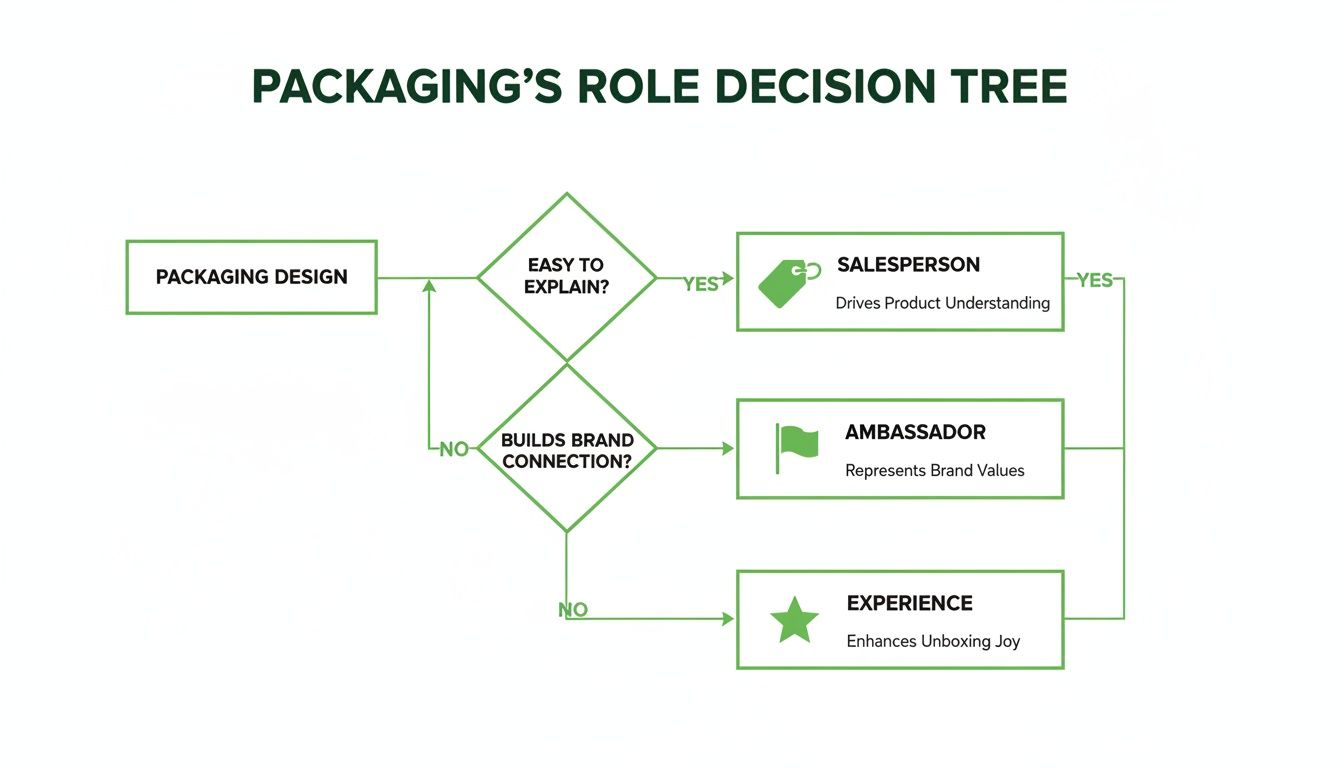
As you can see, a single box can wear multiple hats. Pinpointing its primary function is the key to hitting your business goals.
To help you get started, here's a quick guide to matching the right box to your needs.
Matching Box Types to Your Business Needs
This table is a quick reference guide to help you choose the right box type based on your product and sales channel.
| Box Type | Primary Function | Ideal For (Examples) |
|---|---|---|
| Retail Boxes | In-store appeal and brand presentation | Cosmetics, electronics, gourmet foods, luxury gifts |
| Mailer Boxes | Creating a premium unboxing experience | E-commerce orders, subscription boxes, marketing kits |
| Shipping Cartons | Protection and logistics | Bulk shipments, master cases, e-commerce outer packaging |
Let's dive a little deeper into what makes each of these box types tick.
Retail Boxes: The Silent Salesperson
Retail boxes have one mission: look incredible on a shelf. Think of them as your product’s "shelf appeal outfit," designed to catch the eye and scream quality from a distance. In a physical store, this box is often the very first thing a customer touches.
This means the focus is all on visuals and texture. You'll often see high-end printing, special finishes like embossing or soft-touch coatings, and clever window cut-outs that give a tantalising peek at the product inside. Their main job is to make the sale before the box is even opened.
They're perfect for:
- Cosmetics and beauty products
- Electronics and gadgets
- Gourmet foods and candles
- Luxury goods and gifts
Just remember, while they look stunning, standard retail boxes aren't built to survive the postal system on their own. They need to be tucked inside a tougher shipping carton to keep them looking pristine during transit.
Mailer Boxes: The Curated Experience
Mailer boxes, often called e-commerce boxes, are engineered from the ground up to create an unforgettable unboxing experience. For any direct-to-consumer brand, these boxes are the star of the show. They turn a simple delivery into something that feels like a personally curated gift.
Unlike a basic shipping box, mailers are built to be both tough and beautiful. The popular "roll-end tuck-front" style opens up like a treasure chest, revealing the product nestled inside. This design is also a fantastic canvas for printing on the inside—a perfect spot for brand stories, a simple thank you, or vibrant patterns that surprise and delight your customer.
Mailer boxes perfectly bridge the gap between stunning presentation and robust protection. They're strong enough for shipping but designed to turn a delivery into a special moment that reinforces your brand.
Shipping Cartons: The Trusted Bodyguard
Finally, we have the unsung hero of the packaging world: the standard shipping carton. If a retail box is the outfit and a mailer is the gift experience, then the shipping carton is the trusted bodyguard. Its one and only job is to get your product to its destination safely and in one piece.
Made from sturdy corrugated cardboard, these boxes are all about structural integrity. Function definitely comes before form here, though they can still be printed with a simple logo for brand recognition. They are the essential outer layer of protection, particularly for products that are already in their own retail packaging.
For any e-commerce business, getting the right shipping carton is non-negotiable. It's the difference between a happy customer and a costly return, making it the practical foundation of a great delivery.
Choosing Materials: The Foundation of Great Packaging
Once you’ve figured out the style of box you need—whether it’s for a retail shelf, a cross-country shipment, or a memorable unboxing experience—it’s time to choose the right material. This is where the rubber really meets the road. Your material choice is the foundation for your packaging’s performance, affecting everything from product safety and shipping costs to the final look and feel of your brand.
Think of it like building a house: you wouldn’t use plasterboard for your support beams. Selecting the right material is a strategic choice, matching its physical properties to the journey your product will take. A delicate glass candle needs a whole different level of protection than a sturdy book, and the right material is what delivers it.
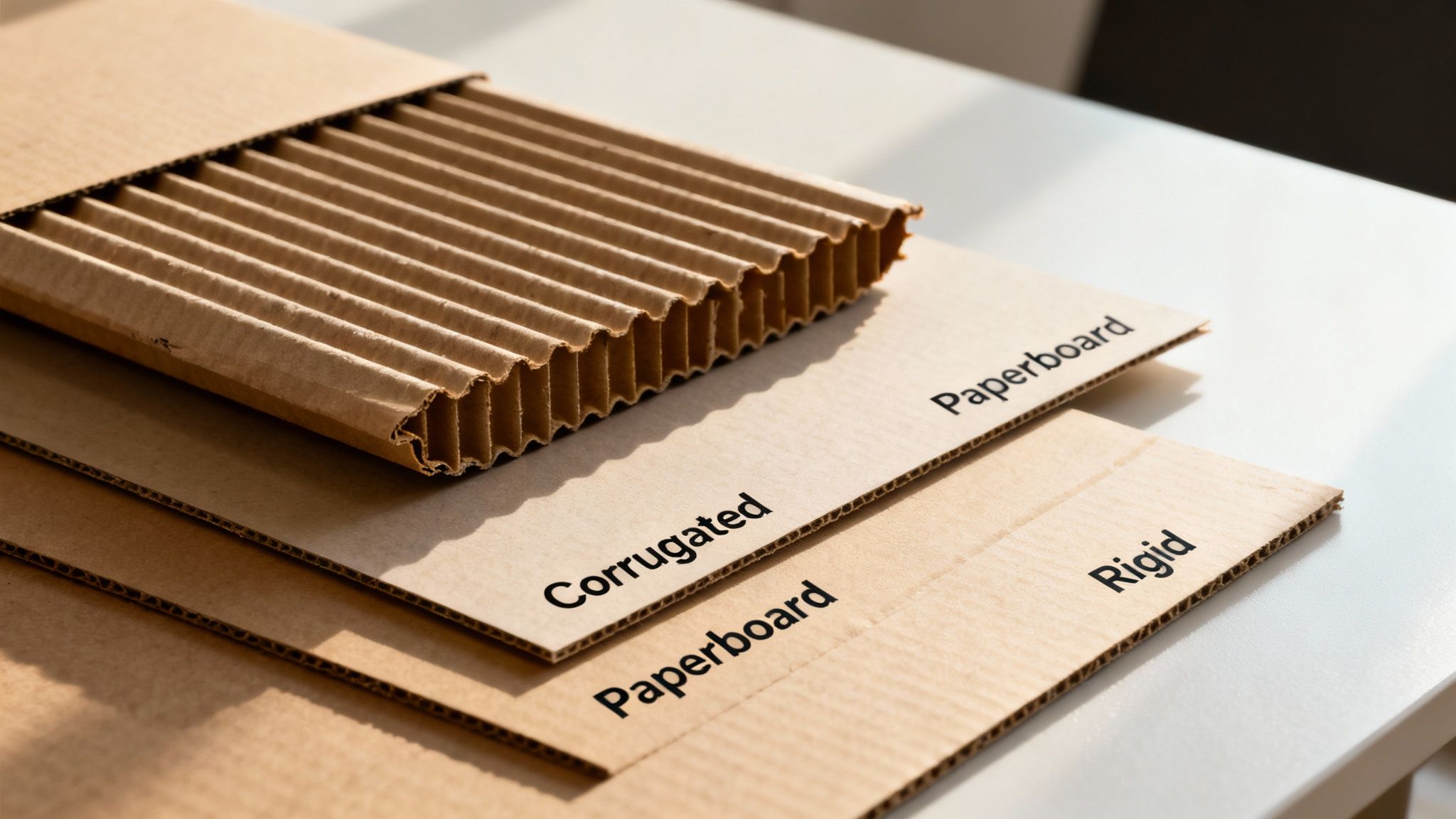
Let's break down the most common options and see how they fit into real-world business needs. This will help you make a smart, cost-effective decision that feels right for your brand.
Corrugated Cardboard: The Workhorse
When you picture a standard shipping box, you’re thinking of corrugated cardboard. This stuff is a quiet engineering marvel. It isn't just a thick piece of card; it’s a clever sandwich of two flat linerboards with a wavy, fluted layer tucked in the middle.
That squiggly centre layer acts like a series of tiny architectural arches. This design gives the box incredible strength and rigidity without making it ridiculously heavy or expensive. It creates a natural air cushion that absorbs shocks and protects what’s inside, making corrugated the undisputed champion for anything that needs to be shipped.
Corrugated material even comes in different thicknesses, known as flute profiles. A thicker flute (like a C-flute) offers more cushioning for heavier items, while a thinner one (like an E-flute) has a smoother surface that’s better for high-quality printing—perfect for those slick, branded mailer boxes.
Paperboard: The Versatile Canvas
If corrugated is the workhorse, then paperboard is the versatile canvas. You might also hear it called boxboard or chipboard, but it’s essentially a much thinner, single-ply material. It’s lightweight and incredibly easy to fold, cut, and print on, which is why it’s the go-to for retail boxes that need to look sharp on a shelf.
Think of the boxes you see for cosmetics, pharmaceuticals, or fancy teas. That’s paperboard. Its smooth surface is perfect for showing off vibrant colours and detailed graphics, letting your branding truly pop.
Paperboard is all about presentation. It won’t give you the heavy-duty protection of corrugated, but it delivers a premium, polished finish that’s essential for any product where shelf appeal is king.
For any business selling in a physical store, paperboard often hits that sweet spot between a professional look, design flexibility, and affordability.
Rigid Boxes: The Luxury Vault
When your product needs to scream premium from the get-go, you bring in the rigid boxes. These are the "luxury vaults" of the packaging world. Think about the box your last smartphone came in, or the one holding a beautiful piece of jewellery.
Made from highly condensed paperboard that is up to four times thicker than the standard stuff, these boxes are exceptionally durable and hold their shape perfectly. You don’t usually print on them directly; instead, they’re wrapped in other materials like specialty paper, leather, or fabric, opening up a world of incredible textures and finishes.
This type of packaging signals exclusivity and high value from the moment a customer lays hands on it. Rigid boxes don’t flatten for shipping—they arrive pre-assembled, which only adds to their substantial, high-quality feel.
The growing demand for premium and protective packaging is a trend we see across the industry. In fact, the rigid plastic packaging market in New Zealand was expected to hit 1.04 million metric tons in 2025, with projections for steady growth. These figures show just how much packaging needs are growing and diversifying across New Zealand's business landscape, from healthcare to retail. You can read more about these packaging trends and projections.
Bringing Your Brand to Life with Custom Printing
You’ve sorted the material, now for the fun part: turning that blank canvas into a powerful branding tool. Custom printing is where your boxes for packaging really start to sing. It transforms a simple container into a storyteller, sharing your brand’s personality before your customer even lays eyes on the product inside.
This is your first, and often best, chance to make a real impression. A well-printed box does so much more than just carry a logo. It signals quality, builds anticipation, and creates a cohesive brand experience that connects with people. It’s the difference between a forgettable delivery and a share-worthy unboxing moment.
Choosing Your Printing Method
Just like there’s no single best material for every job, printing methods aren't one-size-fits-all. The right choice hinges on your design's complexity, how many boxes you need, and of course, your budget. Think of it like choosing between a master artist for a huge gallery exhibition and a nimble creator for a limited series of custom prints.
- Offset Printing: This is your master artist. It uses custom plates to transfer ink onto the packaging, delivering exceptionally sharp, vibrant, and colour-perfect images. For large production runs where every single box needs to look identical, this is the gold standard.
- Digital Printing: And this is your nimble creator. It works a bit like your office printer, applying the design directly onto the box. This method is brilliant for smaller batches, allowing you to easily tweak designs or get a quick turnaround without the high setup costs of offset plates.
If you’re just starting out or want to test a few different looks, digital printing gives you fantastic flexibility. For more established brands with high-volume needs, the lower per-unit cost of offset printing often makes it the smarter choice in the long run.
Adding the Finishing Touches
Printing lays the foundation, but the finishing options are what create that tactile “wow” factor. These details engage your customers' senses of touch and sight, elevating a simple box into something that feels truly premium.
A few of the most popular finishing techniques include:
- Embossing & Debossing: This is where we press your logo or a design into the board to create either a raised (embossed) or indented (debossed) effect. It adds a subtle, sophisticated texture that just begs to be touched.
- Foil Stamping: Using heat and pressure, a thin layer of metallic or coloured foil is applied to the surface. It’s perfect for creating a striking, reflective finish that adds a touch of luxury and makes key elements really shine.
- Lamination: This involves applying a thin protective film to the box. A matte lamination gives a soft, elegant, non-reflective finish that often signals an organic or high-end brand. In contrast, a gloss lamination provides a shiny, vibrant look that makes colours pop and feels modern and sleek.
The right finish does more than just look good; it communicates your brand's identity. A soft-touch matte finish might be perfect for a natural skincare line, while a high-gloss, foiled box could be the ideal choice for a cutting-edge tech gadget.
Designing for Impact
With all these options at your fingertips, it’s crucial to design with purpose. Remember, your packaging is a three-dimensional object, so your design needs to flow seamlessly across all its panels.
Here are a few design tips to keep in mind:
- Prioritise the Front Panel: This is your hero space. Your logo and key branding should live here, grabbing attention on a retail shelf or as soon as the box is delivered.
- Use Side Panels for Details: The sides and back are the perfect spots for telling more of your brand story, listing ingredients, or adding your contact information.
- Don’t Forget the Inside: This is a pro move. Printing a simple pattern or a friendly "thank you" message on the interior of a mailer box is a fantastic way to surprise and delight your customers.
- Create a Physical Mock-up: Before you commit to a big order, print your design out and fold it into a box. This simple step helps you spot any issues with text legibility and ensures every element is exactly where you want it.
Embracing Sustainable Packaging Solutions
In today's market, sustainability isn't just a trendy idea; it's a core value that genuinely influences buying decisions, particularly for thoughtful Kiwi consumers. Opting for environmentally friendly boxes for packaging is less of a niche choice and more of a powerful statement about your brand's values. It’s a move that shows you’re aligned with your customers, which can do wonders for your brand’s reputation and build real loyalty.
Making a sustainable choice is about more than just finding a box that protects your product. It’s about thinking through the entire lifecycle of that box—from how it’s made to what happens to it after it’s been opened. This approach tells your customers you’re invested in our shared environment, not just the sale, creating a connection that goes far deeper than a simple transaction.
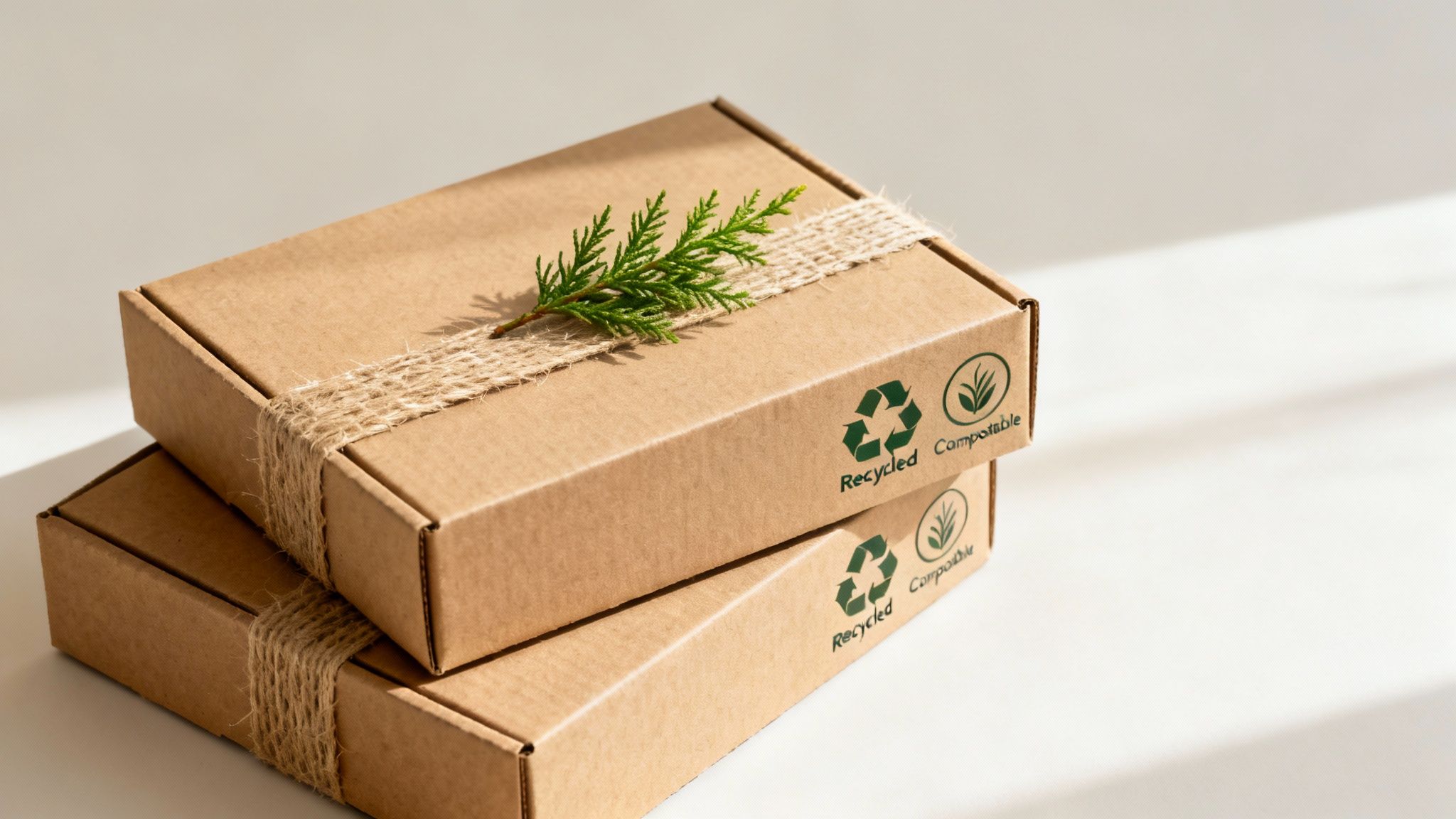
Decoding Eco-Friendly Terminology
The language around "green" packaging can get a bit confusing. To make a smart choice for your business, you need to know what these terms actually mean in practice. Let's break them down.
-
Recyclable: This is the one we see most often. A recyclable box can be processed and turned into new paper-based products. It's a solid choice, but its success hinges on your customer putting it in the right recycling bin.
-
Compostable: These materials are designed to break down into non-toxic, natural elements in a commercial composting facility. If you can find certified compostable packaging, it's a brilliant option—especially for food businesses—because it helps return nutrients to the soil.
-
Biodegradable: This is a much broader term. It just means the material will eventually break down with the help of microorganisms. The catch? It doesn’t say how long it will take or under what conditions, which can sometimes be a bit misleading.
For most e-commerce businesses here in New Zealand, the most practical and impactful starting point is to focus on boxes that are easily recyclable and have a high percentage of recycled content.
The Power of Recycled Content
One of the best things you can do for your packaging’s environmental footprint is to choose boxes made from recycled materials. This is a key part of the circular economy, cutting down our reliance on virgin resources and keeping waste out of landfills.
Using boxes with a high percentage of post-consumer recycled (PCR) content sends a clear message. It shows you’re not just hoping someone else recycles your packaging; you’re actively taking part in the solution from the get-go.
And don't think you're sacrificing quality. Modern manufacturing ensures that boxes made from recycled fibres are tough, durable, and still offer a great canvas for your branding. In fact, many customers now actively look for this and appreciate the slightly more rustic, authentic feel that recycled materials can have.
This push towards sustainable materials is making serious waves in the industry. The moulded fibre pulp packaging market in New Zealand is one of the fastest-growing segments around. Valued at $238.2 million USD in 2025, it's forecast to hit $380.7 million USD by 2035, climbing at a strong 5.8% compound annual growth rate. This growth puts New Zealand well ahead of Australia, positioning us as a regional leader in this space. You can dive deeper by reading the full report on these moulded fibre packaging trends.
How to Order Your Custom Packaging Boxes
Feeling ready to jump in? Moving from a design on a screen to a real, physical box in your hands can feel like a massive step, but the process is more straightforward than you might think. When you break it down into a few clear stages, the guesswork disappears and you can order with confidence.
The trick is to give your packaging partner a crystal-clear brief. The more detail you provide upfront, the faster and more accurate their quote will be. A little preparation now saves a lot of back-and-forth later.
Step 1: Gather Your Product Specifications
Before you even think about designing the box, you need to know exactly what’s going inside it. This is the foundation for every other decision, from the strength of the material to the final dimensions. Getting this wrong can be costly—measurements that are even slightly off can lead to boxes that are too tight, too loose, or just plain unusable.
Start by getting these details down to the millimetre:
- Exact Dimensions: Carefully measure your product’s length, width, and height. Don't guess!
- Total Weight: Know the precise weight of your product. This is crucial for choosing a material that won’t fail during transit.
- Fragility: Is the item delicate, heavy, or an awkward shape? This will tell you if you need special inserts or a stronger grade of corrugated board.
Step 2: Define Your Packaging Needs
With your product specs sorted, you can start thinking about what the box actually needs to do. Picture the entire customer journey, from the moment the courier hands it over to the final unboxing. What do you want them to feel when they see it?
Your packaging has two jobs: protect the product perfectly and represent your brand brilliantly. A great design finds the sweet spot where structure and style meet.
This is also the time to get real about your budget and how many boxes you need. Are you starting with a small run of 100, or do you need 5,000? This number is a key factor in deciding the best printing method—digital printing is great for smaller batches, while offset printing becomes more cost-effective for larger quantities.
Step 3: Prepare Your Brand Assets for a Quote
Now it’s time to get all your brand materials in one place. Having everything organised and ready to go makes the whole process smoother for you and your packaging supplier. Think of it as creating a kit for them to work from.
Here’s a simple checklist of what you’ll need:
- High-Resolution Logo: Make sure your logo is in a vector format (like an .AI, .EPS, or .SVG file). This allows it to be scaled to any size without becoming blurry.
- Brand Colour Codes: To get the colours just right, you’ll need the specific codes. These are usually Pantone (PMS), CMYK, or HEX codes.
- Fonts and Graphics: If your brand uses specific fonts or has other key graphic elements, have those files ready to share.
- Inspiration and Examples: Got a Pinterest board or a folder of packaging you love? Share it! Visual examples are one of the best ways to communicate the aesthetic you’re after.
Before you kick things off, it's a good idea to get a feel for the entire production journey. You can see a great overview of how the custom packaging process works from start to finish. With all this information in hand, you're in the perfect position to get a solid quote and create packaging that does your brand proud.
Common Questions About Packaging Boxes
Even with a perfect plan on paper, a few practical questions always seem to surface when it's time to actually order your packaging. Let's tackle some of the most common queries we get from business owners, so you can lock in those final details and order with confidence.
Think of this as your quick-fire FAQ guide. Getting these points sorted now will make everything from quoting to delivery run that much smoother.
What Is a Typical Minimum Order for Custom Boxes?
Minimum order quantities, or MOQs, really swing depending on your supplier and how your boxes are being printed. It’s the classic trade-off between how many you need and what you want to spend per box.
- Offset Printing: This is the traditional, high-volume method. Because it involves creating custom printing plates and has a much more intensive setup process, you’ll be looking at higher MOQs—often in the thousands. The payoff is a fantastic per-unit price on big runs.
- Digital Printing: Far more flexible, digital printing is your go-to for smaller batches. You’ll find many suppliers happy to do runs as low as 50 or 100 boxes. This makes it a brilliant option for startups testing the waters, creating a limited edition product, or just wanting to avoid tying up cash in inventory.
Our advice? If you're just starting out, a small digital run is a smart, low-risk way to get professional packaging without a massive upfront cost.
How Much Should I Budget for Packaging?
There's no single magic number here, but a solid rule of thumb is to set aside 5% to 15% of your product's manufacturing cost for its packaging. Where you land in that range really comes down to your product and brand positioning.
If you’re selling everyday consumer goods, you’ll probably want to stick closer to the lower end. But for luxury items, where the unboxing experience is a huge part of the appeal, investing closer to that 15% mark is money well spent. It can drive customer loyalty and create the kind of social media buzz money can't buy.
Try to think of your packaging not as a cost, but as a marketing investment. A truly memorable unboxing can generate organic promotion that's worth far more than what you paid for the cardboard.
Can One Box Work for Both Retail and Shipping?
You can do it, but honestly, it’s rarely a good idea. A box designed to look gorgeous on a retail shelf is built for visual appeal, not for surviving the bumps and scrapes of the courier network. Its crisp folds and thinner material will likely get crushed, dented, or scuffed in transit.
The industry best practice is simple: put your beautifully branded retail box inside a tough, plain shipping carton. This dual-box approach protects your product and your primary packaging, making sure the customer gets the pristine experience you intended. The only real exception is a well-designed mailer box, which is specifically engineered from the ground up to be both durable and presentable.
Ready to create packaging that tells your brand’s story? At SONI DESIGN, we specialise in crafting vibrant, high-quality custom boxes that make a lasting impression. Let's work together to bring your vision to life. Learn more about our custom design and print services today!
Leave a Comment
Stay home & get your daily
needs from our shop
Start You'r Daily Shopping with Nest Mart