
Your cart is currently empty.

More than just a way to say, "Hello, my name is," a name tag is your silent brand ambassador. Think of it as the modern professional handshake—it sets the tone for trust and approachability from the moment someone meets your team.
The Power of a Professional First Impression
Your badge name tag is a fundamental part of your professional uniform. It's often the very first thing a customer or client sees when they interact with one of your staff, and that initial glance can shape the entire conversation.
A cheap, flimsy, or hard-to-read tag might accidentally suggest a lack of care. On the other hand, a polished, well-crafted badge sends a clear message of competence, professionalism, and pride. It's a small detail that makes a massive difference to the customer experience.
Imagine a busy retail store. An employee with a clear, easy-to-read name tag is instantly more approachable for a shopper needing help. In a healthcare clinic or corporate office, that same clear identification builds immediate trust and makes interactions feel smoother and more human.
Building Connections and Brand Cohesion
Name tags don't just introduce people; they connect those people directly to your brand. When every member of your team wears a consistent, branded badge, it creates a powerful, unified image. It’s a subtle but effective marketing tool working for you all day long.
A name tag is the most fundamental tool for networking and building rapport. It breaks down the initial barrier of anonymity and makes every interaction feel more personal and human-centred.
This simple act of identification turns an anonymous staff member into an accessible expert. It empowers your employees to represent your brand with confidence and invites customers to connect on a first-name basis. That personal touch can be the difference between a one-off sale and a loyal, long-term customer relationship.
Strategic Assets for Any Kiwi Business
The secret is to stop seeing name tags as a simple supply item and start seeing them as a strategic asset. They are a low-cost, high-impact tool that quietly reinforces your brand's reputation with every interaction.
Whether you're running a bustling Auckland café, a professional services firm in Wellington, or a nationwide retail chain, these tags are essential for:
- Enhancing Approachability: Making it easy for customers to start a conversation.
- Strengthening Brand Identity: Creating a consistent and polished look across your entire team.
- Fostering Trust: Providing transparency and accountability in every customer-facing role.
- Streamlining Networking: Helping forge memorable connections at events and conferences.
To really get the most out of your name tags, it helps to fit them into your wider strategies to increase brand awareness. When every element of your brand works together—right down to the smallest detail—you create a strong, positive impression that lasts long after that first hello.
Choosing the Right Materials and Fasteners
When you’re creating a name tag, the material and fastener you choose are the building blocks. They don't just affect how the tag looks, but how it holds up and feels to wear every single day.
Think of it this way: the material gives the tag its personality. Is it sleek and professional? Warm and down-to-earth? Or maybe classic and sturdy? The fastener, on the other hand, is all about function—how it attaches securely without being a nuisance.
Getting this right is about matching the tag to your environment. A high-end legal firm in Christchurch simply has different needs than a busy Queenstown café, and the name tags should reflect that. This is your first real step in designing a badge that feels like a seamless part of your brand.
It's amazing how much a small detail like a name tag can impact a first impression.
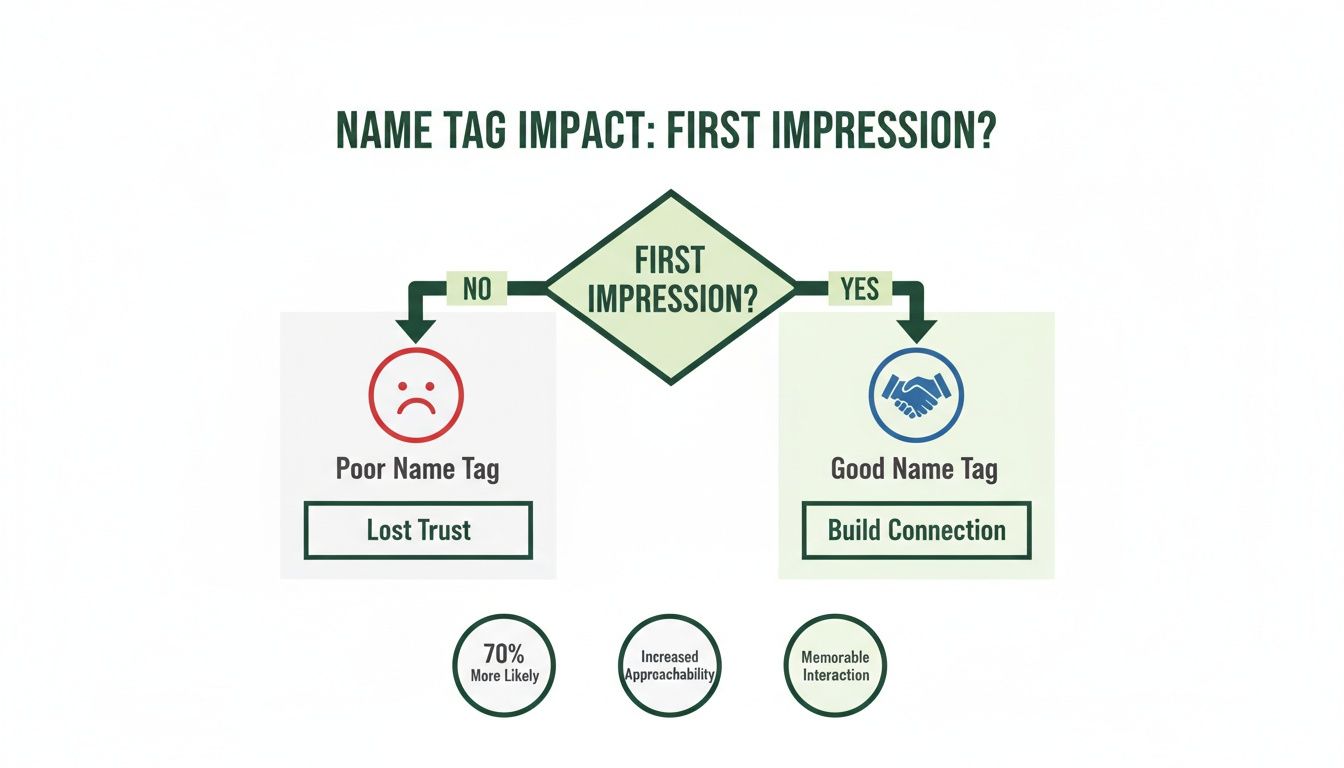
As you can see, a quality badge helps build an instant connection, while a flimsy one can undermine trust before you've even said hello.
What Material is Best for Your Badge?
The material you pick sets the entire tone. It’s a subtle but powerful way to communicate what your brand is all about. Each option brings its own unique blend of style and practicality to the table.
To help you decide, here’s a quick comparison of the most popular choices we see for NZ businesses.
Comparing Badge Name Tag Materials
| Material Type | Best For | Durability | Professional Look |
|---|---|---|---|
| Engraved Plastic | Daily use in busy environments like retail, hospitality, or healthcare. A real workhorse. | High | Clean, clear, and very versatile with lots of colour options. |
| Metal (e.g., Aluminium) | Corporate settings, real estate agents, or legal and financial professionals needing a premium touch. | Very High | Sophisticated, sharp, and gives a feeling of quality and permanence. |
| Wood (e.g., Bamboo) | Cafes, eco-conscious brands, and artisan shops wanting a natural, warm, and approachable vibe. | Medium | Unique, rustic, and stylishly understated. A great talking point. |
Ultimately, the right material should feel like a natural fit for your company’s image and be tough enough for your team’s day-to-day work.
How Should It Attach? Selecting the Right Fastener
Just as important as the tag itself is how it attaches to clothing. The right fastener keeps the badge secure, sits comfortably, and—critically—won't ruin your team's uniforms.
The fastener is the unsung hero of a great name tag. The best one is the one your staff forgets they’re even wearing—it’s secure, comfortable, and doesn’t damage their attire.
Here’s a breakdown of the three main options you'll come across:
-
Magnetic Fasteners: This is hands-down the most popular choice, and for good reason. A powerful two-piece magnet holds the badge firmly in place without piercing or damaging fabric. They're a breeze to put on, sit flat against clothing, and look incredibly professional. They've become the standard for most corporate and retail environments.
-
Pin Fasteners: The classic, traditional option. Pin-backs are budget-friendly and offer a very secure hold, which makes them a great pick for more active roles. While they do leave a small hole in the fabric, they remain a reliable and cost-effective choice for many organisations.
-
Lanyards: Perfect for conferences, trade shows, and big events where visibility is key. Lanyards keep identification front and centre and can double as a holder for keys or access cards. They’re a practical solution when you need staff or attendees to be easily identifiable at a glance.
Designing for Clarity and Brand Impact
A good name tag does more than just state a name; it’s a tiny billboard for your brand and an instant conversation starter. The trick is to design it so anyone can glance at it and immediately know who you are and where you’re from. Nailing that balance between function and form is what turns a forgettable bit of plastic into a powerful first impression.
It all starts with a clear information hierarchy. Think of it like a newspaper headline – you want the most important info to jump out first. For pretty much any name tag, the person's first name is the hero of the show. It needs to be the biggest and boldest thing on there.
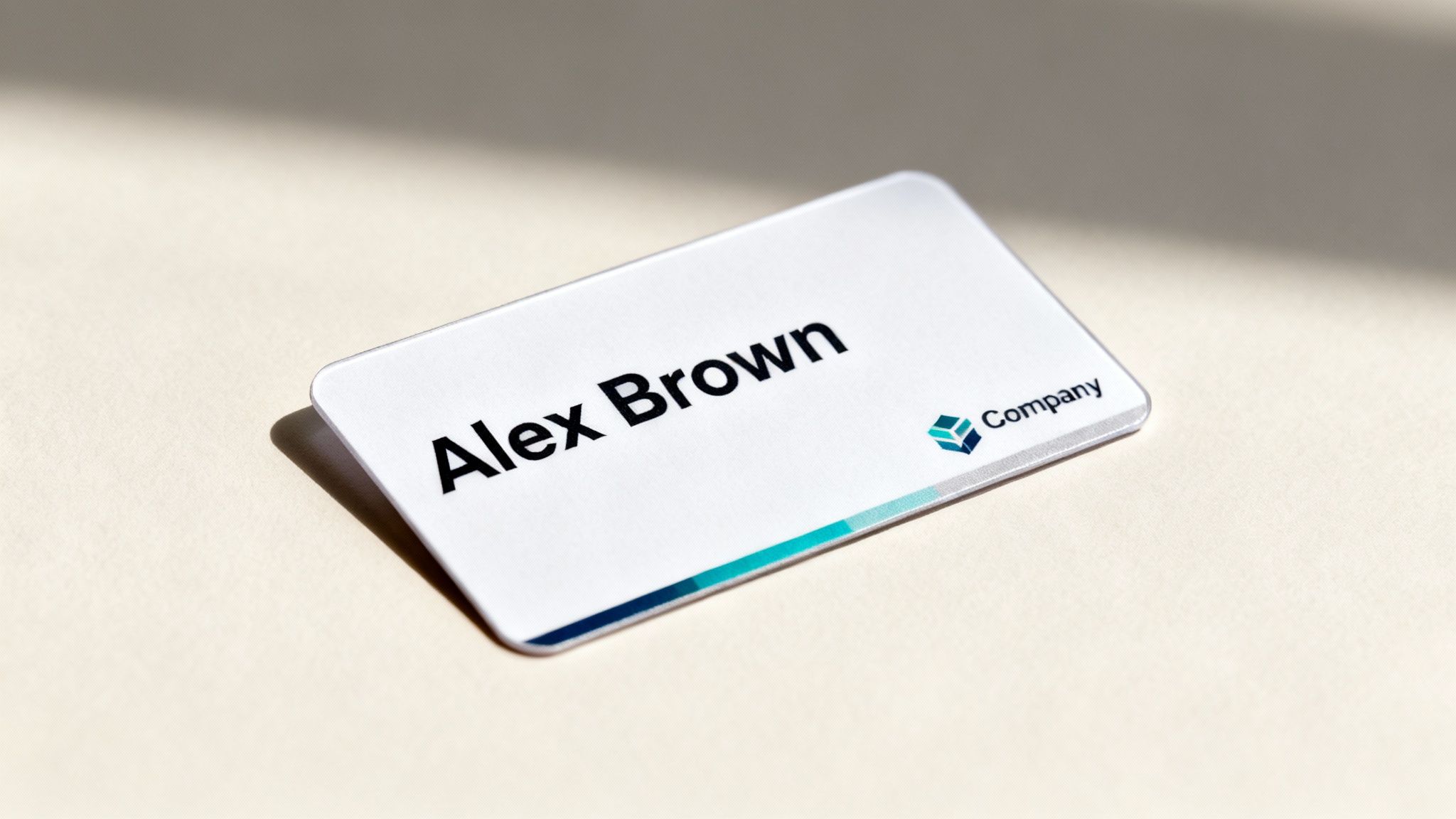
After the name, your company logo and the person's title or department play a supporting role. The absolute key is to avoid clutter. A busy, overloaded design forces people to squint and search, which completely defeats the purpose of wearing a name tag in the first place.
Typography: The Foundation of Readability
The font you pick has a massive impact on how easy your name tags are to read, especially from a few steps away. It’s tempting to use a fancy, stylised font that matches your branding perfectly, but legibility has to be the priority. That beautiful script font might look great up close, but it’ll be a blurry mess from a metre away.
For names and titles, stick with clean, simple sans-serif fonts like Helvetica, Arial, or Lato. They’re designed for clarity and are a breeze to read at a glance. Just as important is making sure there’s strong contrast between your text and the background. Black text on a white background is the gold standard for a reason, but any dark text on a light background (or vice versa) gets the job done.
"A great name tag doesn't make you think; it simply informs. The design should be so clear that the information is absorbed almost subconsciously, allowing the conversation to begin without hesitation."
Sizing and Layout for Different Contexts
There’s no one-size-fits-all answer for name tags. The ideal dimensions really depend on where and why it’s being worn. The context completely dictates the best design and layout.
Think about these common situations:
- Corporate and Retail Badges: These are usually smaller and more discreet, often around 75mm x 25mm. They need to look professional as part of a uniform without being distracting. The layout is typically straightforward: logo on one side, name and title on the other.
- Conference and Event Badges: These are much larger, sometimes up to 100mm x 75mm or even bigger. That extra space is put to good use for bigger names (so you can see them across a crowded room), networking QR codes, event schedules, or sponsor logos.
- Hospitality Tags: Often similar in size to retail badges, but they might include extra details like "Trainee" or languages spoken to give guests a helping hand.
The goal is to match the badge’s size and information density to the environment it will be in. To really nail down what your badge needs to communicate, it can be helpful to think about the ideas behind powerful brand positioning statements. This helps you focus on what truly matters for your design.
Understanding Printing and Production Methods
How your badge name tags are made is just as important as the material you choose. The production method is the final touch that turns a simple piece of plastic or metal into a polished reflection of your brand. It's what dictates the final look, the feel, and ultimately, how long it will last.
Think of it as choosing the right tool for a job. You wouldn't use a paintbrush to carve wood, and the same logic applies here. Each printing technique has its own strengths and is designed to create a specific effect. Getting a handle on these options means you can make a much more informed choice.
Knowing the difference helps you have a better conversation with your provider, ensuring the final product matches your brand's style, budget, and durability needs perfectly.
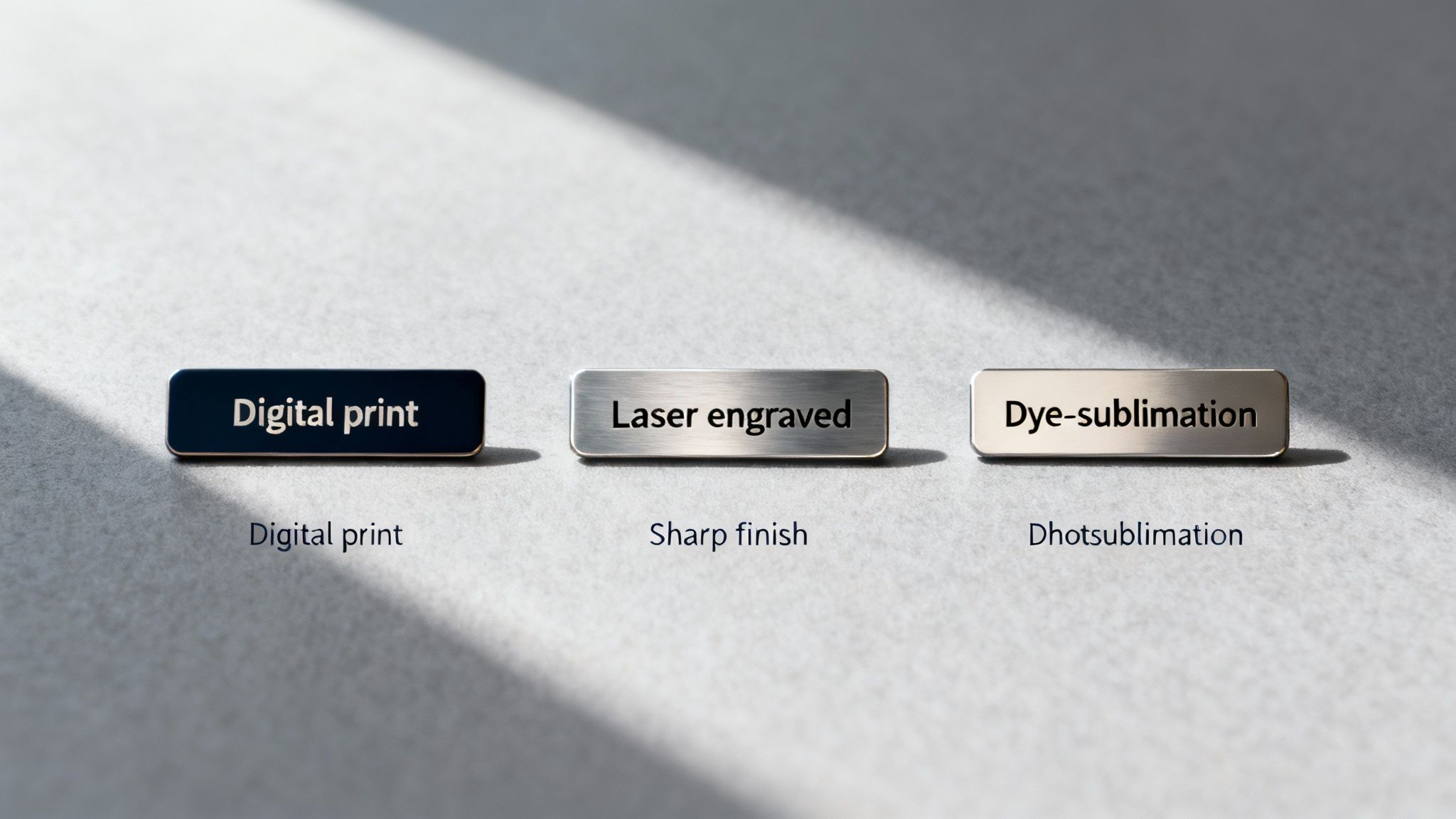
Digital Printing for Vibrant Full-Colour Designs
If your brand lives and breathes vibrant colours, has an intricate logo, or uses specific colour gradients, digital printing is your go-to. This method works a lot like a high-end office printer, applying ink directly onto the name tag's surface. The result is a pin-sharp design with a full, rich spectrum of colours.
This technique is incredibly versatile, perfect for faithfully reproducing complex graphics on materials like plastic and coated metals. Since it's a direct-to-surface process, it's also very efficient for runs of any size, offering a fantastic balance of quality, speed, and cost.
Laser Engraving for a Classic, Permanent Finish
For a sharp, timeless look that’s built to last, nothing beats laser engraving. This process uses a concentrated beam of light to precisely etch your design into the material's surface. It creates a crisp, permanent mark that simply won't fade, peel, or rub off.
Laser engraving is the clear winner for materials like metal, wood, and two-toned plastics—where the laser vaporises the top layer to reveal a contrasting colour underneath. It produces an elegant, professional finish that subtly communicates quality and permanence.
The real beauty of an engraved badge is in its texture and permanence. It’s a mark of quality you can literally feel, telling a story of professionalism and attention to detail.
This method is perfect for:
- Premium Corporate Badges: Achieving that sophisticated look for financial, legal, or real estate professionals.
- Durable Staff Tags: Ensuring names and titles stay legible in tough environments like hospitality and healthcare.
- Natural Wood Badges: Creating a beautiful, rustic effect where the design is etched right into the grain.
Dye-Sublimation for Photorealistic Detail
When your design involves photorealistic images, complex gradients, or colour that needs to run right to the edge, dye-sublimation is the superior choice. It's a fascinating process that uses heat to turn solid dye into a gas, which then infuses the surface of a specially coated material before turning back into a solid.
The outcome is a stunningly vibrant, high-resolution image that becomes part of the name tag itself, rather than just sitting on top. This makes it incredibly resistant to scratching and fading. It’s the ideal method for event badges with headshots or any design where image quality is absolutely critical.
Professional Kiwi suppliers often use advanced tech like direct-to-card dye-sublimation to produce vivid, durable cards, with fast printing speeds perfect for large batches. If you want to see how this is used in the NZ events industry, you can learn more about event name badge printing systems.
How Different Kiwi Industries Use Name Tags
Name tags are far from a one-size-fits-all solution. Think of them more like chameleons of the professional world, adapting their look and purpose to fit the unique needs of different industries across New Zealand. How a busy Auckland hospital uses a name tag is worlds away from how a boutique hotel in Queenstown does.
Getting these details right is the key to creating a tag that doesn't just identify someone but actually makes the customer experience better. A smart name tag strategy tackles real-world challenges, whether that's building trust with a nervous patient or speeding up networking at a huge conference. It’s all about using this simple tool to solve genuine business problems.
Hospitality and Tourism: Building an Instant Rapport
In hospitality and tourism, the entire game is about creating a warm, welcoming, and memorable experience. Name tags are a cornerstone of that effort, turning anonymous staff into approachable, friendly hosts. A clear name on a hotel concierge or a café barista instantly breaks down barriers, making it so much easier for visitors to ask for help or just start a conversation.
That small detail helps forge a personal connection, which is priceless in an industry built on relationships. For instance, a tag might include not just a name but also the languages someone speaks—a subtle but powerful welcome to international tourists. It shows a commitment to great service from the very first hello.
And as sustainable tourism continues to grow in New Zealand, so does the demand for eco-friendly choices. This market, which includes event venues and conferences using branded materials like name badges, is projected to grow from USD 12.7 million in 2025 to USD 57.7 million by 2035. Opting for sustainable materials like bamboo lets businesses show that their brand values align with those of environmentally conscious travellers. You can dive deeper into the growth of the New Zealand sustainable tourism market and what it means for the industry.
Healthcare: Ensuring Safety and Trust
Nowhere is clear, immediate identification more critical than in healthcare. For patients and their families, being in a hospital or clinic can be a stressful time. A name tag becomes a vital tool for building trust and keeping everyone safe.
When a nurse, doctor, or administrator wears a professional, easy-to-read name tag, it provides instant reassurance. Patients can see exactly who is looking after them, along with their name and professional title (e.g., Registered Nurse, Physiotherapist).
In a healthcare environment, a name tag isn't just for introductions; it's a critical component of patient safety protocols and a symbol of professional accountability.
This level of clarity is simply non-negotiable. Badges in this sector have to be incredibly durable, easy to sanitise, and crystal clear to read, all to prevent any confusion and uphold the highest standards of patient care.
Corporate and Retail: Professionalism Meets Accessibility
In corporate offices and retail stores, name tags play a dual role. They project a polished, professional brand image while making staff more accessible to clients and customers. In a corporate setting, a sleek metal badge with a laser-engraved logo reinforces a sense of authority and expertise.
In a retail store, the effect is a bit different but just as crucial. A friendly-looking, easy-to-read name tag makes a salesperson seem more approachable, encouraging customers to ask for help. This simple interaction can directly lead to a better shopping experience and, ultimately, more sales.
Just think about the different ways they're used:
- Real Estate Agents: A premium name badge adds a layer of professional credibility during client meetings and open homes.
- Bank Tellers: Clear identification builds trust and transparency, which is essential for financial transactions.
- Retail Staff: An approachable name tag can be the thing that turns a hesitant browser into a confident buyer.
Events and Conferences: Making Connections Happen
At large-scale events, from industry conferences at Te Pae Christchurch to trade shows at the Auckland Showgrounds, name tags are the central nervous system of networking. They’re usually much larger than your standard tag, designed to be seen in a crowded room.
The main job here is to help attendees spot each other at a glance, sparking conversations and building valuable connections. These badge name tags often pack in more than just a name and company; they might feature QR codes linking to a LinkedIn profile, use different colours to show who's a speaker, sponsor, or delegate, and have a bold design that’s readable from a distance. They are truly indispensable tools for networking and event security.
Bringing Your Custom Name Tag Vision to Life
So, you've got the complete blueprint for creating fantastic badge name tags. You know the difference between materials, what makes a design pop, and how they’re actually made. That knowledge is the foundation for a smart investment in a powerful little branding tool.
Now for the exciting part: turning that vision into a real, tangible product that makes your team look great and your customers feel welcome.
Partnering with a local New Zealand expert like SONI DESIGN makes all the difference. This isn't just about placing an order; it’s a creative partnership. A local provider gets the Kiwi market and is genuinely invested in telling your brand's unique story, making sure the final product is a perfect fit.
What to Expect from the Process
Working with a professional design partner should be a smooth, collaborative experience. It's about crafting a solution together that hits all your goals.
Here’s what the journey usually looks like:
- Initial Consultation: We'll start with a chat about your vision, brand identity, budget, and exactly what you need. This is where your ideas start to take shape.
- Design and Proofing: You'll get a digital mock-up showing exactly how your name tags will look. This is your chance to give feedback and tweak things until you’re 100% happy with it.
- Production: Once you give the green light, skilled technicians get to work, using the right materials and methods to produce your badges with precision.
- Delivery: Your finished name tags are carefully packed and sent your way, ready to make that brilliant first impression.
The Value of Local Expertise
Choosing a New Zealand-based partner gives you a real edge. The local scene is full of professional manufacturers who specialise in high-quality, custom work. Take a business like BadgeWorks in Wellington, for example—they produce full-colour badges with scratch and UV-resistant resin, showing the top-tier quality available right here at home.
Time and again, customer feedback shows how professional name tags lift a team's appearance and build better rapport with customers. If you're curious, you can explore some of the custom name badges made in New Zealand.
Investing in professionally crafted badge name tags is more than just an expense—it's a commitment to your brand's identity, your team's confidence, and the quality of every customer interaction.
When you work with a team that values good storytelling and craftsmanship, you get name tags that do more than just identify. They connect, communicate, and help build lasting relationships.
Got Questions About Badge Name Tags? We’ve Got Answers.
Choosing the right name tags can feel like a small detail, but it’s one that makes a big difference. It's totally normal to have a few questions. To help you get it right for your Kiwi business, here are some clear, straight-up answers to the queries we hear the most.
What’s the Best Fastener for a Name Tag?
Honestly, the "best" fastener really comes down to how and where you'll be using the tags day-to-day.
For most office or professional environments, magnetic fasteners are the crowd favourite. They use a powerful two-part magnet that clamps onto your clothing without leaving any holes. This makes them perfect for expensive uniforms or corporate attire. If you’re on a tighter budget or need something extra secure for a more active role, the traditional pin fastener is a reliable, budget-friendly choice. And of course, for events and conferences where you want names front and centre, you can't go past a good lanyard.
What Should I Actually Put on a Name Tag?
When it comes to the info on your badge, less is almost always more. You want people to get the key details in a quick glance, not have to squint to read a novel.
Keep it simple and focused on the essentials:
- First Name: Make this the biggest and boldest text on the tag.
- Full Name: This can sit just below the first name in a smaller font.
- Job Title: Super helpful for customers and clients to know who they’re talking to.
- Company Logo: A must-have for reinforcing your brand.
The main goal is to avoid clutter. A clean, simple layout makes interactions smoother because the important stuff is easy to read instantly.
How Long Does It Take to Get Custom Name Tags Made?
Your timeline will depend on a few things: the material you pick, how complex your design is, and how many tags you’re ordering.
As a rule of thumb, a simple order of engraved plastic tags can often be turned around in just a few business days. If you’re after something more specialised, like custom-shaped metal badges or full-colour printed ones, you're probably looking at a lead time of one to two weeks. It's always a good idea to chat with your supplier about their current schedule, especially if you have a hard deadline for an event.
"A bit of forward planning goes a long way. Always build in a little buffer time for design sign-off and production. That way, your tags will arrive well before you need them, stress-free."
Can I Just Order a Small Number of Name Tags?
You sure can. Most professional suppliers here in New Zealand are set up to handle small orders, and many have no minimum quantity requirements at all.
This is a lifesaver for small businesses, or when you just need to order a single badge for a new team member or replace one that's gone missing. The cost per badge might be a little higher on a tiny run compared to a bulk order, but the convenience of getting exactly what you need is often worth it.
Ready to create badge name tags that perfectly capture your brand’s personality? The team at SONI DESIGN would love to help bring your ideas to life. Let’s collaborate and craft something extraordinary together!
Leave a Comment
Stay home & get your daily
needs from our shop
Start You'r Daily Shopping with Nest Mart